What should you look for when choosing?
Start with how much your household actually eats. Then compare the nutritional information and, if you need to avoid certain ingredients, check the label on the exact pack.
| What to consider |
What to check when buying |
Who is this important to? |
| Quantity and portions |
Compare the net weight, number of slices and whether the cake is pre-sliced. |
If I don’t eat Dutch breakfast cake every day, I want to open as little as possible at once and plan my slices. Around 36% of shoppers give this need top priority. |
| Nutritional information |
Compare fibre, sugars and ingredients per 100 g; also consider the size of your portion. |
When choosing based on the recipe, I want to know what’s in the exact variant rather than relying on the product name alone. This is the top priority for around 29% of shoppers. |
| How quickly you’ll get through it |
Compare the pack weight with how often and how many people eat Dutch breakfast cake in your household. |
If we regularly have a slice at home, I want to be able to buy a larger pack without having lots left over. This is the main consideration for around 21% of shoppers. |
| Allergens |
Read the current ingredients list, allergen information and any warnings on the pack. |
If I need to avoid an ingredient, the exact Dutch breakfast cake must meet my needs, whatever the pack size. Around 14% of shoppers put this check first. |
Brands to compare
These brands offer examples of different sizes and recipes. Always compare the specific variant, not just the brand name.
Peijnenburg
Peijnenburg offers, among other options, a 345 g pre-sliced plain variant with 12 slices and a 285 g gluten-free variant.
- The number of slices listed for the plain variant makes it easier to plan portions.
- The gluten-free variant shown by PLUS lists milk and lupin; check the label if you need to avoid allergens.
Jumbo
Jumbo lists a 280 g plain Dutch breakfast cake with around 11 portions.
- The weight and stated number of portions make it easy to compare with larger packs.
- The ingredients shown include rye flour and wheat enzyme; check the current pack if you need to avoid these ingredients.
PLUS
PLUS lists, among other options, a 485 g pre-sliced plain Dutch breakfast cake and a 550 g unsliced variant.
- The two formats give people who eat Dutch breakfast cake more often a choice between pre-sliced and unsliced.
- Check the pack for the ingredients and allergens in the variant you’re buying.
Koek & Bakker
ALDI sells pre-sliced wholegrain Dutch breakfast cake and a pre-sliced zero variant under this brand, both weighing 485 g.
- The weight and pre-sliced format are clearly stated for both variants shown.
- Check the physical pack before making a decision based on ingredients, nutritional values or allergens.
Tastino
Lidl sells Tastino Dutch breakfast cake in sizes ranging from 465 to 550 g.
- The stated weights are useful when comparing these packs with smaller ones.
- Check in store which variant and pack you’re actually choosing.
Dutch breakfast cake on Joybuy
If your household gets through Dutch breakfast cake quickly, this unsliced 550 g pack could be a good option. If you’d rather open less at once, bear the larger size in mind.
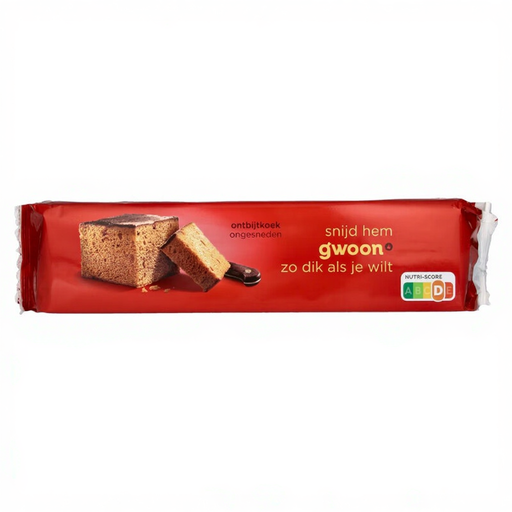 Image unavailable
g'woon breakfast cake, unsliced, 550 g
An option if you get through Dutch breakfast cake quickly at home. The pack contains 550 g of unsliced cake, so bear in mind that you’ll need to cut the slices yourself.
View on Joybuy
Frequently asked questions
What does ‘half loaf’ mean for Dutch breakfast cake?
Don’t use ‘half loaf’ as a measure of how much is in the pack. Compare the product’s weight and number of slices: Jumbo lists 280 g with around 11 portions, Peijnenburg 345 g with 12 slices, and PLUS also offers a 550 g variant.
Is wholegrain Dutch breakfast cake automatically low in sugars?
No. According to Joybuy’s product information, the Peijnenburg wholegrain pre-sliced variant contains 39 g of sugars per 100 g. Check the nutritional information for the exact variant you’re considering.
Can I assume Dutch breakfast cake contains iodine?
No, don’t assume based on the product category alone. The Netherlands Nutrition Centre says that bakers aren’t required to use baker’s salt. Check the ingredients list or ask the manufacturer or baker which salt was used for that particular cake.
Is gluten-free Dutch breakfast cake suitable if I also need to avoid other allergens?
Not necessarily. The gluten-free Peijnenburg variant shown by PLUS lists milk and lupin. Check the current allergen information on the exact pack before choosing.
How should I store Dutch breakfast cake once opened?
Follow the storage instructions on the pack you’ve bought. For the plain variant shown, Jumbo recommends storing it in a cool, dry place; Peijnenburg recommends keeping its Dutch breakfast cake somewhere dry and dark, in a sealed tin or container.


