If you have a small household, choose a compact loaf of Dutch breakfast cake when your recipe calls for only a little and you’re unlikely to use the rest of a larger loaf. A 280 g loaf is available alongside 550 g options, but choosing a smaller pack doesn’t in itself prevent leftovers. Also check that the ingredients, allergens and nutritional information for your chosen option suit your recipe and requirements.
Who might find this choice useful?
Small households making one cake recipe
If you only need a small amount of Dutch breakfast cake, a compact pack may help you avoid having too much left over. Jumbo lists a 280 g plain option alongside 550 g loaves, but work out how much your recipe needs first.
Recipe shoppers who check ingredients
The flavour and ingredients of your chosen loaf should work well in the cake. Compare the ingredients and nutritional information for the exact options, rather than looking only at pack size.
Shoppers with allergies or dietary requirements
Check the current ingredients list and allergen information on each pack. Jumbo’s compact 280 g plain option contains rye and wheat, and may also contain barley and oats.
What should you look for when choosing?
Start with the amount your recipe calls for: a compact loaf suits occasional use, while a larger loaf makes sense mainly if you’ll eat the rest too. Then choose an option whose ingredients work with your recipe and any dietary requirements.
| What to consider |
What should you check? |
Who should consider this? |
| Quantity |
Compare the net weight with the amount your recipe calls for, and think about what you’ll do with the rest. Jumbo lists 280 g and 550 g loaves. |
If I only need a few slices for a cake, I don’t want to be left with lots of an opened loaf. For around 50% of consumers, keeping leftovers to a minimum comes first. |
| Recipe and ingredients |
Check the ingredients and compare sugars, fibre and salt per 100 g for the exact options. |
If the cake recipe gives the loaf a prominent flavour, I want to choose one with a suitable taste and ingredients. Around 30% of consumers give this recipe match top priority. |
| Allergens |
Read the current ingredients list and allergen information, including any warning about cross-contamination. |
If I need to avoid certain ingredients, I need to know what’s in the pack before using it. Suitable allergen information is the main requirement for around 20% of consumers. |
Common mistakes
-
A smaller pack automatically prevents waste
You can still have some of a 280 g loaf left after making a recipe. The size limits how much you buy, not how much you end up using.
Work out how much you need, and before you buy, decide whether you’ll eat any leftover slices for breakfast or as a snack.
-
No added sugars means sugar-free
These are different claims. According to its own product information, Peijnenburg’s wholemeal option with no added sugars still contains 4.9 g of sugars per 100 g.
Read the nutritional information and ingredients list for the exact option, and decide whether its flavour will work in your recipe.
-
A small loaf is automatically suitable for people with allergies
Jumbo’s 280 g plain Dutch breakfast cake contains rye and wheat, and may contain barley and oats. The weight tells you nothing about the allergens.
Check the current pack every time you buy it; don’t rely on the brand name or pack size alone.
-
All Dutch breakfast cake contains iodised baker’s salt
You can’t tell which salt has been used in a particular loaf just from the product type.
If iodine is relevant to your choice, check the ingredients information for the specific product.
Brands to consider
Jumbo
Jumbo lists a compact 280 g plain loaf of Dutch breakfast cake alongside larger options. This makes the brand worth considering when the amount you need is your main priority.
- The product information for the 280 g option includes details such as weight, ingredients, allergens and nutritional values.
- This plain option contains rye and wheat, and may contain barley and oats; don’t choose it if you need to avoid these ingredients.
Peijnenburg
Peijnenburg offers options with different ingredients, including plain and wholemeal varieties with no added sugars. Compare the exact option if its ingredients matter more to you than a compact size.
- According to Peijnenburg’s own product information, one 345 g sliced wholemeal option has no added sugars; this claim doesn’t automatically apply to other options.
- The option mentioned contains rye and may contain nuts and milk. Check the current pack if you have dietary requirements.
Albert Heijn
Its online range includes Dutch breakfast cakes in different weights and with different ingredients, including sliced and unsliced options.
- You can compare options by weight, including a 485 g sliced own-brand loaf and a 550 g unsliced plain loaf.
- Check the ingredients of the specific product: its size or whether it’s sliced doesn’t tell you if it’s right for your recipe.
Koek & Bakker bij ALDI
ALDI lists a 485 g sliced Ontbijtkoek Zero for anyone considering this particular option.
- ALDI describes this option as having no added sugars and being pre-sliced.
- At 485 g, this isn’t a compact size of around 280 g. Check the current ingredients information on the pack.
Dutch breakfast cake on Joybuy
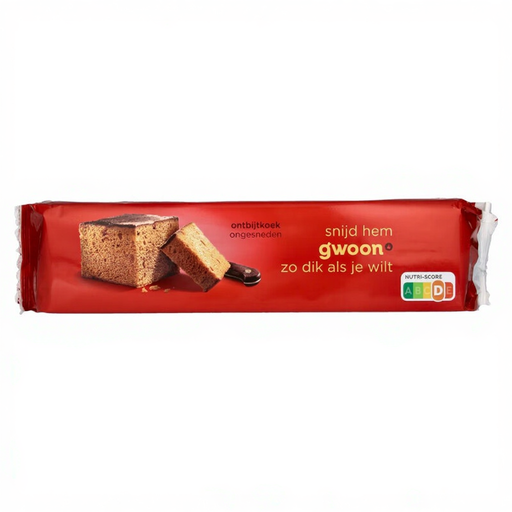
This 550 g unsliced loaf of Dutch breakfast cake is a good choice if you’d like a larger loaf and plan to use the rest after making your cake.
 No image available
g'woon unsliced Dutch breakfast cake 550 g
A good choice if your recipe calls for Dutch breakfast cake and you’ll use the rest of the loaf too.
This unsliced loaf weighs 550 g, so it isn’t a compact option of around 280 g.
The available information about rye in the ingredients and allergen details is contradictory. If you have allergies, check the current pack before using the loaf.
View on Joybuy
Frequently asked questions
Is 280 g of Dutch breakfast cake exactly half a loaf?
No, use the net weight rather than the description ‘half a loaf’. Jumbo lists a 280 g option alongside 550 g loaves; compare the weight with the amount your recipe calls for.
Can I use any Dutch breakfast cake if I need to avoid gluten?
No, Jumbo’s 280 g plain Dutch breakfast cake contains rye and wheat, and may contain barley and oats. Check the current pack and only choose a product whose allergen information meets your dietary requirements.
Where can I find the allergens in pre-packed Dutch breakfast cake?
Read the allergen information on the current pack, including the named grains and any warning about cross-contamination. The Netherlands Food and Consumer Product Safety Authority explains how allergens are listed on the labels of pre-packed foods.
Can I assume Dutch breakfast cake contains iodised baker’s salt?
No, don’t assume so from the product name. Check the ingredients information for the specific loaf if the type of salt used is relevant to your purchasing decision.
How should I store Dutch breakfast cake left over after baking?
Follow the storage advice on the pack of your chosen loaf. Jumbo advises keeping its 280 g plain option in a cool, dry place; check the current pack for advice on storing it after opening.


