
People who read sugar claims carefully
You’re looking for Dutch breakfast cake with a specific sugar claim and want to know how much sugar the product actually contains per 100 g. A ‘no added sugars’ claim doesn’t answer that question on its own.


When choosing a Dutch breakfast cake for King’s Day, don’t rely on claims such as ‘zero’ or ‘less sugar’ alone. Compare the claim with the ‘of which sugars’ figure per 100 g and the amount per serving. According to Peijnenburg, its wholemeal breakfast cake with no added sugars contains 4.9 g of sugars and 17 g of fibre per 100 g; that doesn’t make it sugar-free. If you’re planning to take it with you or share it out, check the packaging too, and read the ingredients.
You’re looking for Dutch breakfast cake with a specific sugar claim and want to know how much sugar the product actually contains per 100 g. A ‘no added sugars’ claim doesn’t answer that question on its own.
You want to compare ingredients and fibre when choosing something for breakfast or a snack, without losing sight of the sugar content. Peijnenburg lists both the proportion of wholemeal rye flour and the fibre content per 100 g for its wholemeal variety.
For King’s Day, you’re looking for a pack that suits the number of people and how you’ll use it on the go. Sliced cakes and individually wrapped bars offer different portion sizes; also check the nutritional information and ingredients.
When choosing Dutch breakfast cake for King’s Day, first decide what you mean by ‘less sugar’. Then compare the fibre and wholemeal flour content, or the portion size if you’re planning to take it with you or share it out.
| What to consider | What to check before buying | Who is this most important for? |
|---|---|---|
| Sugar claim | Read the exact claim and the ‘of which sugars’ figure per 100 g; ‘no added sugars’ doesn’t mean sugar-free. | If I’m specifically looking for sugar-free, I don’t want to rely on a claim that sounds similar. For around 42% of consumers, checking the sugar content comes first. |
| Wholegrains and fibre | Check which flour is listed in the ingredients and compare fibre per 100 g alongside the sugar content. | For a quick breakfast, I want to choose Dutch breakfast cake based on the type of flour and fibre content, not just the front of the pack. These features matter most to around 33% of consumers. |
| Portions and packaging | Compare the number of slices or bars, their weight and the nutritional value per serving. | If I’m taking Dutch breakfast cake with me or sharing it out, I want to know how many portions are in the pack. Around 25% of consumers prioritise this practical convenience. |
These claims don’t mean the same thing. The Diabetes Fund defines sugar-free as containing no more than 0.5 g of sugars per 100 g; Peijnenburg states that its wholemeal Dutch breakfast cake with no added sugars contains 4.9 g per 100 g.
Read the claim alongside the ‘of which sugars’ figure on the packaging. If sugar-free is what you need, ‘no added sugars’ isn’t enough.
Peijnenburg’s product information lists xylitol in the varieties reviewed and warns that excessive consumption may have a laxative effect. It also states that xylitol is not suitable for animals.
Check the ingredients and warnings on the packaging, and keep Dutch breakfast cake containing xylitol out of reach of pets.
Ingredients and nutritional information can change. This is particularly important if you need to check for rye or other allergens.
Before serving, check the current ingredients and allergen information on the packaging, even if you’ve looked at the product online before.
Peijnenburg offers sliced Dutch breakfast cake varieties labelled ‘no added sugars’, including a wholemeal and a plain variety.
ALDI lists a pre-sliced 485 g pack of Koek & Bakker Ontbijtkoek Zero, labelled ‘no added sugars’.
Jumbo Ontbijtkoek Minder Suiker comes in six individually wrapped bars of 50 g each.
These individually wrapped Dutch breakfast cake bars are worth considering if you want to take portions with you or share them out on King’s Day. Check the current label to assess the sugar claim.
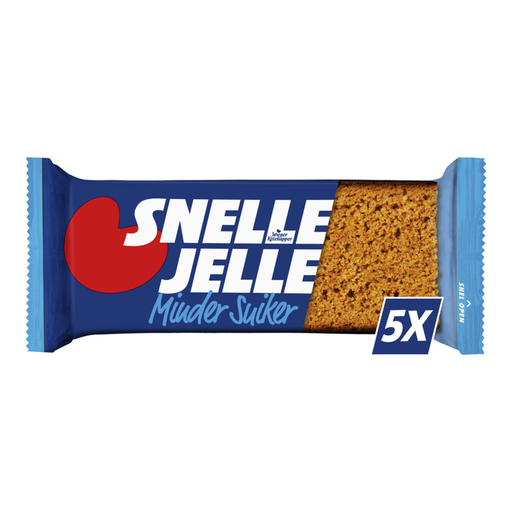 No image available
Handy for taking with you or sharing out: according to the product description, the pack contains five individually wrapped bars of 50 g each.
Glucose-fructose syrup is listed in the ingredients. Don’t assume it’s sugar-free based on the product name; check the current sugar content per 100 g on the packaging.
No, these claims don’t mean the same thing. The Diabetes Fund defines sugar-free as containing no more than 0.5 g of sugars per 100 g; Peijnenburg states that its wholemeal variety with no added sugars contains 4.9 g per 100 g. So always check the ‘of which sugars’ figure on the packaging.
Xylitol is used as a sweetener. It’s listed in the ingredients of the Peijnenburg varieties reviewed; the product information warns that excessive consumption may have a laxative effect.
Keep Dutch breakfast cake containing xylitol out of reach of pets. Peijnenburg states that xylitol is not suitable for animals.
Check the current ingredients list for the specific product. The Netherlands Food and Consumer Product Safety Authority explains that iodine compounds may be present in bakery products through bakers’ salt; this doesn’t mean that every Dutch breakfast cake contains iodine.
Check the current packaging before serving or eating the Dutch breakfast cake. Ingredients and allergen information can change, as Albert Heijn notes in its product information.