
People comparing nutritional information
You want to serve Dutch breakfast cake at your Easter brunch and compare sugars, fibre and salt per 100 g, rather than relying solely on the wording on the front of the pack.


Choose Dutch breakfast cake for Easter based on what matters most to you, rather than relying on the word ‘premium’. If nutrition is your priority, compare sugars, fibre and salt per 100 g; if organic production matters, look for the EU organic logo; or choose an unsliced cake if you want to cut your own slices. A festive design or organic logo alone says nothing about the sugar content.
You want to serve Dutch breakfast cake at your Easter brunch and compare sugars, fibre and salt per 100 g, rather than relying solely on the wording on the front of the pack.
You’re looking for a verifiable organic logo and assess the nutritional information separately.
You want to cut your own slices or are looking for Dutch breakfast cake with an added flavour for Easter breakfast or to enjoy with a cup of coffee.
First decide what matters most for your Easter table. Then check the ingredients and information on the pack too: a logo, nutritional profile and serving format each answer a different question.
| What to consider | Check | Who is this important to? |
|---|---|---|
| Nutritional information | Compare sugars, fibre and salt per 100 g; check the ingredients list too. | When I buy Dutch breakfast cake for brunch, I want to compare varieties on a like-for-like basis rather than relying on different serving sizes. Around 36% of consumers prioritise this nutritional profile. |
| Organic logo | Look for the EU organic logo and check the nutritional information separately. | Verifiably organic production is the deciding factor for me, even if I compare the sugar content afterwards. Around 29% of consumers prioritise organic certification. |
| Presentation and sharing | Check whether the cake is unsliced and whether the size and added flavour suit your table. | If you want to cut your own slices for Easter breakfast, the way it is served is what matters most. This is the main consideration for around 21% of consumers. |
| Ingredients and allergens | Read the current ingredients list and allergen information for the exact variety, including products with no added sugars. | If I need to avoid certain ingredients, I want to know exactly what is in this particular cake before serving it. Around 14% of consumers prioritise this check. |
An organic logo tells you about how a product is made, not its nutritional value. Albert Heijn lists 39 g of added sugars and 41 g of total sugars per 100 g for AH Organic Dutch Breakfast Cake.
Check for an organic logo if organic production is your main priority, then compare sugars, fibre and salt separately per 100 g.
According to Peijnenburg, the Peijnenburg variety examined contains xylitol. The Jumbo variety examined carries a warning about a possible laxative effect if consumed excessively.
For the exact variety, read both the ingredients list and any warnings on the packaging.
The plain varieties from Jumbo and PLUS that were examined list rye and gluten. Peijnenburg states that nuts and milk may be present in its wholemeal variety examined.
Check the current allergen information on the pack you buy, even if you’re already familiar with another variety from the same brand.
You can’t tell from the product category whether a particular Dutch breakfast cake contains iodine-enriched baking salt.
If this is important to your choice, check the current ingredients list for that cake.
These examples relate to specific varieties of Dutch breakfast cake; the features of one variety don’t automatically apply to the whole brand.
An example for anyone comparing a wholemeal variety with no added sugars.
The selection examined includes both an organic variety and a larger baker’s breakfast cake.
The selection examined includes a plain variety and a sliced variety with no added sugars.
An example of sliced plain Dutch breakfast cake for anyone comparing serving formats.
A comparison between a pre-sliced zero variety and an unsliced cake topped with pearl sugar.
A supermarket option for anyone considering a 485 g zero Dutch breakfast cake.
This unsliced Dutch breakfast cake is a good choice if you want to decide how thick to cut the slices for your Easter table. Check the nutritional information on the pack separately if sugars, fibre or salt are your main priority.
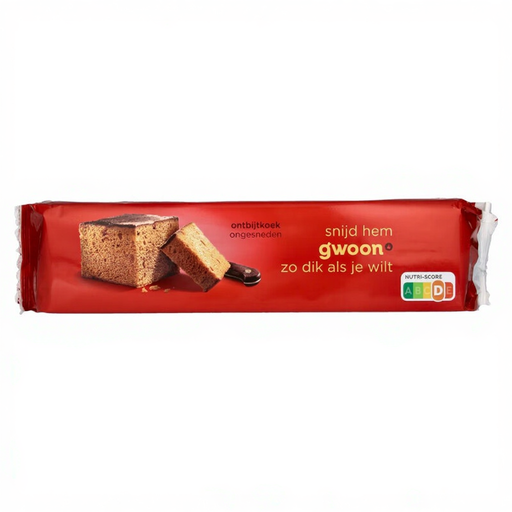 Image unavailable
Ideal for cutting your own slices to share around the table.
Unsliced; 550 g.
No, the organic logo doesn’t tell you how much sugar a Dutch breakfast cake contains. Albert Heijn lists 39 g of added sugars and 41 g of total sugars per 100 g for AH Organic Dutch Breakfast Cake, so compare the nutritional information separately.
Compare the nutritional values per 100 g. The Netherlands Nutrition Centre recommends this basis because manufacturers set their own serving sizes; then check the ingredients and allergens for the variety you want to buy.
Don’t assume so: the product category doesn’t tell you which ingredients were used in a particular cake. Check the current ingredients list if iodine-enriched baking salt is important to your choice.
Follow the storage instructions and best-before date on the pack of your Dutch breakfast cake. The product information examined recommends storing it in a cool, dry, dark place and keeping it in a sealed tin or packaging once opened; check which instructions apply to your variety.