
If you want to cut thick slices yourself
If you want to use Dutch breakfast cake as a base for toppings or as part of a sharing board, look for a loaf labelled ‘unsliced’. That way, you can choose how thick to cut the slices.


If you want to serve thick slices of Dutch breakfast cake on date night, choose a loaf that’s explicitly labelled unsliced so you can decide how thick to cut it. Pre-sliced breakfast cake is more convenient if you want to serve equal portions straight away. If you have specific dietary requirements, check the product description, ingredients and allergen information for your chosen variety first; whether it’s sliced or unsliced doesn’t tell you anything about those.
If you want to use Dutch breakfast cake as a base for toppings or as part of a sharing board, look for a loaf labelled ‘unsliced’. That way, you can choose how thick to cut the slices.
Pre-sliced Dutch breakfast cake gives you individual portions straight away. The trade-off is that you can’t choose the thickness yourself.
If you’re looking for a specific wholemeal variety, a product with no added sugars or gluten-free Dutch breakfast cake, check the product description and allergen information on the packaging first. These features vary from one product to another.
First decide whether cutting it yourself or serving it straight away matters more. Then choose a flavour and check the individual product for any dietary requirements.
| What to consider | What to check before buying | Best suited to |
|---|---|---|
| Choosing the slice thickness yourself | Look for the explicit ‘unsliced’ label. The weight on the packaging doesn’t tell you how thick the slices will be. | If I’m using Dutch breakfast cake as a base for toppings, I want to be able to cut a sturdy slice myself. For around 42% of consumers, having control over the thickness comes first. |
| A flavour that works on a sharing board | Choose a flavour that goes with the toppings you have planned, and check the allergen information for ingredients such as nuts. | I want the flavour of the Dutch breakfast cake to complement the rest of the board. Around 25% of consumers say that choosing the flavour is their top priority. |
| Nutritional information | Compare the nutritional values per 100 g and per intended portion; check fibre, sugars and any sweeteners separately. | When putting the portions together, I want to know what the chosen variety contains. For around 25% of consumers, nutritional information matters most. |
| Gluten-free variety | Check for an explicit gluten-free label as well as up-to-date allergen information. An unsliced loaf isn’t automatically gluten-free. | If a guest needs to avoid gluten, choosing a suitably labelled product matters more than getting the slice thickness you want. Around 8% of consumers put this requirement first. |
The product descriptions to look for are sliced and unsliced. A pack of pre-sliced pieces won’t let you cut a thicker slice yourself.
Choose a loaf explicitly labelled unsliced if you want to decide the thickness yourself, and cut a test slice before serving the rest.
PLUS’s unsliced plain Dutch breakfast cake lists rye flour and gluten-containing cereals. So even with an unsliced variety, you still need to check the individual packaging.
If you need a gluten-free option, check for an explicit gluten-free label and up-to-date allergen information.
A sliced Peijnenburg variety is sold as having no added sugars, but its ingredients also include xylitol. The label also tells you nothing about the slice thickness you want.
Read the ingredients and nutritional information for your chosen variety, and compare them against the portions you plan to serve.
According to the Netherlands Nutrition Centre, bakers aren’t required to use baker’s salt. So you can’t tell from the product category alone whether a particular Dutch breakfast cake contains iodine from baker’s salt.
Check the label or ask the manufacturer for product-specific information if this matters to your choice.
Peijnenburg offers both sliced and unsliced varieties of Dutch breakfast cake.
The range includes own-label Dutch breakfast cake as well as branded varieties.
Jumbo lists sliced and unsliced Dutch breakfast cake from various brands.
Lidl lists plain Dutch breakfast cake in a 485 g pack of pre-sliced pieces.
ALDI lists Koek & Bakker varieties in different slice formats and flavours.
PLUS offers plain Dutch breakfast cake in both sliced and unsliced formats.
These two Dutch breakfast cakes offer different ways to serve them: an unsliced variety for cutting your own pieces, and a sliced wholemeal variety for ready-to-serve portions. For both, check the latest packaging information if ingredients or allergens are important to you.
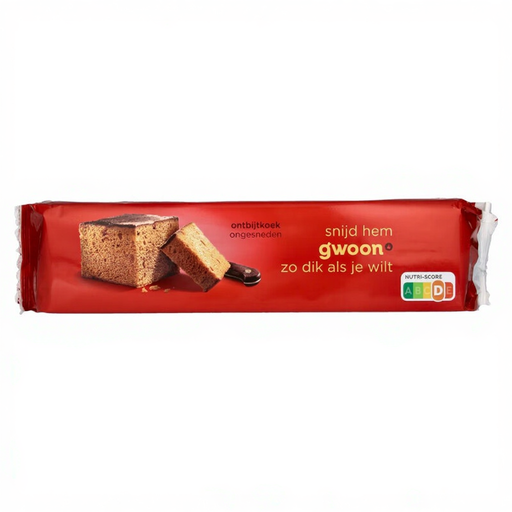 Image unavailable
For a sharing board where you want to choose the slice thickness yourself. The pack contains a 550 g unsliced loaf, so you’ll need to cut the portions yourself.
If you have dietary restrictions, check the ingredients and allergens on the pack.
 Image unavailable
For anyone who wants to serve portions without having to slice the loaf. This wholemeal variety comes pre-sliced and weighs 485 g, so you can’t choose to cut thicker slices yourself.
Check the packaging for the nutritional values, ingredients and allergens for this variety.
Buy a loaf explicitly labelled unsliced and cut the pieces yourself. Cut a test slice first if the cake needs to hold toppings; ‘thick-cut’ on its own doesn’t specify a set slice thickness.
Not automatically: PLUS plain unsliced Dutch breakfast cake, for example, lists rye flour and gluten-containing cereals. If you need a gluten-free option, choose a variety explicitly labelled gluten-free and check the latest allergen information.
It depends on the format of the specific variety. The Peijnenburg wholemeal variety described as having no added sugars comes pre-sliced; if you want to choose the thickness yourself, look for a product that’s also unsliced.
You can’t tell from the name Dutch breakfast cake. According to the Netherlands Nutrition Centre, bakers aren’t required to use baker’s salt. Check the label or ask the manufacturer if the ingredients of a particular product matter to your choice.
Follow the storage instructions on the packaging for your chosen loaf. For PLUS plain unsliced Dutch breakfast cake, the advice is to ‘store in a dry, dark place’; reseal the remainder after slicing, following the instructions on the pack.