
Vandaag of morgen in huis

Kwaliteit gegarandeerd

Welkomstaanbiedingen ontgrendelen: GRATIS bezorging | Tot 80% korting | Gratis 30 dagen JoyPlus-proefperiode
Download de app
A dumbbell set for home might seem simple: choose a pair of dumbbells, put them somewhere and start training. In practice, many buyers make the same mistakes. A set may be too light to help you make progress, awkward to store or have a grip that feels less comfortable when your hands get sweaty.
This guide helps you compare weights for home fitness based on features you can check, such as weight, material, shape, grip and storage. That way, you can choose hand weights to suit your training goals and available space.
When buying a set with several dumbbells, it’s important to check the weight of each individual dumbbell. A 10 kg set, for example, could consist of two 5 kg dumbbells or several lighter weights. You’ll often need different weights for shoulder exercises, cardio and toning than you will for squats or lunges.
So, check:
A soft coating feels comfortable, but the shape and diameter of the handle are just as important. A handle that’s too thick can be difficult to hold, while a smooth surface may offer less grip when you’re sweating. If the information is available, check the stated handle length and diameter.
Neoprene dumbbells usually have a soft outer layer. This can be comfortable for strength training at home and light cardio, but always check the care instructions. Some models, for example, shouldn’t be placed directly on a wooden floor.
Round dumbbells can roll away during a short break. Hex dumbbells have flat sides and, according to their product descriptions, stay more stable when put down. This is useful for exercises where you use the dumbbells on the floor, such as a renegade row.
A dumbbell set with a rack also takes up a fixed amount of space. Measure the available area beforehand and check that the rack can stand securely on a flat surface.
Several lighter weights are useful for beginners and casual exercisers. You can switch weights for different exercises without having to buy a heavy set straight away. A combination of 1, 1.5 and 2 kg is useful for arm, shoulder and cardio exercises. Weights of 3, 4 kg or more may be more suitable for larger muscle groups or people who have been training for longer.
An adjustable dumbbell set offers a different approach: you add or remove weight plates as needed. This saves space, but takes more time to adjust and requires you to secure the collars carefully.
Many fitness weights are made from cast iron with a coating. Cast iron makes for a compact weight, while neoprene or another plastic coating can soften contact with your hands and the floor. Check whether the product information describes the coating as non-slip and whether there are any care recommendations.
Also look out for possible variations in weight. Some products explicitly state that small variations may occur. This is usually useful to know when training at home, particularly if you want to use the same load on both sides.
The handle’s dimensions help determine how naturally the dumbbell sits in your hand. A short handle can work well on compact hand weights, while adjustable dumbbells need more room around the plates.
A practical checklist:

Why it suits this profile: A fixed pair of 2 kg dumbbells is a straightforward choice for beginners who want to get started at home with arm, shoulder and light full-body exercises.
The product clearly states that the set contains 2 x 2 kg. The hexagonal shape helps prevent rolling, and the neoprene layer is designed to provide a secure grip, according to the product description.
2 kg per dumbbell, cast-iron core, matt neoprene coating and a grip measuring approximately 10 x 3.2 cm.

Why it suits this profile: This is a practical choice if you want to combine different training levels and keep your fitness weights neatly stored away.
The set contains three clearly differentiated pairs weighing 1, 2 and 3 kg. The included PP rack helps keep the weights off the floor when they’re not in use.
Six dumbbells, three weights, cast iron with a neoprene coating and flat hexagonal shapes.
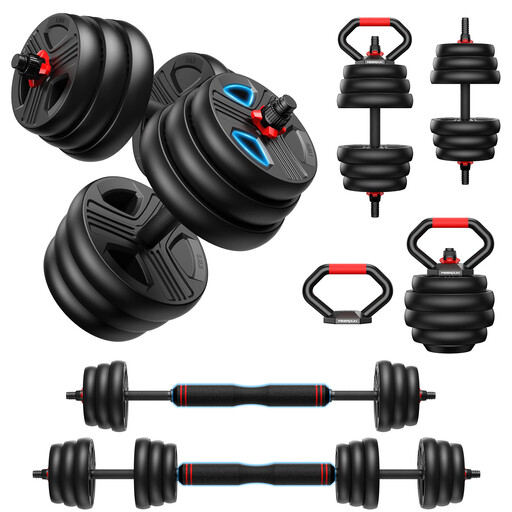
Why it suits this profile: This set is designed for people who want to combine different types of training and prefer to use a single modular system.
The weight is adjustable, so you don’t have to buy several fixed pairs straight away. Before each exercise, check that the collars and other parts are secured correctly.
According to the product information, the set weighs 10 kg in total and can be converted into dumbbells, a barbell, a kettlebell and a push-up stand.
We’ve put together a complete, up-to-date list of products that meet these strict selection criteria and the applicable European safety regulations.
It depends on the exercise and how much you can comfortably lift at the moment. Beginners often choose lighter weights for arm and shoulder exercises than for squats or lunges. A set with 1, 1.5 and 2 kg gives you more choice than a single fixed pair. Start with controlled movements and only increase the weight when your form remains steady.
Neoprene dumbbells are suitable for light to moderate exercises, cardio and toning, depending on the weight available. The coating can feel comfortable, and the hexagonal shape can help prevent rolling. If you want to progress to heavier weights, an adjustable dumbbell set or a heavier fixed pair may be more practical.
Place the dumbbells on a flat, stable surface or use the rack supplied. Put them down carefully, don’t leave them in high places and keep them out of children’s reach. With adjustable models, check the collars regularly and keep metal parts dry to help prevent moisture damage and rust.
