If you often write in a document while referring to sources alongside it, a laptop with two built-in screens could make a separate monitor unnecessary. If you also often work without a second screen, a standard laptop with a portable monitor offers more flexibility. Before you buy, check the video connection, power requirements and combined weight.
Who is this choice relevant to?
Writer who needs sources alongside their text
You want to refer to notes, maps or sources on a second screen while writing, so you’re comparing a built-in duo with a separate monitor. ASUS and Lenovo describe laptops with two built-in screens for this kind of setup.
Traveller who wants to pack light
You sometimes write without a second screen and only take extra screen space with you when you need it. So compare the weight and power requirements of the complete setup, not just the laptop.
Writer with long typing sessions
You want to use two screens, but the keyboard layout and screen positioning matter too. Lenovo lists a separate magnetic keyboard and folio for the Yoga Book 9i Gen 10; consider whether that setup suits your workspace.
What should you consider when using two screens on the go?
First, decide whether you need the extra screen space on most writing trips. Then check how your chosen setup handles video and power, and what you’ll need to carry with you.
| Consideration |
What should you check? |
Who should prioritise this? |
| Using two screens at once |
Check how you use the screens and keyboard with the exact laptop model, and how much workspace the setup requires. |
I want to keep sources open alongside my text while writing, so I don’t have to switch between windows as often. Around 33% of consumers prioritise using two screens at once. |
| Weight and power |
Compare the combined weight of the laptop, monitor and accessories. Also check how the setup is powered; the stated battery life doesn’t automatically apply when using two active screens. |
When I travel light, I want to know what the complete setup will add to my bag and whether I’ll need a power supply. Around 27% of consumers focus mainly on portability and power. |
| Connectivity and expandability |
Check the video output supported by the exact laptop port, as well as the monitor’s connection and power requirements. A USB-C port alone doesn’t guarantee that it supports video output. |
I want to choose my laptop and monitor separately and connect them in a way that suits my needs. Around 20% of consumers prioritise the connectivity and expandability of the setup. |
| Typing and reading |
Assess the keyboard layout and screen positions in the setup you’ll actually use for writing; don’t assume it will be comfortable just because it has two screens. |
During long editing sessions, I want to type comfortably and read sources easily. Around 20% of consumers base their choice mainly on typing and reading comfort. |
Common pitfalls
-
Assuming every USB-C port supports video output
According to ASUS, using a single USB-C cable for video with the ASUS ZenScreen MB169CK requires a laptop port with DP Alt Mode.
Check the laptop port specifications and the requirements of the exact monitor before choosing a setup.
Without this mode, ASUS specifies HDMI for video and USB-C for power with this monitor.
-
Assuming a battery-life figure applies when working with two screens
Apple gives battery-life figures for specific activities, such as streaming video and browsing the internet wirelessly. These figures don’t prove how long the battery will last with a portable monitor connected.
Compare the test conditions and consider the power requirements of your complete setup.
-
Comparing only the laptop’s weight
A separate monitor and the accessories you need add to the laptop’s weight. Lenovo lists the ThinkVision M14t Gen 2 as weighing 700 g; the Yoga Book 9i Gen 10 comes with a separate keyboard and folio.
Compare what you’ll actually carry for both options, including cables and any power supply.
Brands worth considering
ASUS
The Zenbook DUO UX8407AA has two built-in screens, while the ZenScreen MB169CK is a separate portable monitor.
- ASUS lists two 14-inch 3K OLED screens and a weight of 1.65 kg for the Zenbook DUO UX8407AA.
- According to ASUS, using a single USB-C cable for video with the ZenScreen MB169CK requires DP Alt Mode on the laptop. Using HDMI for video also requires USB-C power.
Lenovo
The Yoga Book 9i Gen 10 is a dual-screen laptop, while the ThinkVision M14t Gen 2 is a separate portable monitor.
- Lenovo lists two screens and an included magnetic keyboard and folio for the Yoga Book 9i Gen 10.
- According to Lenovo, the ThinkVision M14t Gen 2 weighs 700 g; include the monitor when comparing the total weight you’ll carry.
Apple
The 13-inch MacBook Air M5 is a standard laptop that can be paired with a compatible external monitor.
- Apple specifies support for using the built-in screen and external displays at the same time.
- The stated battery life for other activities isn’t a battery-life measurement taken with a portable monitor connected.
Dell
The XPS 13 DX13260 is a compact laptop model to consider for a setup with a second screen.
- Dell lists a weight of 1 kg and battery life of up to 17 hours for this model.
- Dell notes that battery life can vary depending on the configuration and how you use the laptop. Check the video output on the model you choose and your monitor’s requirements.
Laptop options at Joybuy
These laptops are options to consider for writing on the go and connecting an external screen. Before you buy, check the video output on the exact model and your monitor’s requirements.
 No image available
Ruzava 14-inch laptop, N5095, 8 GB RAM, 256 GB SSD
An option if you’re considering a laptop for travelling and want to check its external monitor connection in advance.
The product name lists an N5095 processor, 8 GB RAM, 256 GB SSD and an FHD screen.
The product description lists a weight of 1.39 kg, Mini-HDMI and battery life of up to 7 hours; this battery-life figure isn’t a measurement taken with a monitor connected.
View at Joybuy
 No image available
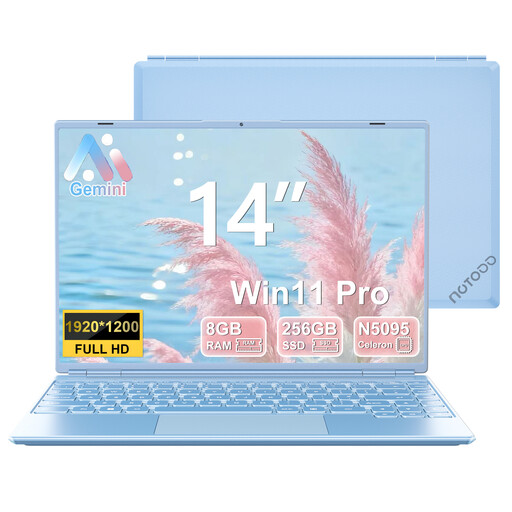
NOTODD 14-inch laptop, Celeron N5095, 8 GB RAM, 256 GB SSD
An option if you want to pair a standard laptop with a portable monitor; check the required cable and power supply too.
The product name lists a Celeron N5095 processor, 8 GB RAM, 256 GB SSD, a screen resolution of 1920 × 1200 and Mini-HDMI.
The product description states that you can connect external monitors via Mini-HDMI. Check that your chosen monitor and the complete connection meet your requirements.
View at Joybuy
Frequently asked questions
Can you connect any USB-C monitor to your laptop with a single cable?
No, it depends on the ports and the monitor. According to ASUS, using a single USB-C cable for both video and power with the ASUS ZenScreen MB169CK requires DP Alt Mode on the laptop. ASUS also describes using HDMI for video and USB-C for power; check the exact models.
Can you put your laptop in your checked baggage when you fly?
EASA advises carrying your laptop in your hand baggage. If an electronic device does need to go in checked baggage, EASA lists conditions such as switching it off completely and protecting it against accidental activation. According to EASA, spare batteries and power banks must be carried in hand baggage; check your airline’s requirements too.
How should you assess the battery of a laptop you take with you often?
For a used or ageing laptop, check its current battery capacity. The Consumentenbond explains that the difference between design capacity and full charge capacity can indicate battery wear. Don’t use a battery-life figure for a different task to predict how long it will last when working with two screens.
What cooling-off period and warranty apply to an online purchase in the Netherlands?
According to the Dutch government, online purchases from a business often come with a 14-day cooling-off period, although there are exceptions. There’s no fixed statutory warranty period in the Netherlands: you’re entitled to a product that works as it should, and the retailer is your point of contact if there’s a problem. Check the terms of any additional warranty too.


