
Translator working with two fixed text windows
Wants to read the source text and translation side by side for extended periods, with the screens set at a comfortable viewing distance. Arboportaal advises placing a screen directly in front of you.


Choose a crossbar if you usually move both screens together side by side; independently adjustable arms are a better fit when your source text and translation need different positions. Check the weight and VESA pattern of each screen, and measure your desk thickness and available space before choosing a clamp or base. A stand helps you position your screens, but it is no substitute for setting up your workstation properly or taking breaks from screen work, as advised by Arboportaal.
Wants to read the source text and translation side by side for extended periods, with the screens set at a comfortable viewing distance. Arboportaal advises placing a screen directly in front of you.
Benefits from independent positioning when documents call for different orientations or alignments. StarTech.com describes manual rotation to portrait orientation for the ARMDUAL3.
Needs to consider the desk edge, the space behind the desk or a preference not to use a clamp. ACT describes the AC8320 as having a freestanding base.
A good fit if: you usually keep your source text and translation side by side and want to move both screens together. ACT describes the AC8344 as having a crossbar with a handle for joint adjustment.
Bear in mind: check that the available independent adjustment is sufficient for your needs. ACT specifies a maximum of 32 inches and 9 kg per screen for the AC8344, plus VESA 75 × 75 or 100 × 100 mm.
A good fit if: you want to position your screens at different heights or in different orientations. Neomounts describes the DS70-250BL2 as offering height and depth adjustment with a gas spring; StarTech.com specifies manual portrait rotation for the ARMDUAL3.
Bear in mind: check the space behind your desk and the limits of the exact model. Neomounts specifies different weight limits for curved and standard screens for the DS70-250BL2.
A good fit if: you don’t want to use a clamp or desk grommet and have enough room for a base. ACT describes the AC8320 as freestanding, with screens that can be aligned independently.
Bear in mind: the base takes up desk space. For the ACT AC8320, the manufacturer specifies a maximum of 34 inches and 8 kg per screen, with VESA 75 × 75 or 100 × 100 mm.
| What to consider | What should you check? | Who is this most relevant to? |
|---|---|---|
| Viewing position for both texts | Decide whether you’ll move the screens together or want to adjust each screen separately for height, depth and angle. | If I read the source text and translation side by side for a long time, I want to be able to set both windows at a comfortable viewing position. Consumers who mainly want a shared reading position account for around 33%. |
| Compatibility with both monitors | Check the weight of each screen without its stand, its VESA pattern and the model-specific limits. Look out for different limits for curved screens. | I want to know in advance whether both my existing monitors will fit the stand, not just whether their diagonal measurements match. Consumers who prioritise compatibility account for around 27%. |
| Mounting and desk space | Measure the desktop thickness and the clearance around the edge for a clamp. If you’re using a base, allow for the space it takes up. | If the desk edge is difficult to access or I don’t want to use a clamp, the mounting method needs to work with my desk. Consumers who mainly consider desk compatibility account for around 20%. |
| Changing screen positions | Check that rotation and the adjustment range work with the width of your screens and the cables in your setup. | When I sometimes read long documents and sometimes compare texts, I want to be able to align the screens to suit my work. Consumers who prioritise different screen positions account for around 20%. |
A monitor may be within the stated screen-size range but still exceed the stand’s weight limit or have an incompatible VESA pattern. For example, Neomounts specifies different weight limits for standard and curved screens for the DS70-250BL2.
Check the weight, VESA pattern and limits of the model you’ve chosen for each screen individually.
A crossbar that adjusts both screens together is not the same as arms that let you align or rotate each screen independently.
First decide whether your source and translation screens will usually move together or need their own positions.
A clamp will only fit a desk edge within that model’s specified range. A freestanding base avoids the need for a clamp, but takes up space on the desktop.
Measure the desk thickness and available space, then compare them with the stand’s mounting method.
According to the Dutch government, there is no fixed statutory warranty period in the Netherlands; if a product is faulty, you should contact the seller.
Keep your proof of purchase and treat the manufacturer’s warranty as an addition to your statutory rights.
The DS70-250BL2 is a dual desk mount with a gas spring for independent positioning and depth adjustment.
The range covered here includes models with a crossbar, dual arms and a freestanding base; the mounting method varies by model.
The ARMDUAL3 is a dual stand with a desk clamp and mechanical height adjustment.
The Viewmate desk 602 is a dual stand with a crossbar for side-by-side screens.
The DS1002C-B1 is a dual desk stand with a clamp and screen rotation.
This selection includes monitor stands and monitor arms for a setup with two text screens. For each model, check that the version and mounting method specified are suitable for your screens and desk.
 No image available
A stand for anyone who wants to place two text windows side by side and adjust their width or angle.
MDF; adjustable width of 80–108 cm and adjustable angle.
 No image available
A dual monitor arm for anyone who wants to position two text screens on their desk.
Before buying, check that the version on offer is compatible with your VESA mounts and screen weights, and that it can be fitted to your desk.
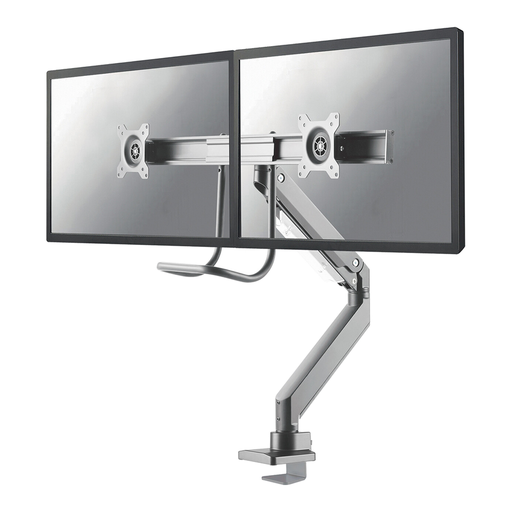 No image available
An option for positioning two screens when you want to be able to adjust their position.
Gas spring, Topfix and 180°-Stop.
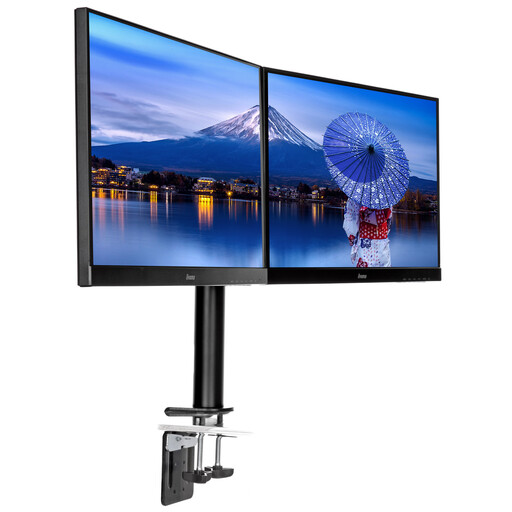 No image available
A clamp-mounted stand for anyone who wants to position two screens side by side and adjust their position.
The Joybuy description specifies two flat screens up to 30 inches and a maximum of 10 kg per monitor, VESA 75 × 75 or 100 × 100 mm, and desk-clamp mounting. iiyama specifies 32 inches on a UK manufacturer page, so check the specification for the version on offer.
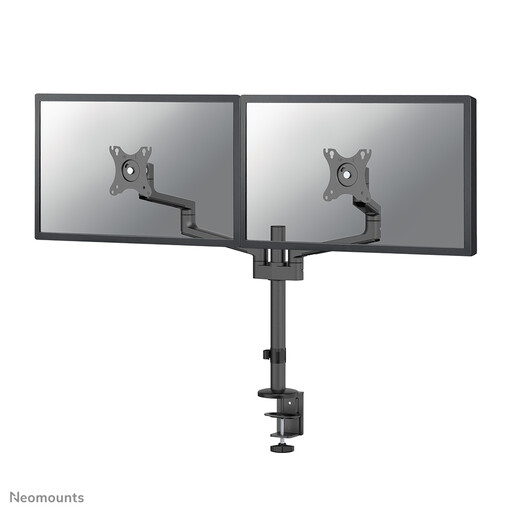 No image available
A monitor arm for anyone who wants to position two screens at a shared workstation.
The product name specifies a version for 17–27-inch screens. Before buying, check the weight, VESA compatibility and mounting method for the version on offer.
Check the weight of each screen without its stand, its VESA mounting pattern and its dimensions. Compare these with the limits of the model you’ve chosen; Neomounts specifies a different weight limit for curved screens for the DS70-250BL2.
No, the mounting method needs to suit your desk. For a clamp, compare the desktop thickness with the stated range; for example, StarTech.com specifies 4–8.5 cm for the ARMDUAL3. A freestanding stand such as the ACT AC8320 avoids the need for a clamp, but the base still needs to fit on the desktop.
Adjust the screens from a relaxed seated position and find a position that works for both text windows. Arboportaal advises placing a screen directly in front of you, with the top just below eye level and your gaze angled slightly downwards. Break up long periods of screen work with other tasks or a break.
The Dutch government says that a home workstation should be ergonomically sound and that an employer can provide ergonomically suitable equipment. This guidance does not establish a general right to reimbursement specifically for a dual monitor arm; discuss the setup you need and any possible reimbursement with your employer.
When you buy as a consumer, the product must meet what you can reasonably expect; if a product is faulty, you should contact the seller. According to the Dutch government, there is no fixed statutory warranty period in the Netherlands. A manufacturer’s warranty is in addition to these rights.