
Someone with limited desk space
Wants to view a dashboard and report at the same time while keeping space free for a keyboard or documents. Allow for the space needed to fit the mount and move the arms.


For a small desk, a manually adjustable dual monitor mount is a sensible choice if your dashboard and report usually stay in the same positions. If you often change your screen positions, individually adjustable arms are more useful, provided they can move alongside and behind the desk. First, check that the mounting method suits your desk and that each screen is within the mount’s weight limit and VESA pattern specifications.
Wants to view a dashboard and report at the same time while keeping space free for a keyboard or documents. Allow for the space needed to fit the mount and move the arms.
Wants to position each screen separately when switching attention between a dashboard and a report. The arms need enough room to move freely.
Needs to check whether a grommet mount is an option or whether a base will fit on the small desktop.
Start with the mounting method and the space around your desk. Then choose based on your screens and how often you want to adjust their positions.
| What to consider | What to look for | Who should consider this? |
|---|---|---|
| Space on and behind the desk | Compare the space needed for the clamp or base and the arms’ range of movement with the available desktop and wall space. | If I want to keep space free for my keyboard and documents, I also check how much room the arms need behind the desk. Around 31% of consumers prioritise keeping their workspace clear. |
| Compatibility with both monitors | Check the weight, VESA pattern and dimensions of each screen for your intended setup. | I want to know in advance whether both of my existing screens will fit the same mount, not just whether one will. Around 25% of consumers make compatibility their top priority. |
| Independent adjustment | Consider how often you move your screens and whether the arms have enough room to do so. | If I regularly change the alignment of my dashboard and report, I want to position the screens independently. Around 25% of consumers prioritise adjustability. |
| Desk mounting | Check that the edge, thickness and any grommet hole match the model’s instructions; a base takes up space on the desktop. | If my desk doesn’t have a suitable edge for a clamp, I need to check whether a grommet mount or a base will work. Around 19% of consumers start by checking the mounting options. |
Screen size alone won’t tell you whether both monitors will fit. Check each screen’s weight and VESA pattern against the limits of the mount you’re considering.
Don’t use screen size as your only compatibility check; check the specifications for both monitors.
If the combination isn’t suitable, you may still need another mount or a compatible adapter.
The arms and screens also need room to move alongside and behind the desk. A wall or partition can restrict their movement.
Measure the available space and compare it with the dimensions and range of movement of the specific model. If there’s a wall, check whether a stop mechanism will work with your setup.
A desk base avoids the need for a clamp, but takes up space on the desktop.
Compare the base dimensions with the space you need to keep free for your keyboard and documents.
For the FPMA-D700D, Neomounts lists a height adjustment range of 32–42 cm, while the Joybuy description states 52–83 cm. For the DS1002C-B1, iiyama lists a maximum screen size of 32 inches, while the Joybuy description states 30 inches.
Check the latest manufacturer documentation for the exact model code and ask the seller for clarification if the details don’t match.
Conflicting measurements can mean extra research and the hassle of making a return if the model doesn’t suit your setup.
The FPMA-D700D and DS70-250BL2 offer different ways to adjust two screens and mount them to a desk.
The AC8302 is a dual mount with clamp and grommet mounting options; the AC8320 is an alternative with a desk base.
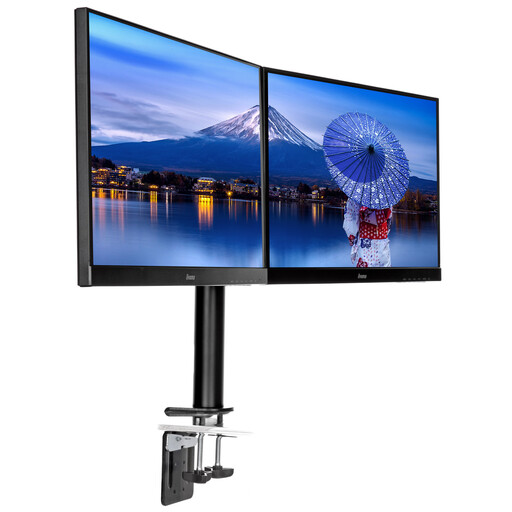
The DS1002C-B1 has a desk clamp; the DS3002C-B1 is a dual gas spring arm with clamp or grommet mounting.
These products are designed for two screens on a desk mount, with options including an adjustable stand or dual arms attached to the desk. Check the mounting method and the specifications relevant to your monitors for each model.
 No image available
For anyone who wants to place two monitors side by side and adjust the stand’s width and angle.
The product name specifies MDF and an adjustable width of 80–108 cm.
 No image available
A dual arm for anyone who wants to attach two screens to a desk with a clamp and adjust their position.
The product description mentions height and depth adjustment, as well as cable management. The desk must be sturdy enough for clamp mounting.
 No image available
For anyone who wants to attach two screens to the edge of a desk and adjust their position.
The product description mentions height, tilt and swivel adjustment, as well as VESA 75×75 or 100×100 mm. The desk edge must be suitable for the clamp, and the desktop must be sturdy enough.
Not necessarily, but check the weight and VESA pattern of each screen separately, and make sure both screens will fit side by side in your intended setup. The maximum weight capacity applies to each screen.
Place the screen you work on most directly in front of you. Arboportaal advises positioning the top of the screen slightly below eye level; adjust the second screen to suit how you use it. This is positioning advice, not a promise that a monitor arm will prevent discomfort.
Follow the fitting instructions for the model you’ve chosen and check that the clamp or grommet mount suits your desk. Stay within the weight capacity for each screen and make sure the screens, arms and cables don’t knock against anything.
For a distance purchase from a business, you generally have a 14-day cooling-off period, according to the Dutch Government. You’re also entitled to a product that meets the required standards in the Netherlands, but there’s no fixed statutory guarantee period. Check who the seller is and which returns terms apply to your order.
No. The Dutch rules described do not require you to buy a dual monitor arm specifically. However, there are requirements for workplaces where screen-based work is carried out; Arboportaal includes a height-adjustable screen among its recommendations and outlines employers’ obligations. The applicable requirements depend on the working situation.