Brands to consider
The brands mentioned illustrate different designs. The features below apply to the specified models or product ranges and aren’t general statements about the brands as a whole.
Neomounts
The DS70-250BL2 NEXT Slim is an example of a model with two movable arms, designed for a shared workspace near a wall or partition.
- For this model, the manufacturer specifies a gas spring, rotation stop, and clamp or grommet mounting.
- The specified range is 1–9 kg per screen, or up to 8 kg for a curved or ultrawide screen. Also check that each screen has a VESA pattern of 75×75 or 100×100 mm.
ACT
The ACT AC8322 with crossbar and freestanding AC8332 offer two different ways to position two screens side by side.
- For the AC8322, ACT specifies clamp and grommet mounting, as well as joint, tool-free height adjustment.
- The AC8332 has a freestanding base and, according to ACT, is limited to 6 kg and 27 inches per screen.
StarTech.com
The ARMDUAL3 is an example of a model with two articulated arms and manual height adjustment.
- The manufacturer’s Dutch product page specifies a maximum of 8 kg per arm and a VESA pattern of 75×75 or 100×100 mm.
- The height is adjusted mechanically; the specified desk clamp is designed for desktops 4 to 8,5 cm thick.
Ergotron
The LX Dual Side-by-Side Arm is an example of a mount for two screens positioned side by side, with a wide range of movement.
- For the version reviewed, the manufacturer specifies an individual screen weight of 3,2–9,1 kg.
- The product information consulted is for the US version. Check the exact model and fitting before buying.
BakkerElkhuizen
According to the manufacturer, the Filex Galaxy Modular Flex Dual has a modular design that can be adapted to suit a future configuration.
- The manufacturer specifies two arms, each with a static and a dynamic section, a rotation stop, and a desk clamp plus grommet fitting as standard.
- Check the specifications for the version you choose against your own screens; a modular design alone doesn’t guarantee compatibility.
Dual monitor mounts at Joybuy
This product selection is intended for using two monitors side by side to compare text, with options for different screen positions and desk setups.
 No image available
Floordirekt monitor stand for 2 monitors, 80–108 cm, white
An option if you want to position two screens side by side and adjust the setup.
The product name specifies adjustable width and angle, MDF, and a white finish, in a size of 80–108 cm.
View at Joybuy
 No image available
DELL Dual Monitor Arm MDA20
A dual monitor arm for viewing source text and translation side by side. Check that the model is compatible with both screens and your mounting area.
View at Joybuy
 No image available
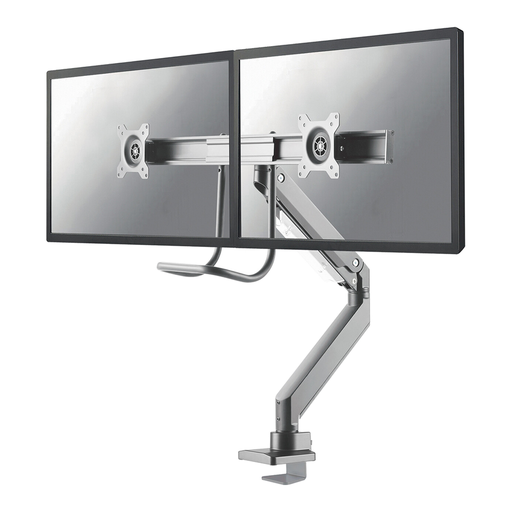
Neomounts NM-D775DXSILVER monitor arm
An option if you want to position two screens and adjust the setup. Check that it’s suitable for each of your screens.
The product name specifies 10–32 inches, a gas spring, Topfix and a 180° stop.
View at Joybuy
 No image available
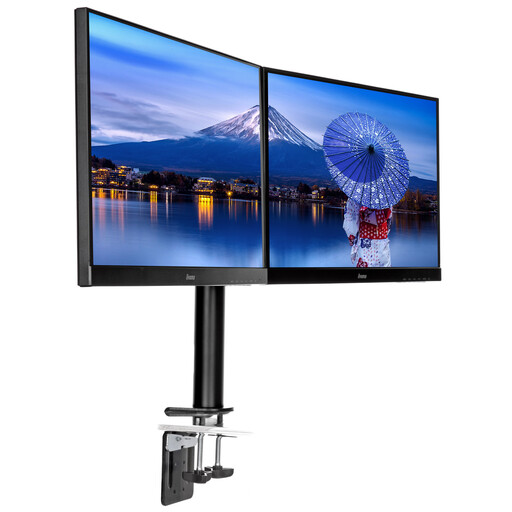
iiyama dual desktop arm
A possible option for using two screens side by side. Check the specifications for this model against your monitors and desk.
View at Joybuy
 No image available
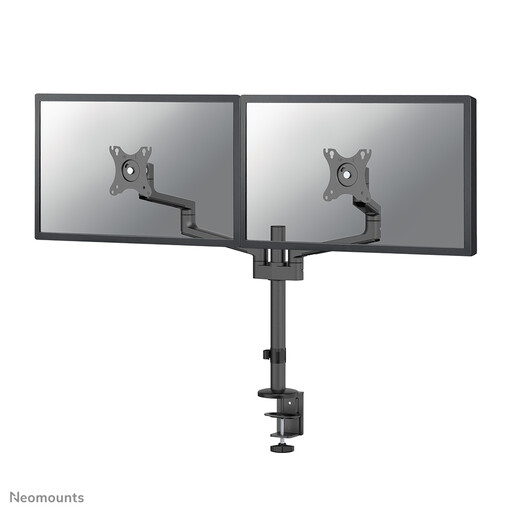
Neomounts DS60-425BL2 monitor arm, 17–27 inches
An option for two screens if you want to adjust their position. Check that the mount and available space will work with your desk.
The product name specifies 17–27 inches and Space Saving.
View at Joybuy
Frequently asked questions about dual monitor mounts
Do my two monitors need to be the same size?
Not necessarily, but check the weight, VESA pattern and preferred position of each screen separately against the specifications for the exact mount. Weight limits apply to each model and may differ between screens.
How do I set up the two screens after installation?
Position the source text and translation where you want them physically, then arrange the displays in your computer’s settings too. Microsoft explains how to drag the screens into their actual positions there; the monitor mount doesn’t control the display itself.
What can I do if the height adjustment won’t stay in place?
Refer to the installation and adjustment instructions for the exact model, and check that each screen is within the specified weight range. A gas spring and a manually adjustable mechanism work differently, so follow the instructions for your model.
What warranty and cooling-off period apply to an online purchase in the Netherlands?
When you buy as a consumer, you’re entitled to a product that meets the terms of the agreement. According to the Dutch Government, the Netherlands has no fixed statutory warranty period. Online purchases from a business usually come with a 14-day cooling-off period. A manufacturer’s warranty is in addition to your statutory rights and doesn’t replace them.
Does Dutch health and safety legislation require one particular type of dual monitor arm?
Arboportaal’s guidance on display screen work doesn’t specify a particular type of dual monitor arm. There are requirements for setting up a display screen workstation, including that the screen must be height-adjustable; the employer assesses the risks of the workspace.


