
Document comparer
You read two full versions side by side and want to be able to position each screen for your viewing comfort.


A crossbar is a good fit if your two screens usually stay side by side and you mainly want to adjust their height together. Separate arms give you more freedom to turn or move each screen independently. For each screen, check its weight without the stand and its VESA pattern. Also measure your desk thickness and the available space for your chosen mount and screen positions.
You read two full versions side by side and want to be able to position each screen for your viewing comfort.
You share your workspace with colleagues and want to adjust the screen position easily when someone else takes over.
You want to set up two existing screens on a desk with limited space or specific mounting options.
First decide how each screen needs to move, then check that the screens and desk are compatible with the mounting method and dimensions of the exact model.
| What to consider | What to look for | Who is this important for? |
|---|---|---|
| Positioning two documents | Check whether the screens can be turned and moved independently, or can only be adjusted together. | When I read two full versions at once, I want to position each screen as needed without constantly moving the other one. Around 29% of consumers prioritise positioning documents independently. |
| Readjusting when someone else takes over | Check which adjustments can be made without tools and whether the screens move together or independently. | When a colleague takes over my desk, I want to be able to adjust the screen position quickly for them. Around 29% of consumers prioritise being able to readjust quickly when someone else takes over. |
| Making sure the screens and desk fit | For each screen, compare its weight without the stand and its VESA pattern with the specifications of the exact model. Also check the desk thickness and mounting method. | I want to know in advance whether both my existing screens and my desk are suitable for the mount I’ve chosen. Around 24% of consumers say technical compatibility is their top buying priority. |
| Space around the desk | Measure the space behind and beside your desk, and take account of the screen positions you want to use. | With little space behind my desk, I want to avoid a screen hitting a wall or divider when I adjust it. Around 18% of consumers prioritise the space available around their desk and wall. |
A screen may fall within the stated size in inches but still be too heavy or have an unusual mounting pattern.
Make a note of the weight without the stand and the VESA size for both screens. Compare these with the specifications for the exact mount model and check whether you need an adapter.
A crossbar may suit two screens that move together, but it offers less flexibility if you want to position each document separately.
Decide in advance which movements each screen needs and which can be made together.
Desk thickness, clamp clearance and the distance from a wall or divider all affect whether you can achieve the screen positions you want.
Measure the desk edge and the clear space behind the screens. Compare these measurements with the mounting method and dimensions of your chosen model.
The Dutch government distinguishes between consumer and business purchases, including in relation to cooling-off periods and consumer guarantees.
Check in advance who is placing the order and which warranty, service and returns terms apply to the purchase. Ondernemersplein explains the difference.
The AC8322 is a crossbar option for two screens that usually stay side by side in a shared workspace.
The DS70-250BL2 NEXT Slim is an option with two movable arms and a 180° stop, designed for setups near a wall or divider.
The K59601WW has independently adjustable arms, while the K58272WW uses a crossbar with a handle for adjusting the height of both screens together.
These product picks are designed for two screens in a shared workspace, with adjustable setups as well as a stand with a fixed screen height.
 No image available
This dual monitor arm is designed for two screens. Its height and depth adjustments can help you adapt the setup when someone else takes over.
The product description lists cable management for up to ten cables.
The clamp requires a sufficiently strong desk surface.
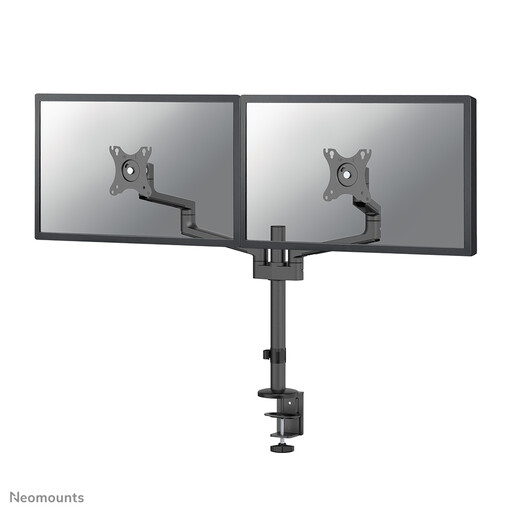 No image available
This adjustable desk mount is designed for two screens and may suit you if you want to position the screens independently on a desk close to a wall.
The product description lists VESA 75 × 75 or 100 × 100 mm and a maximum of 8 kg per screen.
Height and depth are adjusted manually. Don’t install the mount on a fragile, loose or uneven desk surface.
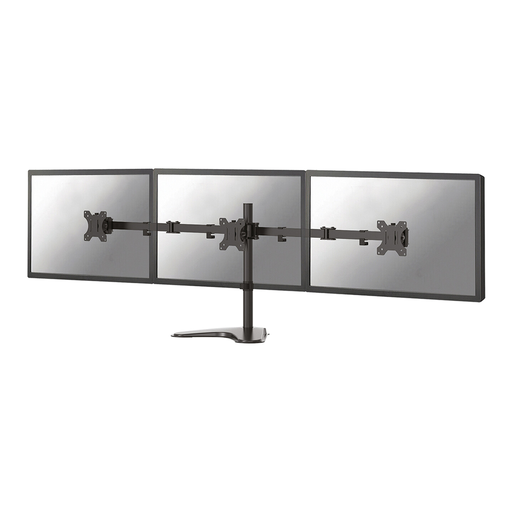 No image available
This desk mount is designed for two flat screens, with adjustable screen positions for a shared workspace.
The product description lists VESA 75 × 75 and 100 × 100 mm and a maximum of 8 kg per screen.
Height adjusts from 0 to 46 cm and depth from 4 to 40 cm. The screens can also tilt, rotate and swivel.
 No image available
This stand is designed to position two monitors side by side. Its width is adjustable and the side platforms can rotate.
The width is approximately 80–108 cm. The screen height is fixed at 10,4 cm.
Place the stand on a stable, level surface.
For each screen, note its weight without the stand and its VESA hole pattern. Compare these details with the specifications of the exact mount model, and measure your desk to check whether it allows clamp or grommet mounting. The maximum screen size alone isn’t enough to confirm compatibility.
First, position the screen you mainly work on directly in front of you, then adjust the screen positions to suit your own workspace. Arboportaal advises positioning the screen directly in front of the user and notes that screens are often set too high. This workplace setup advice doesn’t guarantee that a particular mount will prevent discomfort.
Check whether an adapter is needed for a non-standard VESA pattern and whether the mounting hardware is suitable for your chosen installation method. If you’re ordering in a company’s name, ask about the agreed warranty and returns terms; consumer terms don’t automatically apply to a business purchase.
The Arboportaal guidance referred to here doesn’t specify a particular type of monitor mount. It does set out requirements and considerations for screen-based workstations, including screen adjustability. For anyone who works at a screen for more than two hours a day, there are also requirements for the combination of screen and keyboard.
As a general rule, consumers who buy online have a statutory 14-day cooling-off period; this consumer cooling-off period doesn’t apply to business purchases made by entrepreneurs. Ondernemersplein explains the difference. For a business order, check the returns terms you’ve agreed to.