Brands to compare
The models below illustrate different types of dual mounts. A brand mention doesn’t in itself indicate that a specific model is available.
Neomounts
The DS70-250BL2 is a dual arm with independently positioned screens, clamp or grommet mounting, and a rotation limit for use close to a wall.
- Neomounts specifies 1–9 kg per screen, a maximum of 8 kg per screen for curved or ultrawide screens, and VESA 75 × 75 or 100 × 100 mm.
- Check the weight and mounting for each screen; the inch size alone doesn’t prove that a combination will fit.
ACT
The range includes models with separate arms, a crossbar and a freestanding base.
- For the AC8344, ACT specifies two screens of up to 9 kg each and mentions that rotation can be restricted when there’s a wall behind the desk.
- For the freestanding AC8332, ACT specifies a maximum of 6 kg per screen; the base takes up desk space. This limit doesn’t automatically apply to other ACT models.
StarTech.com
According to the manufacturer, the ARMDUALPIVOT supports side-by-side and stacked configurations; the ARMDUALSS is a separate freestanding stand.
- For the ARMDUALPIVOT, StarTech.com specifies a maximum of 8 kg per screen and clamp mounting on desktops 10–48 mm thick.
- According to StarTech.com, the ARMDUALSS has a 300 × 520 mm base. Mounting details for one model don’t automatically apply to another.
Ergotron
According to Ergotron, the LX Pro 45-686-292 is a dual arm for side-by-side screens, with a tension indicator and modular design.
- These features are the manufacturer’s specifications for the LX Pro 45-686-292.
- Ergotron says the older LX 45-245-224 is no longer available, so don’t consider it a current buying option.
Joybuy products for two screens
These products are for anyone looking to mount two screens on a stand or dual desk mount; check the mounting method and suitability for your screens and desk for each model.
 No image available
Floordirekt monitor stand for 2 monitors, adjustable width and angle, MDF, 80–108 cm, white
A stand for two monitors, with adjustable width and angle to suit your preferred screen layout.
The product name specifies MDF and a white finish, with a width of 80–108 cm.
View at Joybuy
 No image available
DELL MDA20 dual monitor arm
A dual monitor arm to consider if you want to position two screens at an adjustable viewing angle.
Check that your desktop is sturdy enough for the clamp.
View at Joybuy
 No image available
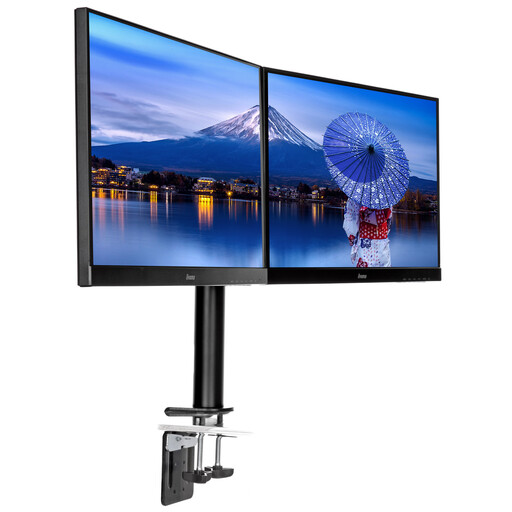
iiyama Simple and functional dual desktop arm
This dual desktop arm is suited to a setup where you want to mount two screens to your desk.
Check that your desktop is suitable for the clamp.
View at Joybuy
 No image available
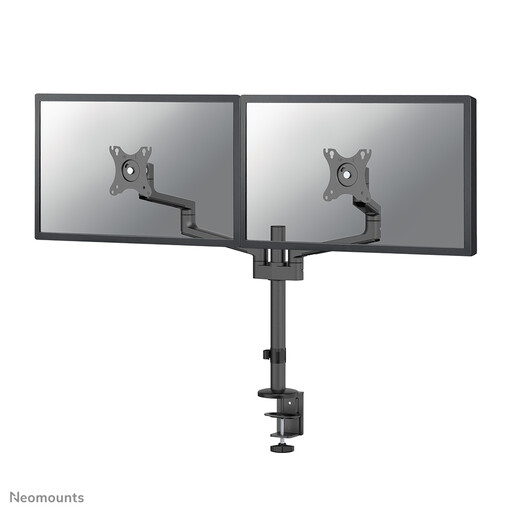
Neomounts DS60-425BL2 monitor arm, 17–27 inch, Space Saving
A dual monitor arm to compare if you want to mount two adjustable screens on a desk.
According to the product information, avoid mounting it on a fragile, loose or uneven desktop.
View at Joybuy
Frequently asked questions
Can I place two screens side by side if one is mainly for speaking notes?
Yes, as long as the screens and arm physically fit. Position the presentation screen directly in front of you and put the notes screen beside it; measure the total width and the space needed behind the desk first.
What should I consider when mounting an arm to my desk?
Follow the instructions for your chosen model and check the desktop thickness, edge, cable tray and clearance for movement. For example, StarTech.com specifies a clamp range of 10–48 mm for the ARMDUALPIVOT; this range doesn’t automatically apply to other models.
What should I do if a gas spring arm rises or drops after installation?
First check that the screen is within the arm’s weight range, then adjust the tension according to the model’s instructions. Adjusting the tension won’t make a screen suitable if it’s outside that range.
What are the rules on returns and guarantees in the Netherlands?
According to ACM ConsuWijzer, online consumer purchases generally come with a statutory 14-day cooling-off period after delivery, subject to exceptions. The Dutch government says there’s no fixed statutory guarantee period; if a product is faulty, contact the seller, as the product must meet reasonable expectations.
Does Dutch law require you to use a dual monitor arm?
The rules on working with display screens don’t specifically require a dual monitor arm. Arboportaal outlines the requirements for a safe workplace where the relevant display-screen rules apply; employers have a duty of care towards their employees.


