Choose two independently adjustable arms if you want to turn or move your invoice screen separately from your main screen. A crossbar may be suitable if both screens usually stay side by side, but it offers less independent positioning. Check the weight and VESA size of both screens, and measure your desk’s mounting point and the space needed for movement.
Who is this relevant for?
Someone with a main screen and an invoice screen
You want your admin work directly in front of you, with invoices positioned separately alongside it. Two independently adjustable arms may suit you, provided both screens are within the limits of the arms you choose.
Someone with two fixed screens
You usually keep the screens side by side and want to adjust their combined position when sitting or standing. A crossbar is an option if positioning each screen independently is less important.
Someone with limited desk space
Your choice depends on having a suitable desk edge or cable-management grommet, as well as enough space behind the desk for the arms to move. Measure your set-up before choosing a mounting method.
What should you consider when choosing?
Two independently adjustable arms
Suitable if: you want your main screen directly in front of you and to turn or move your invoice screen separately.
Bear in mind: the space needed for movement and the weight capacity for each screen.
Dual arm with crossbar
Suitable if: the screens usually stay side by side and you want to change their combined position.
Bear in mind: a crossbar does not offer the same independent positioning as two separately adjustable arms.
| What to consider |
What should you check? |
Who is this important for? |
| Screen positioning |
Check the height, depth and rotation you want for both screens, and make sure there is room to adjust them. |
If I want to keep my main screen directly in front of me and read invoices from a different angle, independent adjustment is important. Around 36% of consumers give screen positioning their top priority. |
| Screen compatibility |
Note the weight of each screen without its stand and its VESA mounting pattern; compare these with the limits of the exact model variant. |
If you want to keep using two existing screens, you’ll want to know in advance whether both are within the weight limit and fit the mount. Around 29% of consumers put compatibility first. |
| Desk mounting |
Measure the desk thickness and check whether a clamp or grommet mount will fit, and whether there is enough room behind the desk for movement. |
If I use a sit-stand desk, I want to know whether the mount will fit my desktop and let the screens move freely. Around 21% of consumers start by checking the mounting and space around the desk. |
| Adjustment and terms |
Consider how often you adjust the screens and compare the adjustment mechanism and terms of the models you’re considering. |
If you regularly change your screen position, you may want to consider ease of adjustment and service terms before choosing a model. Around 14% of consumers consider these the most important factors. |
Common buying mistakes
-
Looking only at the screen’s diagonal measurement
A screen may be within the stated size in inches but still be too heavy or have a different VESA size from the one the arm supports.
For both screens, check the weight without the stand and the VESA pattern against the specifications for the exact model variant.
A screen that isn’t compatible may mean you need a different arm or mounting solution.
-
Assuming a crossbar works like two fully independent arms
A shared crossbar is less suitable if you want to position the invoice screen noticeably differently from the main screen.
Sketch where both screens need to be when you’re sitting and standing. Compare these positions with the adjustment range offered by the model you’re considering.
-
Checking the mounting point only after buying
The desk edge, any grommet hole and the clear space behind the desk all affect whether the arm can move where you want it to.
Measure the desktop and the space around the desk before choosing a model, and check the arm’s mounting instructions.
An unsuitable desk edge or insufficient space may mean you need a different mounting method or arm.
Brands to consider
Neomounts
Neomounts offers the DS70-250BL2, with two adjustable arms and a 180° stop, as well as the separate DS70-750BL2 variant for screens up to 27 inches.
- The manufacturer specifies a maximum of 9 kg per flat screen and 8 kg per curved screen for the DS70-250BL2.
- For the DS70-750BL2, the manufacturer specifies a range of 2–7 kg per screen. So check the full model code and the limit for each screen.
ACT
ACT offers the AC8344, with a gas spring and crossbar for two side-by-side screens, and the AC8302, with pivot points but no gas spring.
- According to ACT, the AC8344 supports up to 9 kg per screen and VESA 75 × 75 or 100 × 100 mm. ACT specifies a maximum of 8 kg per arm for the AC8302.
- The crossbar adjusts both screens together, so it does not offer fully independent positioning for each screen.
Ergotron
The manufacturer describes the LX Dual Side-by-Side, variant 45-245-224, as having two arms and offering both a desk clamp and a grommet mount.
- The mounting options give you a choice to compare with the construction of your desk.
- Before finalising your set-up, check the weight capacity, screen sizes and mounting requirements for the exact variant you’ve chosen.
Fellowes
According to the manual, the Platinum Series Dual Monitor Arm is a dual gas-spring arm for two screens up to 32 inches.
- Fellowes specifies 1.5–8 kg per arm, VESA 75 × 75 or 100 × 100 mm, and a clamp range for desktops measuring 10–85 mm thick.
- The stated limited 3-year manufacturer’s warranty applies to this model; a manufacturer’s warranty and your statutory rights are not the same thing.
Joybuy products
This selection includes stands and arms for two screens on a desk, with different ways to make the most of your available workspace.
 No image available
Floordirekt monitor stand for 2 screens, white, 80–108 cm
A desk riser for two screens, ideal if you want to adjust the width of your set-up.
The width adjusts from 80 to 108 cm; the fixed height is 10.4 cm. The side platforms swivel. MDF.
View at Joybuy
 No image available
DELL Dual Monitor Arm MDA20
A dual monitor arm for positioning two screens on a desk.
The product description mentions height and depth adjustment, as well as cable management for up to ten cables. Dell Quick Release is designed for compatible UltraSharp and P Series monitors; check compatibility. The desktop must be sturdy enough to support the clamp.
View at Joybuy
 No image available
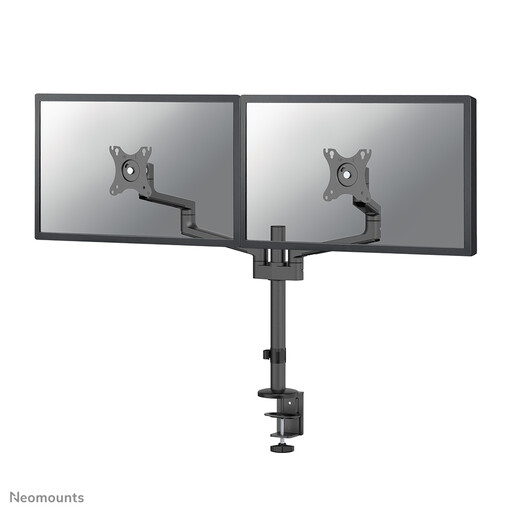
Neomounts DS60-425BL2 Space Saving, 17–27 inches
A desk mount for two screens, with swivel, tilt and rotation adjustment.
The product description specifies VESA 75 × 75 or 100 × 100 mm and a short upper arm section for positioning close to a wall or panel. Mounting it on a fragile, loose or uneven desktop is not recommended.
View at Joybuy
 No image available
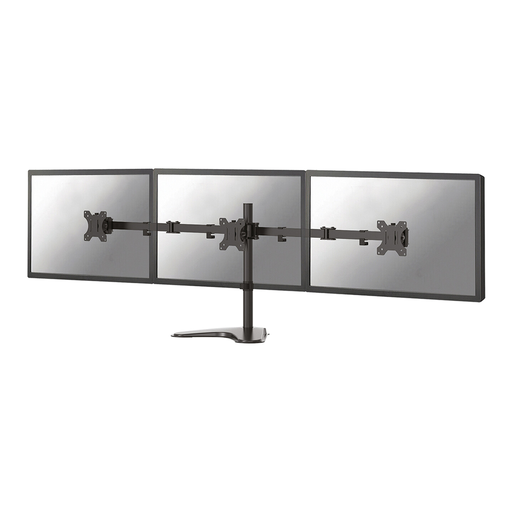
Neomounts FPMA-D550DDBLACK, 10–32 inches
A desk arm for anyone who wants to use two screens on one mount and adjust their viewing angle.
The product description specifies manual height adjustment from 0 to 46 cm, depth adjustment from 4 to 40 cm, and VESA 75 × 75 and 100 × 100 mm. The title states a screen size of 10–32 inches.
View at Joybuy
Frequently asked questions
How should you position your screens if you alternate between sitting and standing?
Position the screen you use most directly in front of you. Arboportaal recommends having the top of the screen slightly below eye level and looking slightly downwards. After changing your working position, check that both screens are still easy to read. This is workplace guidance, not a promise that a monitor arm will prevent discomfort.
Will a dual monitor arm fit any sit-stand desk?
No, you can’t tell from the product category alone. Compare the desktop thickness and the options for a clamp or grommet mount with the mounting details for the arm you’ve chosen, and check there’s enough clearance when the desk is raised. According to its manual, the Fellowes Platinum Series Dual has a clamp range for desktops measuring 10–85 mm thick; this range does not automatically apply to other models.
How do you adjust a gas-spring arm to suit your screen?
Follow the instructions for the model you’ve chosen and adjust it to match the actual weight of your screen. A screen outside the specified weight range is not suitable for that arm; the manual for the Fellowes Platinum Series Dual specifies 1.5–8 kg per arm.
In the Netherlands, what is the difference between a manufacturer’s warranty and the statutory guarantee?
When you buy as a consumer in the Netherlands, you’re entitled to a product that conforms to the sales agreement; there is no fixed statutory guarantee period. According to the Dutch government, a manufacturer’s warranty is additional. If there’s a problem, contact the seller about a statutory remedy.
What are the Dutch rules on working with screens?
For employees, employers must set up screen workstations safely and healthily in line with the applicable employment rules, and ensure screen work is regularly alternated with other work or a break. Arboportaal explains these obligations for the relevant employment situation; they do not require you to buy a monitor arm from a specific brand.


