
Student comparing two texts side by side
Wants to read both document versions at the same time and align the screens neatly. A side-by-side setup is a natural starting point; ACT describes this arrangement for the AC8322, among other models.


If you often read two versions of a document at the same time, a side-by-side setup is usually the most practical choice. Then choose between a compact crossbar and individually adjustable arms, depending on your desk and the space available behind it. Check the VESA pattern and weight without the stand for both screens, and measure the clearance you’ll need to move them, as well as whether the desk clamp will fit. A vertical setup can work well if you’re short on width, but it places the documents one above the other rather than side by side.
Wants to read both document versions at the same time and align the screens neatly. A side-by-side setup is a natural starting point; ACT describes this arrangement for the AC8322, among other models.
Needs to consider the space behind the desk, the width of the setup and how it will be mounted. ACT gives a wall clearance of 14 cm for the AC8322; this figure applies to this model only.
May benefit more from individually adjustable arms if screen size, viewing distance or orientation varies. ACT describes the AC8302 as having three pivot points per monitor; check that your screens are within the specifications.
Start with how you want to read: if you compare documents side by side, a side-by-side setup is usually best. Then decide whether your priority is a compact fit, greater freedom of movement or a mounting option that suits your desk.
| What to consider | What should you check? | Who is this important for? |
|---|---|---|
| Aligning two documents | Check that the mount allows a side-by-side setup and that the screens will fit across your desk. | If I regularly read two versions side by side, I want to be able to align both screens at a useful height and position. Around 36% of consumers prioritise comparing documents at the same time. |
| Desk and wall | Measure the space behind and beside the desk, and allow for the movement of the screens and arms. | With a small desk against a wall, it’s not just the footprint that matters to me, but also how much space the arm needs. Around 29% of consumers focus mainly on the desk space available. |
| Screen and desk mounting | For each screen, compare its VESA pattern and weight without the stand with the mount’s limits; also check the mounting method and desk thickness. | If I want to attach both monitors to one mount, I want to know in advance whether it will suit both the screens and my desktop. Around 21% of consumers prioritise this compatibility check. |
| Adjusting the setup | Check the height, depth, tilt and swivel adjustments offered by the model you’re considering, and how much clearance they need. | If I often reposition my screens, I want to be able to adjust the viewing angle and distance for each one. Around 14% of consumers focus mainly on regular adjustments. |
A screen may be within the stated size range but still be incompatible with the mount’s VESA pattern or weight limit. Neomounts gives a range of 2–7 kg per screen for the DS70-700BL2.
Check the VESA pattern, weight without the stand and dimensions of each monitor separately, in the position you intend to use it.
An incompatible fitting or a screen outside the stated range could mean you need a different mount or suitable additional parts.
The clearance required varies by model. ACT gives a wall clearance of 14 cm for the AC8322, while the manufacturer says the Neomounts DS60-600BL2 has a 180° stop. These features are different and don’t apply to every mount.
Measure the space behind your desk and check how much room the screens and arms need to move, as well as the dimensions of the clamp or base.
If an arm can’t move freely enough in the position you’ve chosen, you may need a different setup.
With a vertical mount, the screens sit one above the other. This can free up desk width, but if you’re constantly comparing documents side by side, you’ll need to shift your gaze between different heights more often.
Check the available height and consider whether reading one screen above the other suits your task before choosing this arrangement.
A commercial manufacturer’s warranty is not the same as your statutory rights if a product is faulty. The Dutch Government states that there is no fixed statutory warranty period in the Netherlands.
Check the manufacturer’s warranty terms and, if a product is faulty, contact the retailer about your statutory rights.
The models reviewed offer both a compact crossbar and individually adjustable pivot points.
The models described here differ in their adjustment mechanisms and layouts, including gas springs, manual adjustment and vertically stacked screens.
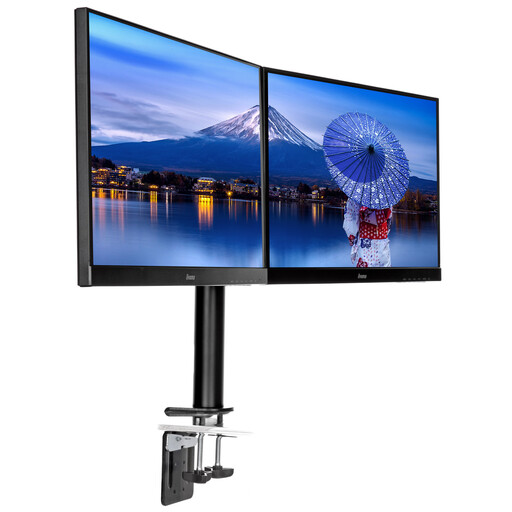
The Vertical Stacking Dual Monitor Arm is one option we reviewed for vertically stacked screens when horizontal space is at a premium.
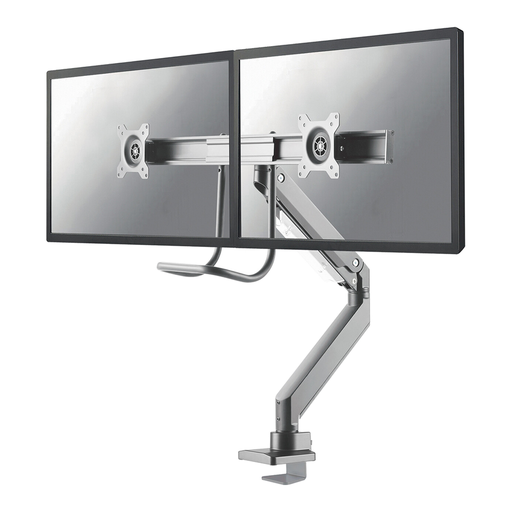
The ARMBARDUO model we reviewed has a freestanding crossbar setup for two screens.
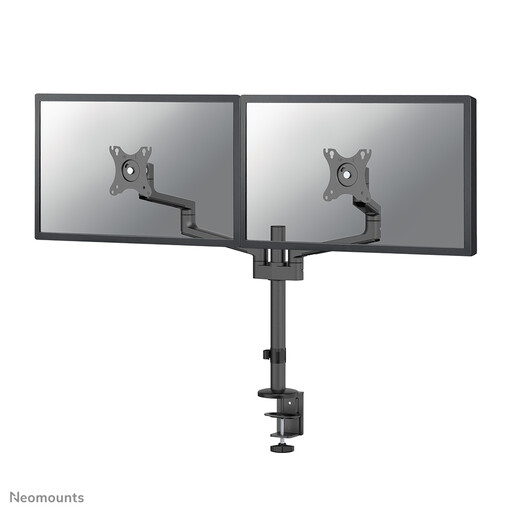
The LX Dual Side-by-Side Arm we reviewed is a side-by-side setup with individually adjustable arms.
These Joybuy products are worth considering if you want to mount two monitors on a desk; they differ in layout, adjustability and the space they take up.
 No image available
An option if you’re looking for an adjustable stand for two monitors.
The product name specifies MDF, an adjustable width of 80–108 cm and a white finish. Make sure you have enough room for it.
 No image available
Suited to anyone who wants to position two screens on a desk and adjust their height and depth.
The product description lists two screens up to 27 inches and cable management clips for up to ten cables. Dell Quick Release is mentioned for compatible Dell UltraSharp and P-series monitors.
 No image available
An option if you want to adjust two screens independently and change their positions regularly.
The product description specifies two screens from 10–32 inches, up to 8 kg per screen and VESA 75 × 75 or 100 × 100 mm. Height and depth are adjustable; the description also mentions a 180° stop.
 No image available
Suited to anyone who wants to position two screens on a desk with a range of adjustment options.
The product description lists two monitors up to 30 inches, up to 10 kg per monitor and VESA 75 × 75 or 100 × 100 mm. Height, tilt, swivel and rotation adjustments are listed; the mount uses a desk clamp.
 No image available
An option if you want to position two screens independently and your desk is close to a wall.
The product description specifies up to 8 kg per screen and VESA 75 × 75 or 100 × 100 mm. The mount offers manual height and depth adjustment, and the description says it has a short upper arm for positioning close to a wall or partition.
For each screen, note the VESA pattern, its weight without the original stand and its dimensions in the position you intend to use it. Compare these details separately with the specifications for the exact model. For example, Neomounts lists VESA 75 × 75 or 100 × 100 mm and 2–7 kg per screen for the DS70-700BL2. Screen size alone isn’t enough to confirm compatibility.
Yes, if the model you choose has a suitable clamp. ACT lists both clamp and through-desk mounting for the AC8322, with a maximum desk thickness of 88 mm. Also check that there’s enough room for the clamp beneath the desk edge.
The Arboportaal (Dutch Working Conditions Portal) recommends positioning the top of a screen slightly below eye level and looking slightly down towards it. Adjust your monitors from your usual seated position, and avoid having to turn your neck repeatedly to read. This is ergonomic guidance, not evidence that a particular mount prevents discomfort.
According to the Dutch Government, when you buy online from a business you generally have 14 days to change your mind; exceptions apply to distance selling. You’re also entitled to a product that is fit for purpose when buying as a consumer, and the retailer must offer a solution if something is wrong. The Dutch Government states that there is no fixed statutory warranty period in the Netherlands.
Don’t assume that employers’ obligations apply just because you study at home. The Arboportaal describes these obligations for employers and says they apply to students within the framework and facilities of their educational institution when the work is similar to professional practice. However, the ergonomic setup tips may still be useful at home.