
Reading a script during video calls
You want to turn or move your script while keeping the call in view. Look for independent adjustment and rotation.


If you regularly want to reposition your script screen during a video call, two independently adjustable arms are a better fit. A crossbar is an option if you usually keep both screens side by side. Check the weight and VESA pattern for each screen, and measure the mounting space and clearance around your desk. A freestanding stand can be useful if a clamp or grommet mount won’t work, but it takes up desk space.
You want to turn or move your script while keeping the call in view. Look for independent adjustment and rotation.
You usually keep your call and script side by side and want a tidy desk setup.
You can’t clamp anything to the edge of your desk or don’t want to drill a grommet hole. If so, factor in the space needed for a freestanding base.
A good fit if: you want to turn your script or position the two screens independently.
Bear in mind: each arm must be within its weight limit, with enough room to move behind and beside your desk.
A good fit if: you usually keep your call and script screens side by side in a straight line.
Bear in mind: you can’t adjust the screens’ heights as independently as you can with two separate arms.
A good fit if: you can’t use a clamp on the edge of your desk and don’t want to drill a grommet hole.
Bear in mind: the base takes up desk space.
| What to consider | What should you check? | Who is this important for? |
|---|---|---|
| Independent positioning | Check the rotation, height and depth adjustments, and measure the clearance behind your desk. | If I want to turn my script without moving the call screen, independent positioning comes first. Around 33% of consumers give this need top priority. |
| Compatibility with both screens | Check the weight and VESA pattern of each screen, then compare both with the stand’s limits. Neomounts lists 1–9 kg per screen for the DS70-250BL2, with a maximum of 8 kg for curved or ultrawide screens. | If I want to mount two existing screens, the fittings need to suit both. Around 27% of consumers prioritise weight and VESA compatibility. |
| Desk space and mounting | Measure the desk thickness, available edge space and clearance to the wall. Also check whether a base will fit on the desktop. ACT lists a clamp and grommet mounting option for the AC8322, with a maximum desk thickness of 88 mm. | If I don’t have a suitable edge or grommet hole, the mounting method needs to work with my desk without taking up unnecessary workspace. Around 20% of consumers give mounting and available space top priority. |
| Adjustments and aftercare | Consider how often you change the screen height, and check the warranty terms from the manufacturer and seller for the specific offer. | If I adjust my screens often, I want to do it without a complicated process and know where to go for aftercare. Around 20% of consumers prioritise ease of adjustment and aftercare. |
A suitable screen size doesn’t, by itself, confirm that each screen’s weight and VESA pattern are within the stand’s limits. The Neomounts DS70-250BL2 also has a lower maximum load for curved or ultrawide screens.
Before buying, check the weight, VESA pattern and conditions for your screen type separately for each screen.
If a screen isn’t compatible, you may need a different stand or a suitable adapter plate.
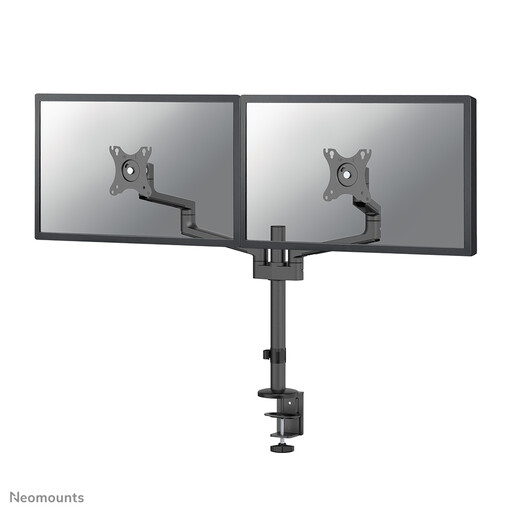
A crossbar adjusts the height of both screens together. This is different from a setup with two independently adjustable arms.
Choose the adjustment mechanism based on how often, and how independently, you move your script and call screens.
The thickness of your desktop, the accessible edge and the desk’s construction all affect whether a clamp will fit. A freestanding base avoids the need for an edge clamp, but takes up desk space.
Measure your desktop and check the mounting method for the model you’ve chosen. Consider a grommet mount or freestanding stand if a clamp won’t fit.
You may need a different mounting method or stand if the clamp isn’t suitable for your desk.
The DS70-250BL2 is an example of a dual stand with two separate arms, suited to anyone who wants to position screens independently.
The AC8322 is a crossbar model for a desk clamp or grommet mount; the AC8332 is a freestanding version.
The Monitorarm, 2 schermen is a crossbar option for screens that usually stay in a straight line.
These product picks are suited to keeping a script alongside a video call: adjustable dual arms and a freestanding stand for two screens.
 No image available
An option for anyone who wants to position two screens with height, depth and rotation adjustments.
The description states that it supports two screens up to 27 inches and includes cable clips for up to ten cables. The arm attaches with a desk clamp, so your desktop needs to be sturdy enough. Check the weight capacity and screen compatibility for your setup.
 No image available
This dual arm is designed for anyone who wants to turn and adjust their script and call screens independently.
The description lists a maximum of 8 kg per screen, VESA 75×75 or 100×100 mm, and rotation, swivel, height and depth adjustments. The short upper arm is designed for positioning close to a wall. Check that your desktop is sturdy and flat enough for the clamp.
 No image available
A freestanding option for anyone who wants to place two screens on their desk without using an edge clamp.
The width adjusts from around 80 to 108 cm, and the side platforms can swivel. The height is fixed at 10.4 cm, so bear this in mind if you want to adjust your screen height.
Not necessarily. Check the weight, VESA pattern and available positioning space for each screen separately. A stated screen size alone doesn’t confirm that both screens will fit.
Two independently adjustable arms are suited to screens you want to move or turn independently. A crossbar is an option if you usually keep both screens side by side. Also check the weight limits and clearance around your desk.
Measure the desktop thickness and check that there’s enough clear space for a clamp or grommet mount. A freestanding stand avoids these fittings, but takes up space on your desktop.
For a standard online consumer purchase, you generally have a statutory cooling-off period of up to 14 days after delivery; ACM ConsuWijzer explains the exceptions. You’re also covered by the statutory guarantee if the product doesn’t meet what you could reasonably expect under normal use. The seller is responsible for this.
No, the rules cited don’t specifically require a dual monitor arm. Arboportaal does set out requirements for display screen workstations, including a height-adjustable screen. The stated workstation requirements apply to employees who work with display screens for more than two hours a day. This doesn’t automatically mean every private user is required to buy one.