
Swimmers with heat-sensitive swimwear
If you want to follow the care label and are short on space, heating isn’t automatically a benefit. For the arena swimsuit reviewed, arena advises drying it away from heat sources.


Start with the care label: if it says to keep the garment away from heat sources, choose a compact, unheated airer. If heat is permitted, compare a folding winged airer with a heated tower in terms of space in use, storage size and ventilation. The stated wattage alone won’t tell you how much a full drying cycle costs. The NVWA states that electrical products placed on the market in the Netherlands must carry CE marking. Check this on the exact electrical model before considering it a suitable purchase.
If you want to follow the care label and are short on space, heating isn’t automatically a benefit. For the arena swimsuit reviewed, arena advises drying it away from heat sources.
Consider both the space needed for an airer when it’s unfolded and the room you’ll need to store it afterwards.
You’ll need a suitable place for wet fabrics, as well as ventilation to remove moist air. Milieu Centraal recommends extra ventilation when drying laundry indoors.
Choose this if: the care label says to avoid heat sources, or you only need to dry a few items without using electricity.
Bear in mind: drying time still depends on the room and ventilation. A hanging airer doesn’t automatically provide a flat surface for drying clothes flat.
Choose this if: the care label and instruction manual allow heat, and you have room to unfold the wings.
Bear in mind: adjustable heat doesn’t prove that a particular setting is safe for every swimsuit. Measure your storage space too, and ventilate the room.
Choose this if: there isn’t enough room for widely extended wings, but you have enough height and storage space.
Bear in mind: a tower takes up vertical space and needs somewhere to be stored after use. Heated bars are still subject to the garment’s care label.
| What to consider | What to look for when buying | Who is this important for? |
|---|---|---|
| Drying swimwear according to its care label | Read the care label first. If it says to avoid heat, choose an unheated place to dry your swimwear. | If I want to avoid a heated airer conflicting with my swimwear’s care label, I’ll choose based on that label. Around 31% of consumers put garment care first. |
| Space for use and storage | Measure the available floor space, height and storage area. Check the folded dimensions if they matter. | If my home has limited storage space, I want to know whether the airer will fit both when unfolded and when stored away. Around 31% of consumers choose mainly based on the space an airer takes up. |
| Removing moisture when drying indoors | Choose a spot where you can ventilate while drying. A cover doesn’t replace ventilation. | If I dry clothes indoors, I need somewhere moist air can be removed. Around 19% of consumers put having a practical, well-ventilated drying space first. |
| Energy use and operating time | Compare the wattage and actual operating time. Assess an electric drying cycle in kWh and use your own electricity tariff. | If I only dry a small amount of swimwear, I want to weigh up whether heating is necessary compared with an airer that uses no electricity. Around 19% of consumers focus mainly on running costs and ease of use. |
For the arena swimsuit reviewed, the advice is to dry it away from heat sources. This guidance doesn’t automatically apply to all swimwear.
Follow the care label on your garment. If it says to avoid heat sources, consider an unheated airer.
A folding winged airer may still take up more room than you have available when it’s in use.
Measure both the space where you’ll use it and the area where you’ll store it. If necessary, check the folded dimensions.
Even with a heated airer, moisture from wet fabrics needs to be able to leave your home.
Plan to use it somewhere you can ventilate while drying. Milieu Centraal recommends extra ventilation when drying laundry indoors.
Costs also depend on how long you use the airer. The stated wattage alone doesn’t determine the cost of a full drying cycle.
Compare energy use in kWh over the actual operating time, and factor in your own electricity tariff.
The examples below refer to specific product ranges and versions. A brand name alone says nothing about availability or suitability for your swimwear.
Its range includes a folding electric winged airer with adjustable heat and a timer.
The Premium range reviewed includes both a heated winged airer and a heated tower.
The folding models reviewed offer different drying lengths.
Unheated hanging airers are an alternative if you want to avoid heat sources.
These products are suited to compact drying: an unheated wall-mounted airer for natural drying and a folding heated winged airer. Only use the heated model for swimwear if the care label and instruction manual allow heat. For the electric model, check the CE marking on the exact version too before considering it a suitable purchase.
 No image available
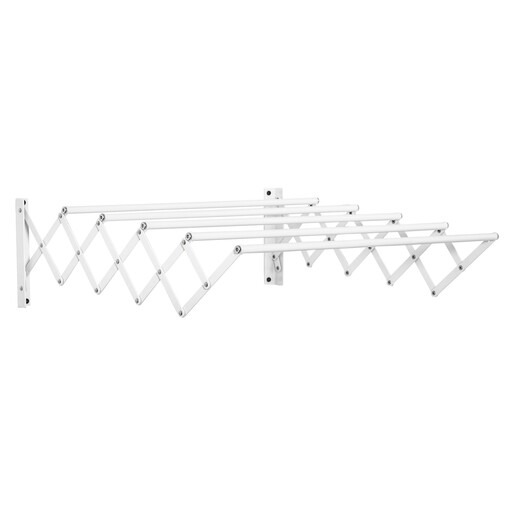
A wall-mounted airer for anyone who wants to keep floor space clear and let laundry dry naturally.
Dimensions: 63,5 × 60 × 20 cm. The airer has five rails and a stated total load capacity of 10 kg. Wall mounting is required, so check that the chosen location is suitable.
 No image available
A heated winged airer for anyone looking for a folding design, provided the garment’s care label allows heat.
Stated power: 230 W. Dimensions in use: 144 × 53 × 91 cm. The description lists adjustable heat from 45–55 °C and a minimum distance of 31 cm from walls. Use indoors on a stable, level surface with adequate ventilation. Check the care label and instruction manual.
No. Follow the swimsuit’s care label. For the arena swimsuit reviewed, the brand advises drying it away from heat sources. This isn’t a general temperature limit for all swimwear.
Follow the care label and make sure moist air can be removed. Milieu Centraal recommends extra ventilation when drying laundry indoors.
Multiply the actual energy use in kWh by your own rate per kWh. As an example, 230 W for one hour at that power uses 0,23 kWh. A full drying cycle may take longer, and the actual power may vary.
The NVWA states that electrical products placed on the market in the Netherlands must carry CE marking. Check the marking on the exact version; a CE logo isn’t proof of an independent product assessment.
In the Netherlands, you have statutory rights against the seller if a product is faulty. ACM ConsuWijzer states that statutory guarantee applies alongside any seller’s guarantee; a manufacturer’s guarantee doesn’t replace those rights.