
Owner of delicate summer dresses
Wants to check the care label and recommended drying method for each dress. For some delicate garments, such as cashmere, Clevercare advises drying flat and away from heat sources.


A heated airer is suitable for summer dresses only if the care label and fabric allow the chosen heat and drying method. Otherwise, an unheated airer is the gentler option. Choose a winged airer if you have enough floor space widthways, or a tower if space is limited, but check that long dresses can hang freely on either type. Ventilation is important when drying clothes indoors, and electricity use depends on both the wattage and how long the airer is used.
Wants to check the care label and recommended drying method for each dress. For some delicate garments, such as cashmere, Clevercare advises drying flat and away from heat sources.
Wants to dry several dresses indoors during a seasonal wardrobe change, and needs to decide whether a wider winged airer or a taller, tower-style airer will fit the available space better.
Is wondering whether extra heat is needed for this occasional drying task. Milieu Centraal suggests line drying or drying in an unheated room as alternatives to using a tumble dryer.
Suitable if: you want to hang or spread out several dresses side by side and have enough floor space widthways.
Bear in mind: heated bars use electricity. Check the care label and the airer's dimensions when fully opened.
Suitable if: floor space is limited and you have enough clear hanging height for your dresses.
Bear in mind: a long dress may reach the lower tiers. Check the usable hanging height of the model.
Suitable if: you don't need extra heat, or the care instructions call for gentle drying.
Bear in mind: the airer doesn't add heat, and indoor drying still requires ventilation.
| What to consider | What to check before buying | Who should consider this? |
|---|---|---|
| Suitability for the dress | Read the care label and check the temperature settings and drying method for the exact model. | I don't want to take a chance with heat or hanging a delicate dress; around 33% of consumers put clothing care first. |
| Indoor drying time | Check whether dresses can hang with space between them, and how you can ventilate the room. | If outdoor drying isn't an option, I want to know whether extra heat indoors is right for my drying needs; around 27% of consumers prioritise indoor drying time. |
| Space and hanging height | Measure the space for the airer when fully open and check the clearance between tiers. | When space is limited, I want to know whether long dresses will hang freely and where the airer will fit; around 20% of consumers focus mainly on space. |
| Electricity use | Compare the stated wattage with the length of time you'll use the airer and any timer on the model. | For a task that mainly comes around during a seasonal wardrobe change, I want to know whether electric heating is needed; around 20% of consumers prioritise electricity use. |
A tumble-dryer symbol doesn't confirm that direct contact with heated bars is suitable. For some delicate garments, Clevercare advises drying flat and keeping them away from heat sources.
Read the full care label before choosing an airer and drying method.
Plenty of drying space doesn't automatically mean a long dress can hang freely or that there will be enough space between dresses.
Compare the length of your dresses with the usable hanging height, and measure the space where the airer will stand when fully open.
Wattage alone doesn't tell you how much electricity a full drying session will use; how long the airer is on matters too.
Compare the wattage and running time for a similar drying task. Consider an unheated airer if extra warmth isn't needed.
Laundry releases moisture into the air as it dries indoors. Milieu Centraal recommends extra ventilation when drying laundry inside.
Consider the ventilation options in the room and follow the positioning instructions for the model you choose.
Silvergear's Dutch product information describes both a heated winged airer with a cover and a heated drying tower with a cover.
DreamGoods' product information describes a foldable electric airer with temperature settings and a timer.
The Dutch product range includes unheated freestanding, hanging and tower-style airers.
A useful unheated alternative if you're looking for hanger hooks or adjustable tiers.
For summer dresses you want to dry indoors: an unheated clothes airer and a heated winged airer.
 No image available
Ideal if you want to dry dresses on hangers and put the airer away after use.
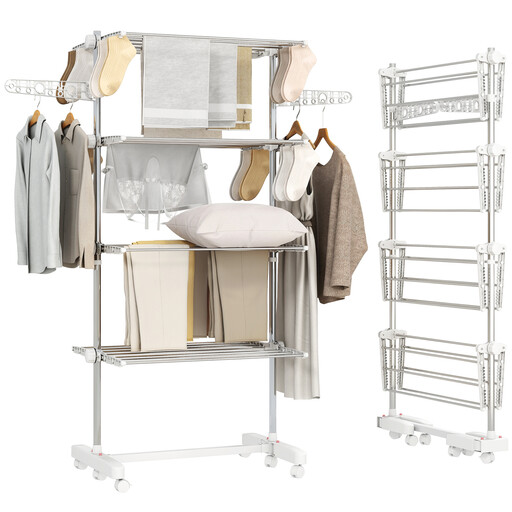
Four shelves and side arms with slots for clothes hangers; the airer has wheels and folds away.
Dimensions when open: 172 × 142 × 55 cm. Distribute laundry evenly, load each shelf with no more than 6 kg and lock the brakes during use.
 No image available
Ideal if you want to dry several dresses side by side and only use extra heat when the care instructions allow it.
The central drying area has two fold-out side wings. Stated wattage: 230 W; dimensions: 144 × 53 × 91 cm.
The recommended maximum load is 10 kg. Use the airer on a stable, level surface in a ventilated area, at least 31 cm away from walls. Check whether contact with heated bars is suitable for each dress.
That symbol doesn't confirm that heated bars are suitable. Follow the instructions for natural drying too, and consider the dress's fabric and construction. If you're unsure about heat contact, choose a suitable unheated drying method.
Consider both the available space and the clearance needed for the dress. A winged airer needs width; with a tower, check that the dress can hang freely between the tiers.
To calculate electricity use in kWh, multiply the wattage in kW by the number of hours it's used. Compare airers for a similar drying task, and remember that an unheated airer uses no electricity for heating.
Leave space between garments and make sure damp air can escape; Milieu Centraal recommends extra ventilation when drying laundry indoors. Also follow the instructions for the exact model when positioning, connecting and cleaning it.