
Space-conscious napkin dryer
You dry fabric table napkins indoors and want to save floor and storage space. So compare a hanging rack with a folding freestanding rack.


First, measure the space where the rack will stand while in use, as well as where you’ll store it. Also check whether you can hang the napkins separately. A heated rack could work if you want to reuse your napkins regularly, but it uses electricity and its stated wattage doesn’t guarantee a drying time. For a small load when you’re not in a hurry, a hanging rack or an unheated freestanding rack may be enough. If you dry clothes indoors, ventilate the room, as advised by Milieu Centraal.
You dry fabric table napkins indoors and want to save floor and storage space. So compare a hanging rack with a folding freestanding rack.
You want to reuse your napkins regularly and are considering a heated rack, provided it fits when unfolded. A set drying time for napkins isn’t guaranteed.
You’re weighing the electricity used by a heated rack against unheated drying, and want to be able to ventilate the room while drying clothes indoors.
First, choose a rack that fits where you plan to use it and can be stored away. Then decide whether heating is worth the electricity use and ventilation requirements for your napkin washing.
A good fit if: you dry napkins regularly, have space for the rack when unfolded and value the heating function.
Bear in mind: electricity use, and the difference between the storage dimensions and the space needed while the rack is in use.
A good fit if: floor space is limited and you have a suitable door, wall or other place to hang it.
Bear in mind: where you can attach it, the available drying length and air circulation; drying may take longer.
A good fit if: you’d rather not hang anything up and the unfolded dimensions suit the space you’ve chosen.
Bear in mind: even a folding freestanding rack takes up floor space while in use.
| What to consider | What should you check? | Who is this important for? |
|---|---|---|
| Space in use and in storage | Measure the available space and compare the unfolded and folded dimensions. For a hanging rack, check that the place you’ll attach it to is suitable. | If I have limited floor and storage space, I want to make sure the rack will fit both when I use it and when I put it away. Space is the top priority for around 36% of consumers. |
| Drying time and spacing | Check the layout of the rails and whether you can hang the napkins separately. Don’t assume a drying time is guaranteed. | If I want to reuse napkins regularly, I’ll look for enough room to spread them out. Drying time is the top priority for around 29% of consumers. |
| Electricity use | Compare the wattage, your expected hours of use and your electricity tariff. To estimate the cost: power in kW × hours = kWh; then multiply the kWh by your price per kWh. | If I’m considering a heated rack, I want to factor in electricity use when deciding whether to use it regularly. This is the top priority for around 21% of consumers. |
| Moisture and electrical use | Check whether you can ventilate the room. Follow the instructions and, for a mains-powered model, check the relevant product markings. | If I dry clothes indoors, I want to be able to ventilate the room and use an electric rack according to the instructions. Moisture and safe use are the top priority for around 14% of consumers. |
A rack with extendable wings can take up much more space while drying than it does in storage.
Measure the space where you’ll use it and compare both the storage dimensions and the unfolded dimensions of the exact model.
The stated power tells you how much electricity the rack uses, not how quickly your table napkins will dry in your conditions.
Don’t treat drying-time claims as a guarantee unless they’re backed by a relevant test. Use the wattage and your expected hours of use only to estimate electricity consumption.
Drying clothes indoors adds moisture to your home, even when you use a heated rack.
Choose a spot where you can ventilate the room. Milieu Centraal recommends extra ventilation when you dry washing indoors.
Offers heated, folding racks with wings, including Drywing and Warmmat. Compare the full model name and specification.
Offers unheated hanging racks as an alternative if you want to keep floor space clear.
The Classic 100 Easy is a folding, unheated freestanding rack for anyone who doesn’t want to use a door rack.
The British Lakeland range features heated racks in various sizes, including a Mini version.
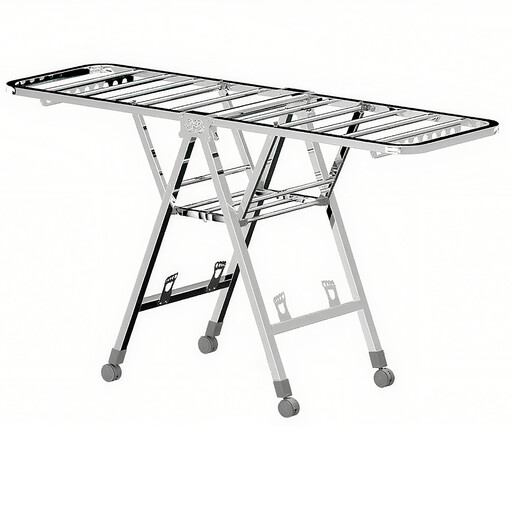
A folding freestanding rack for drying clothes indoors when you want to put it away after use.
 No image available
This folding floor airer could work if you want to put it away after use; it still needs floor space while clothes are drying.
Material according to the product name: stainless steel.
No, not necessarily. If you’re not in a hurry and have a suitable place to hang it, an unheated hanging rack may be enough. Before choosing a heated version, compare how much space it needs while in use.
Ventilate the room when you dry washing indoors. Milieu Centraal recommends extra ventilation; heating the rack doesn’t replace ventilation.
Use the wattage for the exact model and your expected hours of use: divide the power in watts by 1,000, then multiply by the hours to get kWh. Multiply this by your own price per kWh to estimate the cost. The wattage won’t tell you how long your napkins will take to dry.
If you buy in the Netherlands, you’re entitled to a product that’s fit for purpose. If there’s a fault, the seller must provide a solution. The Dutch Government states that there’s no fixed statutory two-year guarantee period for every product.
Electrical equipment covered by the Low Voltage Directive and placed on the EU market must carry a CE marking. Check whether the requirements apply and look for the marking on the exact model. CE is a declaration by the manufacturer, not an independent performance test.