
For a small laundry corner
You want to dry towels without the rack blocking your way when it’s in use. Compare the full dimensions of a freestanding model when set up with the space needed for a wall-mounted one.


Choose a rack based on the space it takes up when in use and how much laundry you want to hang at once. A compact heated rack is ideal for a few towels, while a larger rack gives you room for extra laundry. An unheated rack avoids active electric heating, but good ventilation remains important when drying clothes indoors.
You want to dry towels without the rack blocking your way when it’s in use. Compare the full dimensions of a freestanding model when set up with the space needed for a wall-mounted one.
You regularly want to hang several items of laundry at once, and need to weigh the extra drying space against the room a larger, unfolded rack takes up.
You want to dry clothes indoors, so you’ll need to check that the area has enough ventilation and is suitable for an electric rack. Milieu Centraal and Brandweer Nederland offer practical advice on ventilation and using appliances safely.
First, measure the available space with the rack set up and decide how many towels you want to hang at once. Then check the ventilation and the instructions for your chosen location.
A good fit if: you mainly dry a few towels and have limited floor or wall space.
Consider: it offers less versatile drying space than a wider clothes airer. If you plan to mount it on a wall, check that you have a suitable place to install it.
A good fit if: you want to spread out other laundry as well as towels, and can free up floor space while it’s in use.
Consider: a larger set-up can dominate a small laundry corner. Silvergear lists 20 heated bars and 230 W for one heated clothes airer; the wattage alone doesn’t tell you how long your laundry will take to dry.
A good fit if: you have a suitable permanent spot on the wall and also need bathroom heating.
Consider: the Eurom Sani-Towel 500 White is a wall-mounted bathroom heater, not a portable drying rack. Its stated 500 W output doesn’t prove a specific drying time.
A good fit if: your towels have enough time to dry without extra electric heating.
Consider: the rack doesn’t produce heat. Milieu Centraal recommends drying laundry outdoors or in an unheated room where possible.
| What to consider | What to check before buying | Who is this important for? |
|---|---|---|
| Space when in use | Measure the available floor or wall space and compare it with the rack’s full dimensions when set up, not just its folded size. DOMO lists dimensions of 52,5 × 36,5 × 90 cm for the DO7117DR model. | If my laundry corner is narrow, I want to know whether I can still get past when the towels are hanging up. Around 33% of consumers prioritise the space available when the rack is in use. |
| Hanging space | Decide how many towels you need to dry at once, and check whether the arrangement of the bars will also work for any other laundry. | If I want to dry towels alongside clothes, I look for enough room to spread them out and an easy-to-reach set-up. Around 25% of consumers give practical hanging space top priority. |
| Ventilation and placement | Check that you can ventilate the area and follow the instructions for your chosen location. DOMO lists IPX4 for the DO7117DR model and Eurom lists IP24 for the Sani-Towel 500 White; these model specifications don’t mean that every bathroom location is suitable. | If my drying area is damp, I want to be able to remove moisture and position the electric rack in line with the instructions. Around 25% of consumers put moisture control or a suitable place to set up the rack at the top of their list. |
| Power consumption | Compare the stated wattage with how long you’ll need to use the rack and your own electricity tariff. A lower wattage doesn’t prove that a towel will dry faster or that a drying session will use less electricity. | If I don’t think active heating is essential, I also want to consider an unheated rack. Around 17% of consumers prioritise power consumption over active heating. |
A rack can take up much more space when in use than it does in storage. The stated dimensions when set up also vary from model to model.
Measure the space with the rack fully set up, and allow for the room taken up by the hanging towels.
If the rack blocks your way, you may need to find another place to dry your laundry.
The wattage figures for different models aren’t comparable measurements of drying sessions; how long the rack is switched on also matters.
Calculate energy use in kWh by multiplying the power in kW by the number of hours of use. Then compare the result with your own electricity tariff.
Drying laundry indoors adds moisture to the air. Heating doesn’t replace the ventilation needed to refresh the air in your home.
Choose a place where you can ventilate, even when using a heated rack. Milieu Centraal recommends removing stale air and letting fresh air in.
DOMO describes the DO7117DR as a compact electric towel rack that can be used freestanding or wall-mounted.
Silvergear offers heated clothes airers with bars, as well as a heated drying tower. A wider airer may be more suitable for towels and other laundry together.
The Sani-Towel 500 White is a fixed electric bathroom and towel radiator for anyone who also needs bathroom heating.
Brabantia describes unheated drying racks in a range of designs, including hanging, folding and wall-mounted models.
This selection includes a heated wall-mounted towel rack, a wider heated clothes airer, and unheated wall-mounted and freestanding drying racks.
 No image available
A good fit if you want to dry towels on a heated wall-mounted rack without using floor space for a freestanding airer. You’ll need a suitable wall space.
The description lists a digital temperature display, touch controls and a top shelf. Dimensions according to the product description: 58,5 × 55 cm.
 No image available
A good fit if you want to spread out other laundry as well as towels, and can free up enough floor space while the airer is in use.
Power: 230 W. Open dimensions: 144 × 53 × 91 cm. According to the description, use indoors on a stable, level surface, with ventilation and at least 31 cm of clearance from walls.
 No image available
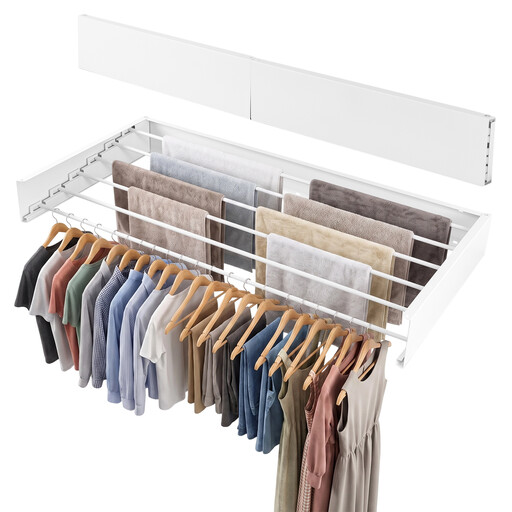
A good fit if you want to hang towels without taking up floor space with a freestanding rack. It doesn’t produce heat and needs a suitable wall space.
The description lists six drying bars. Dimensions: 100 × 50 cm when extended and 3 cm when folded.
 No image available
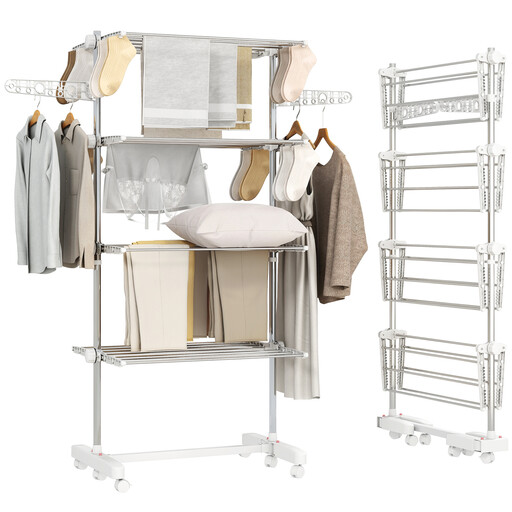
A good fit if you want to dry laundry on several levels and move the rack around. It doesn’t provide active heat.
The description lists six wheels, two of which can be locked, and a maximum load capacity of 30 kg. Open dimensions: 172 × 142 × 55 cm.
No. Check the manual for the exact model and the location where you plan to use it. DOMO lists IPX4 for the DO7117DR and Eurom lists IP24 for the Sani-Towel 500 White; these model specifications don’t confirm that every bathroom location or electrical connection is suitable.
Yes. Drying laundry adds moisture to your home, and heating doesn’t replace ventilation. Milieu Centraal recommends removing stale air and letting fresh air in.
Multiply the power in kilowatts by the number of hours the rack is switched on to calculate consumption in kWh. Multiply that figure by your own rate per kWh for an estimated cost. This doesn’t tell you how long the towels will take to dry.
Contact the seller. According to the Dutch government, statutory guarantees in the Netherlands have no fixed legal term; any manufacturer’s warranty is separate.