
Leggings wearer with limited floor space
You want to open the airer without blocking the laundry nook or walkway, then fold it away neatly when you’re finished.


A heated airer is worth considering if it fits when fully opened, your care label allows heat and you can ventilate the laundry nook. If you want to avoid exposing your leggings to heat, or a standard airer gets them dry in time, a compact, unheated airer is likely to be a better fit. Manufacturer claims do not prove that leggings dry faster on a heated airer.
You want to open the airer without blocking the laundry nook or walkway, then fold it away neatly when you’re finished.
You prioritise protecting the fabric and check the care label before exposing your leggings to heat.
You want to dry clothes indoors and take ventilation, drying time and potential electricity use into account.
| Consideration | What to check | Who should pay particular attention? |
|---|---|---|
| Space when open and storage | Measure the airer, walkway and storage space. Adler lists the AD 7821 as measuring 148 × 52.5 × 90 cm when open and 113 × 52.5 × 8 cm when folded. | If my laundry nook is narrow, I want to open the airer fully without blocking the walkway, then store it away neatly. Around 28% of consumers prioritise space and storage needs. |
| Heat and protecting your leggings | Check the care label on your leggings and find out which parts of the airer heat up. A general manufacturer claim does not prove that heat exposure is suitable for your garment. | If I want to avoid exposing my sports leggings to heat, I give the care label more weight than a general claim about delicate fabrics. Around 22% of consumers prioritise protecting the fabric. |
| Drying time | Hang your leggings according to the care label, and only compare drying-time claims when the drying method and fabric are the same. | If I want my leggings to be dry in time for their next wear, I want to know what the drying method means for my laundry. Around 22% of consumers prioritise drying time. |
| Moisture in the laundry nook | Check whether you can ventilate the space. Milieu Centraal points out that poor ventilation can contribute to damp problems and mould. | If I dry clothes indoors and want to limit moisture in my home, I consider ventilation as well as the airer. Around 17% of consumers prioritise the indoor climate. |
| Electricity use | Adler lists the AD 7821 at 220 W: one hour at that power works out to 0.22 kWh. Compare the power rating and expected running time with your own electricity tariff. | If I use the airer regularly, I want to know how much electricity the heating uses. Around 11% of consumers prioritise ongoing electricity use. |
An airer can take up much more room in use than it does when stored away. Adler lists the AD 7821 as 148 cm wide when open.
Before choosing a model, mark out its full footprint and the space you need to walk around it.
Whether heat is suitable depends on the specific garment. A general manufacturer claim cannot tell you what the care label on your leggings allows.
Follow the care label. Choose an unheated drying spot if you want to avoid heat exposure.
A heated airer will not remove moisture from wet laundry and send it outside. Milieu Centraal highlights the importance of ventilation to remove moist air.
Assess the ventilation in your laundry nook, whichever type of airer you choose.
Specifications, electrical connections and conditions can vary from model to model.
Before buying, check the exact model and the relevant product documentation for electrical equipment.
Adler’s AD 7821 is a foldable airer with heated bars. Bear in mind how much space it takes up when fully open.
The range includes heated drying towers, including a Mini model, as an alternative to a horizontal airer with wings.
Brabantia offers unheated drying towers and hanging airers for anyone looking to save floor space or avoid a heated airer.
The unheated Storm 34 is an option if you can make use of vertical space and sometimes want to open the airer only partway.
Leifheit describes unheated airers for anyone looking for drying space and hanging options without heat.
This selection includes compact, unheated airers and one foldable heated airer. Measure the available space and, for the heated model, check that the care label, ventilation and product documentation suit the way you plan to use it.
 No image available
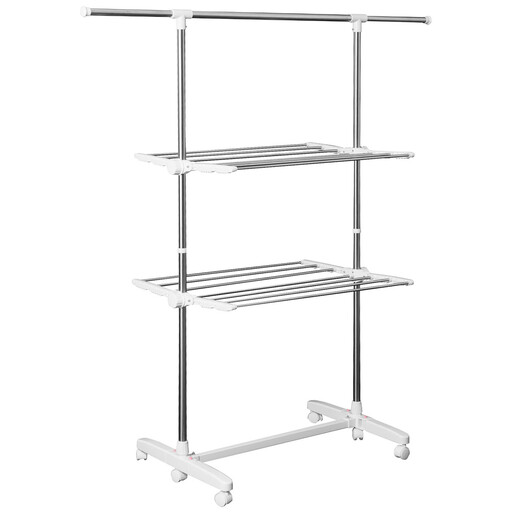
Ideal if you want several drying levels and an extra rail, and would like to fold the airer away after use.
Listed dimensions when open: 136.5 × 55 × 154 cm. The description mentions two adjustable shelves, an extendable rail and six wheels, two of which have brakes.
 No image available
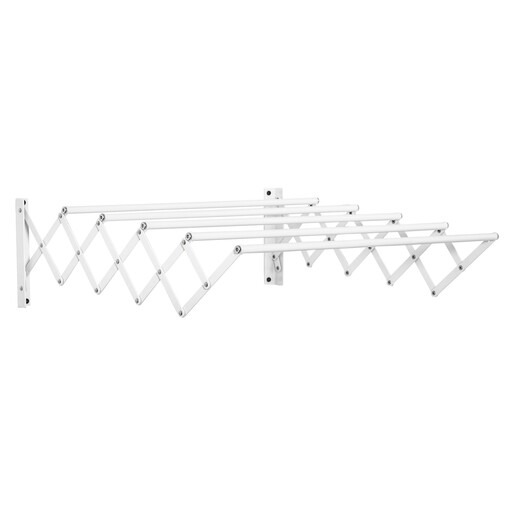
Ideal if you want to save floor space and can attach the airer to a wall.
Listed dimensions: 63.5 × 60 × 20 cm. The description mentions five rails and pre-drilled mounting holes; the airer must be wall-mounted to use it.
 No image available
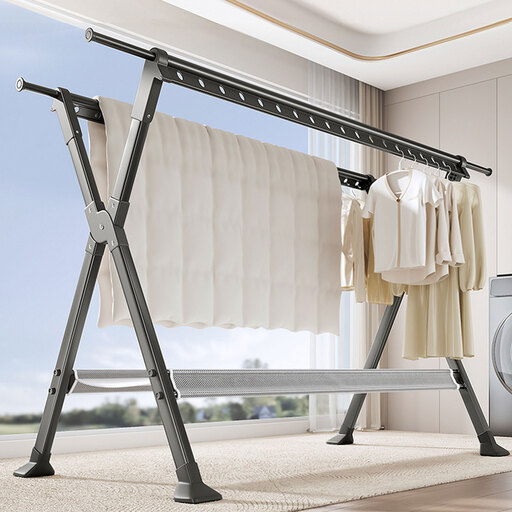
Ideal if you want to adjust the length of the airer to suit the space available.
The listed length adjusts from 136 to 230 cm. The airer folds flat for storage.
 No image available
Ideal if you’re looking for heated bars, provided the care label allows heat exposure and there is enough space and ventilation.
Listed power: 230 W. The description gives a recommended maximum load of 10 kg. Use the airer in line with the stated requirements for ventilation, clearance from walls and an earthed socket. Check the documentation for the exact electrical model before buying.
No. Don’t assume they’re suitable based on a general claim about delicate fabrics. Check the care label on the specific pair of leggings, and choose an unheated drying spot if you’re unsure about heat exposure. Nike recommends air-drying synthetic sportswear or using the lowest heat setting when tumble-drying it; this does not mean every heated airer is suitable.
Yes. Make sure moist air can escape. Milieu Centraal points out that poor ventilation can contribute to damp problems and mould; heating does not replace ventilation.
At a constant power of 220 W, one hour of use works out to 0.22 kWh. Multiply the number of kWh by your own tariff; this does not tell you how much electricity a full drying cycle will actually use.
For a standard online consumer purchase, you generally have 14 days from delivery to change your mind, although exceptions may apply. ACM ConsuWijzer also explains that you are entitled to a product that, under normal use, meets what you could reasonably expect. A manufacturer’s guarantee does not replace your statutory guarantee.
No. CE marking is not an independent quality mark. Business.gov.nl explains that manufacturers must comply with the applicable requirements and draw up an EU declaration of conformity. Check the documentation for the exact model before buying.