Who would benefit from a food dehydrator for herbs?

Growers of soft leafy herbs

If you harvest basil or mint, you’ll want to dry the moist leaves quickly and with controlled heat. The National Center for Home Food Preservation gives recommended temperatures for herbs, while Penn State Extension notes that soft, moist herbs can go mouldy if they don’t dry quickly enough.

Growers with limited kitchen space

If you only dry garden herbs occasionally, you’ll need an appliance that fits both when you’re using it and when you’re putting it away. Check the external dimensions of the exact model; manufacturers provide these for models including the Tristar PD-9064 and Fritel DH 2025.

Growers with variable harvests

If you sometimes pick more herbs at once, you’ll want to spread the leaves out without overlapping them across the drying trays. The National Center for Home Food Preservation recommends arranging herbs in a single layer, so check the usable tray area rather than just the number of tiers.

What should you look for when drying small batches of garden herbs?

Compact electric food dehydrator

Choose this when: You regularly dry small batches or moist leafy herbs and want to control the temperature and air circulation.

The trade-off: You’ll need to clean and store the appliance. Also check whether fine leaves will stay on the trays.

Air-drying herbs

Choose this when: You occasionally have a small bunch of hardy herbs and have a dry place with good air circulation.

The trade-off: Soft, moist leafy herbs such as basil and mint can go mouldy if they dry too slowly, warns Penn State Extension.

An oven you already own

Choose this when: Only if your oven can be set to a sufficiently low temperature and you can monitor the temperature and progress.

The trade-off: Air circulation and drying time depend on the oven and the conditions. Don’t assume it will use less electricity without comparing like-for-like measurements.

What to consider What to look for Who it matters to
Low drying temperature and air circulation Check the temperature range and air circulation of the exact model. The National Center for Home Food Preservation generally recommends preheating a food dehydrator to 95–115 °F (around 35–46 °C) for herbs. If you harvest basil or mint, you’ll want to adjust the heat and ensure good air circulation; around 36% of consumers put control over the drying process first.
Worktop and storage space Measure the space available and compare the external dimensions of the whole appliance. Don’t estimate how much room you’ll need based only on the number of trays. If your kitchen is short on space, you’ll also need somewhere to put the appliance after use; around 29% of consumers say limited worktop and storage space is their main concern.
Tray layout Compare the usable area and mesh size, and check whether a herb mat is included if you need one. Arrange herbs in a single layer. If your harvest varies, you’ll want to spread the leaves out without overlapping them; around 21% of consumers prioritise a tray layout that suits their harvest.
Cleaning and energy consumption Check the cleaning instructions for each part. Compare energy use in kWh for similar drying cycles; wattage alone doesn’t tell you how much energy a cycle uses. If you dry small batches, you’ll want to factor in cleaning and energy use per cycle; around 14% of consumers say these running costs are their main concern.

Common mistakes when drying herbs

  • Assuming the timer proves the herbs are dry

    Drying times vary. The National Center for Home Food Preservation recommends checking the herbs as they dry: the leaves should crumble and the stems should snap.

    Check the herbs themselves before storing them, even if the programme has finished.

  • Comparing only the number of drying trays

    Herbs should be arranged in a single layer while drying. The number of trays alone won’t tell you whether your harvest will fit or whether small leaves will stay on the tray.

    Compare the usable area and mesh size, and check whether a herb mat is included with the exact model, if applicable.

  • Assuming lower wattage means lower running costs

    Wattage indicates power, not the measured energy consumption of a full drying cycle. How long the appliance runs matters too.

    Compare energy use in kWh for similar batches and drying results, then calculate the cost using your own electricity tariff.

Brands to compare

Tristar

Tristar describes the PD-9064 as a compact model with five tiers and an adjustable temperature range of 35–70 °C.

  • The manufacturer lists external dimensions of 25 × 23,4 × 27,1 cm and a power rating of 220 W.
  • According to the manufacturer, the parts are not dishwasher-safe. The wattage doesn’t tell you how much energy a full drying cycle uses.

WMF

WMF describes the KITCHENminis® 415250011 as a space-saving food dehydrator with five tiers, a timer and a temperature range of 30–70 °C.

  • The adjustable minimum temperature and timer are manufacturer specifications you can take into account when drying small batches.
  • A timer alone doesn’t tell you whether the herbs are dry enough; check them yourself.

Fritel

Fritel says the DH 2025 has five plastic trays, two stacking configurations and a temperature range of 35–70 °C.

  • The manufacturer lists tray dimensions of 24,5 × 31,5 cm and dishwasher-safe parts.
  • Compare the overall dimensions and tray area with the space you have and the amount of herbs you dry.

Princess

Princess describes the 112380 as a stackable model with six tiers.

  • The manufacturer lists a temperature range of 40–70 °C, 350 W and external dimensions of 33 × 33 × 20 cm.
  • Compare the minimum temperature and the worktop space required with the herbs you dry and the space available.

Rommelsbacher

Rommelsbacher says the DA 350 is designed for users who want multiple trays and adjustable tray height.

  • The manufacturer lists five trays, a total drying area of 0,42 m² and a temperature range of 35–75 °C.
  • This tray area may be more than you need if you only dry small batches; compare it with your usual harvest.

Food dehydrators for small batches of herbs

These Joybuy products are food dehydrators. Compare the listed temperature settings, tray layout and cleaning instructions with your harvest. For the exact model, also check that the food-contact parts and electrical appliance meet the applicable requirements.

YASHE GGJ-261B food dehydrator with five adjustable trays

YASHE GGJ-261B food dehydrator

Suitable if you want to set the temperature for herbs and spread small batches across several trays.

Temperature range: 35–70 °C. Timer: up to 72 hours. Five height-adjustable trays. Power: 240 W.

View at Joybuy

YASHE GGJ-261A food dehydrator with five adjustable trays

YASHE GGJ-261A food dehydrator

Suitable if you’re looking for an adjustable temperature setting and several trays for small batches of herbs.

Temperature range: 35–70 °C. Five adjustable trays. Power: 240 W. The product name states that it is BPA-free.

View at Joybuy
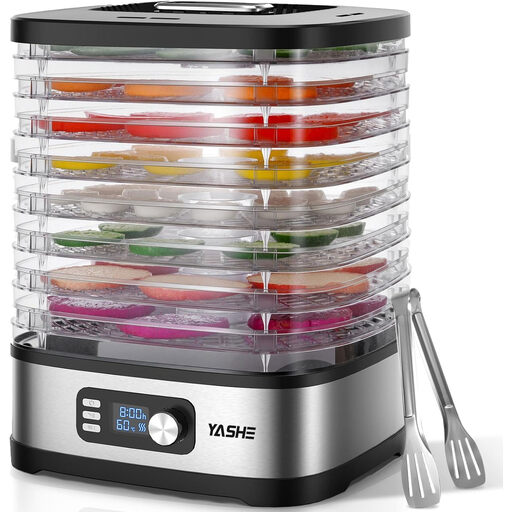
YASHE GGJ-261C food dehydrator with eight trays and mesh screens

YASHE GGJ-261C food dehydrator

Suitable if you want to spread herbs across several trays and place small leaves on mesh screens.

Eight trays and eight mesh screens. The product name also mentions a fruit roll tray and stainless steel tongs.

View at Joybuy

YASHE FD-1019 food dehydrator with five stainless steel trays

YASHE FD-1019 food dehydrator

Suitable if you want to dry herbs at an adjustable temperature and vary the drying time.

Five stainless steel trays. The product name mentions an adjustable timer and temperature, 360° airflow and a power rating of 400 W.

View at Joybuy

Food dehydrator with five tiers and an adjustable temperature range of 35–70 °C

Food dehydrator with five tiers

Suitable if you want to spread small batches across several tiers and are looking for an adjustable temperature range.

Temperature range: 35–70 °C. Five tiers. Power: 350 W. The product name states that it is BPA-free.

View at Joybuy

Frequently asked questions

Which herbs are better suited to air-drying?

You can air-dry a small bunch of hardy herbs such as thyme, sage or rosemary if you have a dry place with good air circulation. Soft, moist leafy herbs such as basil and mint can go mouldy if they dry too slowly, so choose a method that lets you keep a close eye on the drying process.

What temperature should you use to dry herbs in a food dehydrator?

The National Center for Home Food Preservation generally recommends preheating a food dehydrator to 95–115 °F, around 35–46 °C, for herbs. Also follow the instructions for the exact model and check the herbs as they dry.

How can you tell when herbs are dry enough?

Check the herbs themselves: according to the National Center for Home Food Preservation, the leaves crumble and the stems snap when they’re dry. A timer or automatic shut-off doesn’t replace this check.

How do you compare the energy use of food dehydrators?

Compare energy use in kWh for drying cycles with similar batch sizes and results, then use your own electricity tariff to calculate the cost. The stated wattage alone doesn’t tell you how much energy a full drying cycle uses.

What should you check about food-contact parts and electrical safety?

For the exact model, check that the parts which come into contact with herbs comply with the applicable EU rules for food-contact materials, including Regulation (EC) No 1935/2004. Electrical appliances are subject to the applicable EU product safety and CE requirements; according to Your Europe, the manufacturer is responsible for compliance. A CE mark alone is not independent proof of testing.
