
Herb grower with limited worktop space
You want to dry a small harvest indoors without the appliance taking over your small kitchen. So compare its external dimensions and the space it needs with the number of trays.


In a small kitchen, a food dehydrator is most useful if you want to dry delicate, moist herbs under controlled conditions and have enough space for the appliance and its ventilation. So start by comparing the external dimensions and lowest temperature setting. For small bunches of robust herbs, air-drying in a dry, well-ventilated place may be enough. More trays give you extra drying space, but that alone doesn’t tell you whether the appliance will fit on your worktop.
You want to dry a small harvest indoors without the appliance taking over your small kitchen. So compare its external dimensions and the space it needs with the number of trays.
If you harvest basil, mint or lemon balm, for example, look for temperature control and good air circulation. Penn State Extension points out that delicate leaves with a higher moisture content can go mouldy if they don’t dry quickly.
You want to spread leaves over several layers and weigh up the extra drying space against the worktop and storage space required. Rommelsbacher lists seven trays and 0.5 m² of drying area for the DA 650.
Suitable if: the available width and depth are your priority and you’re drying small to medium-sized batches.
Trade-off: remember to allow space for ventilation, too. More layers don’t automatically mean all the herbs will dry at the same rate.
Suitable if: you want to process larger harvests in one go and have enough worktop depth.
Trade-off: compare the drying area with the external dimensions; according to Rommelsbacher, the DA 650 is 43 cm deep.
Suitable if: you have small bunches of robust herbs and a dry place with good air circulation.
Trade-off: delicate, moist leaves can go mouldy if they dry too slowly. Keep the drying area away from sources of moisture such as the sink and dishwasher.
| Consideration | What to look for | Who is this important for? |
|---|---|---|
| Fit on the worktop | Check the width, depth and height, as well as the position of the cord and the ventilation instructions for the specific model. | I want to keep my worktop clear and know where the appliance will fit first; around 36% of consumers make fit their top priority when choosing. |
| Drying delicate herbs | Check the lowest temperature setting and whether the leaves fit in a single layer on the trays. | I dry herbs such as basil or mint and want to control the heat and air circulation; around 29% of consumers prioritise controlled drying for delicate herbs. |
| Space for your harvest | Compare the number of trays and usable drying area with the external dimensions of the same model. | I want to spread out a larger harvest in one batch without judging by the number of layers alone; around 21% of consumers prioritise having enough space for their harvest. |
| Cleaning and use | Read the care instructions. To estimate electricity costs, compare actual energy use, running time and your electricity tariff. | I don’t want unnecessary cleaning after every harvest and want to estimate the cost of use; around 14% of consumers prioritise maintenance and running costs. |
A larger drying area may come with an appliance that takes up a lot of worktop depth. Rommelsbacher lists seven trays and a depth of 43 cm for the DA 650; according to the manufacturer, the Tristar PD-4910 is 24 cm deep.
Measure the available width and depth, and follow the ventilation instructions before choosing a spot.
Penn State Extension distinguishes between robust herbs and delicate leaves with a higher moisture content, which can go mouldy if they dry slowly.
Choose the method to suit the herb. Spread herbs in a single layer in the dehydrator and check that they are completely dry.
Mouldy leaves can make some of your harvest unusable.
According to ACM ConsuWijzer, your statutory rights against the seller apply alongside any manufacturer’s guarantee.
Keep your proof of purchase and assess any fault against what you could reasonably expect from the product when used normally.
The PD-4910 is a stackable model worth comparing if worktop depth is limited.
The 112380 is an option to compare if you want six stackable layers and can make room for it on a 33 × 33 cm area of your worktop.
The DA 650 is worth considering when drying area and seven trays matter more than a shallow appliance.
The KITCHENminis 415250011 Snack to-go dehydrator is worth comparing if you also want to use the included storage boxes and timer.
This selection includes stackable models with adjustable temperature and the Rommelsbacher DA 650, with seven trays and a stated drying area.
 No image available
A model worth comparing if you want to spread herbs over several layers and adjust the temperature.
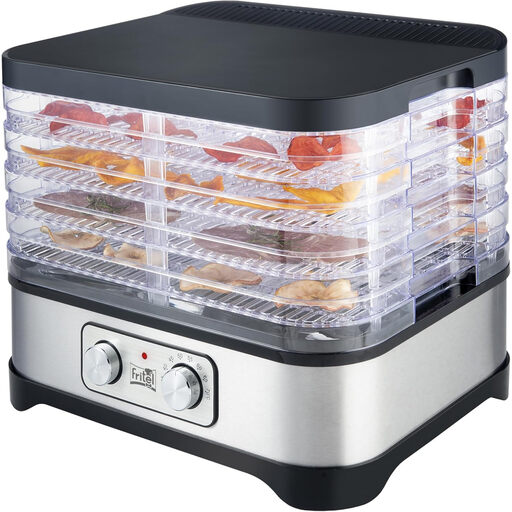
Five trays measuring 24.5 × 31.5 cm; stated external dimensions: 371 × 307 × 258 mm. The adjustable temperature range is 35–70 °C and the stated power is 250 W. Keep the ventilation openings clear; the casing and interior get hot during use.
 No image available
Worth comparing if you want to spread larger quantities of herbs across one batch and have enough worktop depth.
Rommelsbacher lists seven trays, 0.5 m² of drying area and an adjustable temperature range of 35–75 °C. The stated external dimensions are 29 × 43 × 27.5 cm; its depth of 43 cm is an important consideration in a small kitchen.
 No image available
An option worth comparing if you want to spread herbs over several layers and use a timer.
The product specifications list five stackable trays, an adjustable temperature range of 35–70 °C and a 24-hour timer. The instructions advise against drying exceptionally moist or oily foods.
According to the National Center for Home Food Preservation, leaves are dry when they crumble, and stems when they snap as you bend them. Let the herbs cool completely, then store them in an airtight container in a cool, dry, dark place. Discard any mouldy contents.
For an electric model, follow the manufacturer’s set-up and ventilation instructions. Penn State Extension advises keeping herbs away from sources of moisture such as the sink and dishwasher when air-drying and storing them.
Don’t compare the stated wattage alone: to work out the cost per drying cycle, you also need the actual running time, energy use in kWh and your electricity tariff. For example, manufacturers list 220 W for the Tristar PD-4910 and 350 W for the Princess 112380. These are power specifications, not measured costs per harvest.
According to ACM ConsuWijzer, ordinary online purchases generally come with a statutory cooling-off period of up to 14 days after delivery, although exceptions depend on the product and circumstances. The product must also do what you could reasonably expect when using it normally; your statutory rights apply alongside any manufacturer’s guarantee.
CE marking is mandatory for electrical equipment within the applicable range of 50–1000 V AC. The Netherlands Food and Consumer Product Safety Authority explains that the manufacturer uses it to declare that the product meets the relevant requirements; a CE logo alone is not proof of independent testing. Check the product information for the exact model and the requirements for materials that come into contact with food.