
People moving with little time to dry laundry
If you want your flannels dry before packing, weigh up the benefit of extra warmth against the time available, and check that the cloths are actually dry.


For just a few flannels, a heated airer may not be necessary. If you have enough time and can hang them with space between, a folding, unheated airer may do the job. Choose a heated model only if you want to use extra warmth and its design, placement and instructions suit your needs. None of the specifications listed guarantee how quickly your flannels will dry.
If you want your flannels dry before packing, weigh up the benefit of extra warmth against the time available, and check that the cloths are actually dry.
If you have little floor or storage space, check whether the airer will fit while in use and can be stored compactly afterwards. A heated or unheated model could work.
When drying laundry indoors, choose a spot where the air can circulate, whether or not the airer has heated rails. Milieu Centraal lists drying laundry as a source of moisture in indoor air.
Start by considering when your flannels need to be dry and where you can set up the airer. Then decide whether extra electric heat is worthwhile for such a small load.
| What to consider | What to look for when buying | Who is this important for? |
|---|---|---|
| Dry in time | Check how many flannels can hang separately and how much time you have. A heated rail does not guarantee a set drying time. | If I want to pack the flannels before leaving, I look for enough hanging space and time to check they are dry. Drying time is the main consideration for around 33% of consumers. |
| Space and storage | Compare the dimensions when open and folded, and allow room to move around it. | If my room or moving route is cramped, I want to know whether the airer will fit when open and can be put away after use. For around 27% of consumers, a well-fitting airer that can be stored away is a priority. |
| Damp and ventilation | Choose a spot where the air can circulate and, for an electric model, follow the placement instructions. | If I dry laundry indoors, I want to be able to ventilate the area so that damp air does not linger. Around 20% of consumers prefer a well-ventilated drying spot. |
| Electricity and simplicity | Compare the stated power and expected running time with your need for extra warmth; an unheated airer does not use electricity itself. | If I would rather not use an extra electrical appliance for a few flannels, a simple airer may suit my preferences better. Around 20% of consumers prioritise simplicity. |
A stated power rating or heated rails do not tell you how quickly your flannels will dry in your particular conditions.
Spread the flannels out and check they are completely dry before packing them.
An airer that folds flat takes up more floor space when in use. An electric model must also be positioned in line with its instructions.
Measure the space with the airer fully open and check the manual for the exact model.
Drying laundry indoors adds moisture to the air. Heating does not replace the need to let damp air out.
Whether you use a heated or unheated airer, choose a spot where the air can circulate.
Adler describes the AD 7821 as a folding electric clothes airer with 18 heating elements and a stated power rating of 220 W.
The InnovaGoods Warmmat is described as a folding electric clothes airer with side wings, a timer, temperature control, 20 rails and a power rating of 230 W.
The Leifheit Pegasus Slim 15 m is a folding, unheated clothes airer. The manufacturer lists a width of 55 cm and holders for small items.
The Brabantia HangOn 15-metre clothes airer has adjustable wings and folds away for storage.
This product selection includes folding indoor clothes airers, including one electrically heated model. Compare the space required, storage options and whether you need extra warmth.
 No image available
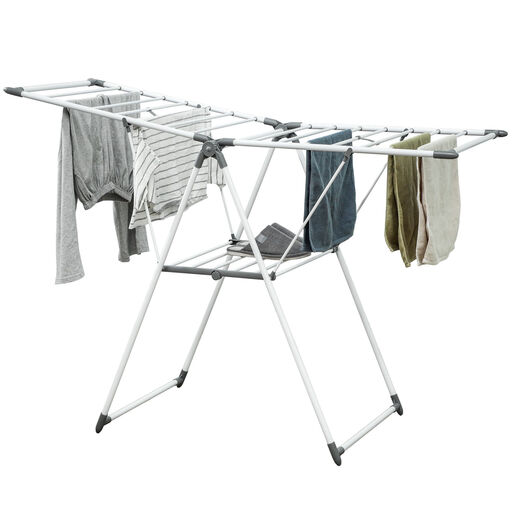
An option for spreading flannels across separate drying rails, then folding the airer away for compact storage.
Dimensions: 156,5 × 61,5 × 97 cm; 8 cm thick when folded. Two adjustable levels; maximum load 15 kg. Distribute the load evenly, do not exceed the limit and keep the airer away from heat sources.
 No image available
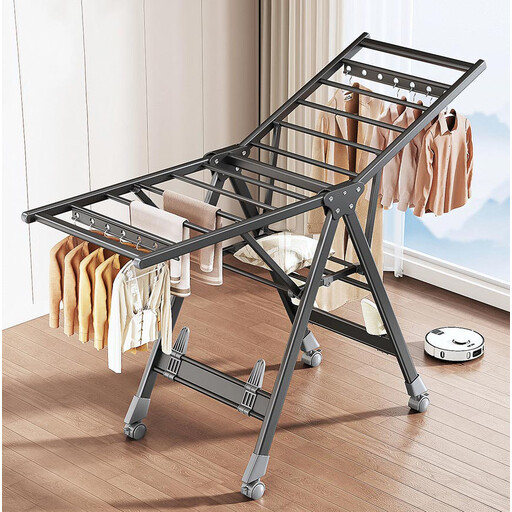
The adjustable wings let you adapt the hanging space to laundry of different lengths.
The wings adjust from 108 to 160 cm. The airer has lockable wheels and folds without the need for tools.
 No image available
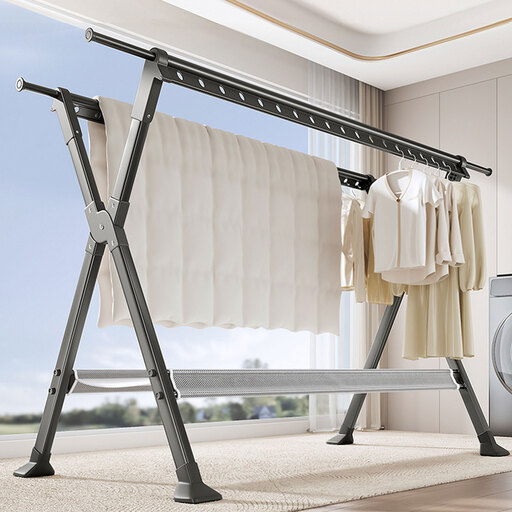
The lower drying mesh provides a separate space for small or delicate items, such as flannels.
The airer has 42 openings, which the product description says help keep laundry in place, and it folds flat for storage.
 No image available
An option if you want extra warmth from the drying rails; the stated features do not guarantee a drying time for flannels.
Stated power: 230 W. Dimensions: 144 × 53 × 91 cm. Use indoors on a stable, level surface, with ventilation and at least 31 cm clearance from walls. Before buying, check the details and instructions for the exact electric model; use an earthed socket, unplug it after use and supervise children.
 No image available
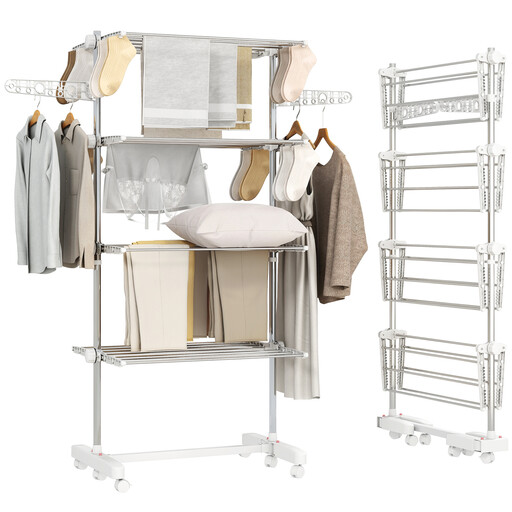
The shelves and side wings provide several places to hang and dry laundry. If your room is small, bear in mind how much space the airer takes up when open.
Four main shelves and two side wings. Open dimensions: 172 × 142 × 55 cm; folded: 80 × 13 cm. The product description recommends a maximum of 6 kg per shelf and advises locking the brakes during use.
Let fresh air in and damp air out. Milieu Centraal lists drying laundry as a source of moisture in indoor air; extra warmth does not replace ventilation.
Follow the manual for the exact model and allow enough space and ventilation. For the Joybuy model described here, this includes using a stable, level surface and leaving at least 31 cm between the airer and walls; that clearance does not automatically apply to other models. The Brandweer advises giving electrical appliances room to release heat.
Multiply the stated power in kilowatts by the number of hours it is switched on and your rate per kilowatt-hour. For Adler's stated 220 W, that is 0,22 kW × hours of use × your rate. This calculation is based on the rated power, not the measured electricity used for a drying cycle.
CE marking is required for electrical products covered by the relevant EU rules. The Netherlands Food and Consumer Product Safety Authority states that the low-voltage rules apply, among other things, to electrical equipment with a rated AC voltage of 50 to 1.000 V. Check the details for the exact model; a CE marking alone says nothing about drying time.
If you use a product normally in the Netherlands, you are entitled to a product that does what you could reasonably expect it to do. According to ACM ConsuWijzer, the seller is responsible for providing an appropriate free solution if a product is faulty; a manufacturer's guarantee does not replace your statutory rights.