
Someone with limited drying space
You share your floor space and want to be able to fold the airer away after use. Check its dimensions when fully open before considering heated features.


A standard airer is fine for individual cushion covers if you can spread them out on it and ventilate the room well. A heated airer may suit you if you dry clothes indoors more often, the care instructions allow heat and you have enough space. Heating is no substitute for ventilation. If you’re considering an electric model, check its instructions and model-specific conformity documents before making your choice.
You share your floor space and want to be able to fold the airer away after use. Check its dimensions when fully open before considering heated features.
You want to spread out your covers without overlooking the fabric’s care instructions. GINETEX explains that care symbols apply to the most delicate part of a textile item.
You’re looking for a practical spot for regular loads of washing, while also considering ventilation in a shared home. Milieu Centraal recommends extra ventilation when you dry washing indoors.
First measure the space where you’ll hang the covers. Then check that the fabric and ventilation are suited to your chosen drying method.
| Consideration | What to look for when buying | Who is this most relevant to? |
|---|---|---|
| Space and storage | Measure the available space and access routes; compare the dimensions when fully open and the storage space required. | If I need room to move around in a shared home, I want to know how much space the airer takes up and where I can put it after use. Around 31% of consumers put space first. |
| Suitability for the cover | Read the care label and check that the cover fits on the airer without folding. | I want to hang the cover so it fits without ignoring its care instructions. Around 25% of consumers put fabric care first. |
| Moisture and electrical use | Check whether you can ventilate the room and follow the instructions for the cord and connection. | If I dry clothes indoors, I want to be able to clear the moist air and use an electric airer as instructed. Around 25% of consumers put moisture and safe use first. |
| Electricity use | Compare the rated power and expected usage time; you’ll also need your electricity tariff to work out the cost. | I want to weigh up whether heating is worth the extra electricity for my drying needs. Around 19% of consumers focus mainly on running costs. |
The stated power ratings of different types of airer don’t tell you on their own how quickly a cushion cover will dry. The fabric, residual moisture and ventilation all play a part too.
First check that the cover can hang properly. Then compare the rated power and the usage time you expect.
A heated airer uses electricity. Consumption depends in part on its power rating and how long it’s switched on.
Heating doesn’t remove the moisture released during drying. Milieu Centraal recommends extra ventilation when you hang washing indoors.
Choose a spot where you can ventilate, and agree with your housemates on how to use shared ventilation.
A seller’s claim alone doesn’t prove that the documentation for a specific model is complete. Electrical appliances must meet the applicable EU requirements. Where required, the manufacturer must apply the CE marking and draw up an EU Declaration of Conformity, as explained by the Dutch government’s Ondernemersplein.
Before choosing an electric model, check the exact model, its marking and instructions, and the relevant Declaration of Conformity.
Heated, folding winged airers among the listings reviewed from Aosom Netherlands.
According to DOMO, the compact heated airer DO7117DR can be freestanding or wall-mounted.
Non-heated, folding airers for anyone considering storage space and floor space.
Non-heated HangOn airers for anyone looking for extra hanging space, including a version with a drying shelf.
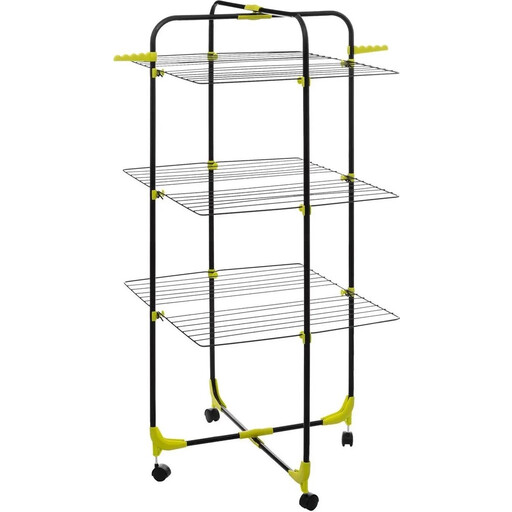
This product is a good fit if you’re looking for a standard folding airer and don’t need heating.
 No image available
An option if you want plenty of drying space and the ability to put the airer away after use, without a heating function.
The product description lists a drying length of 30 m across three overlapping drying surfaces, a folding design and wheels. Self-assembly is required.
You can’t tell from the symbol prohibiting tumble drying alone. Check all the cover’s care instructions and the airer’s user manual. The tumble-drying symbol relates to tumble drying and doesn’t automatically mean the fabric can be exposed to heat.
Yes. You still need to remove the moisture released when drying clothes indoors, even with a heated airer. Milieu Centraal recommends extra ventilation when you dry washing indoors.
It depends on how long you use the airer and your electricity tariff. For continuous use at the rated power, calculate energy consumption in kWh by multiplying the power in kW by the number of hours. Multiply this by your own tariff to work out the cost. Thermostat control and switching the airer off can change actual consumption.
Electrical appliances placed on the Dutch market must meet the applicable EU product requirements, including the CE marking and an EU Declaration of Conformity where required; the Dutch government’s Ondernemersplein explains these requirements. For ordinary online consumer purchases, you generally have a 14-day cooling-off period after delivery, according to ACM ConsuWijzer. Your statutory guarantee depends on what you could reasonably expect from the product; it isn’t simply a fixed two-year period.