
Host preparing lots of slices
Wants to prepare enough citrus for drinks or garnishes before the gathering, and is mainly concerned with how many slices can fit on the trays at once without overlapping.


For a small, one-off batch, you could start by considering your oven or air fryer. For larger batches or more regular use, a food dehydrator with multiple trays and adjustable temperature settings makes it easier to plan the drying process. Compare the usable tray area with your own arrangement of slices, as the number of tiers alone won’t tell you how many slices will fit. Don’t rely on a set drying time or shelf life: check the results and let the slices cool completely before packing them away.
Wants to prepare enough citrus for drinks or garnishes before the gathering, and is mainly concerned with how many slices can fit on the trays at once without overlapping.
Wants to schedule the drying process in good time and store the slices carefully; drying time and any remaining moisture matter more than a set promise of shelf life.
Doesn’t want to buy another appliance unnecessarily for a one-off occasion, and is comparing a food dehydrator with the oven or air fryer they already have at home.
A good fit if: you want to use multiple tiers but have limited worktop space.
Bear in mind: compare the tray dimensions and spacing with the size of your slices; the number of tiers doesn’t guarantee a particular capacity.
A good fit if: you want to process a larger batch in one planned session and have plenty of worktop space. According to HENDI, the HENDI Profi Line 229026 has ten trays measuring 395 × 380 mm.
Bear in mind: the stated cabinet dimensions are 430 × 550 × 416 mm, so measure the available space first.
A good fit if: you’re making a small, one-off batch and want to try an appliance you already own first. Voedingscentrum describes a general method for drying fruit in an oven or air fryer.
Bear in mind: that recipe isn’t specifically for citrus. University of Minnesota Extension describes oven drying as generally slower and more energy-intensive than using a food dehydrator.
| Consideration | What to look for when buying | Who is this most relevant to? |
|---|---|---|
| Drying area | Compare the tray dimensions and number of trays with the diameter and desired quantity of slices. | If I want to lay out lots of slices at once for the party, I’ll compare the usable tray area with my own arrangement. Around 36% of consumers say having enough drying space for the gathering is their top priority. |
| Planning and control | Check the adjustable temperature range and timer; inspect the slices before storing them. | When I have a date for the party, I want to be able to plan the drying process without assuming that a set time guarantees the result. Around 29% of consumers put planning and control first. |
| Storing slices until the party | Allow time for the slices to cool completely, and check them for moisture or mould while they’re stored. | If I prepare the citrus in advance, I want to let it cool and store it properly before serving. Around 21% of consumers say storage is their main consideration. |
| Purchase and kitchen space | Decide whether you’ll use the appliance regularly and measure the space where it will go. | For a one-off occasion, I’ll first see whether my oven or air fryer will do the job rather than automatically buying another appliance. Around 14% of consumers say keeping purchases to a minimum is their top priority. |
The diameter of the slices and the space between them determine how many will fit on the trays without overlapping. If they’re packed too closely, you may need to run extra drying cycles.
Before buying, sketch out the number of slices you want to dry and compare your layout with the tray dimensions.
Drying times can vary. Any moisture left behind or absorbed again can encourage spoilage.
Check the slices after drying, let them cool completely, and look for moisture or mould while they’re stored.
Without knowing the actual running time or taking a measurement, the stated power rating won’t tell you how much energy a drying cycle uses.
Only compare energy use using measurements for similar quantities and conditions.
The DH 2025 is a stackable dehydrator with five trays, designed for preparing a smaller batch.
The Profi Line 229026 is a larger cabinet dehydrator with ten trays, suited to a planned batch.
The 112380 is a stackable dehydrator with six tiers.
The PD-4910 is a stackable dehydrator with five tiers and a timer function.
The DA 650 is a model with seven trays and electronically adjustable time and temperature settings.
This selection features food dehydrators with five trays or tiers. Compare their dimensions and layout with your slices, and check the relevant conformity information for your chosen model before buying, including the CE marking where applicable.
 Image unavailable
An option if you want to use multiple trays and set the drying process to suit your needs.
Five height-adjustable trays; temperature control from 35 to 70 °C; 72-hour timer; 240 W; BPA-free.
 Image unavailable
Suited to anyone looking for multiple trays and an adjustable temperature setting for drying fruit.
Five adjustable trays; temperature control from 35 to 70 °C; 240 W; BPA-free.
 Image unavailable
An option if you want to dry fruit on multiple trays and adjustable timer and temperature settings are important to you.
Five stainless steel trays; adjustable timer and temperature; BPA-free.
 Image unavailable
A possible fit if you want to dry fruit on multiple tiers and are looking for an adjustable temperature range.
Five tiers; temperature control from 35–70 °C; 350 W; BPA-free.
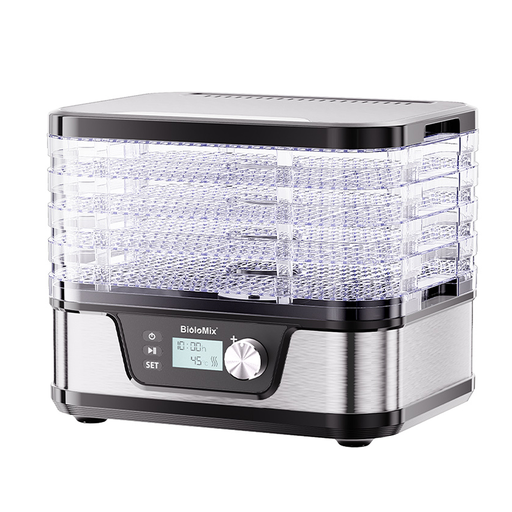 Image unavailable
An option if you want to set a planned drying cycle using multiple trays.
Five trays; 24-hour timer; adjustable temperature range of 35 to 75 °C; 10 L capacity.
Wash citrus if you’re going to use the peel, then cut it into even slices. Excalibur recommends slices of 1/8–1/4 inch for its own citrus recipe; this is recipe guidance, not a required thickness for every appliance. Voedingscentrum notes that washing doesn’t remove all pesticide residues.
Yes, as long as you check the drying results and how the slices are stored. Let dried fruit cool completely before packing it away; the National Center for Home Food Preservation recommends conditioning fruit for longer-term storage to distribute any remaining moisture. Discard mouldy fruit, and don’t assume a manufacturer’s claim guarantees a set shelf life.
Compare energy use using measured kWh per drying cycle for similar quantities and drying results; the stated wattage alone doesn’t measure the energy used per batch. In the Netherlands, statutory legal guarantee is different from a limited manufacturer’s warranty. ACM ConsuWijzer explains that a product should last as long as you can reasonably expect it to under normal use; if there’s a fault, contact the seller.
Check the product information and the applicable CE marking for the specific model. The Netherlands Food and Consumer Product Safety Authority outlines the rules for electrical products; CE marking isn’t an independent performance test.