A portable heated airer is a good fit if you have several bath towels to dry and want to put the airer away afterwards. An electric towel radiator is better suited to a permanent hanging spot in a bathroom, provided the installation is permitted by the instructions for that specific model. Whichever you choose, leave enough space between towels and ensure good ventilation: Milieu Centraal recommends extra ventilation when drying laundry indoors.
Which drying solution is right for you?
A family with a pile of freshly washed towels
After the school week, a family may want to hang several towels out to dry at once, so it’s worth weighing up the usable hanging space against the available floor space. Which? also highlights drying space and the floor area required as factors to consider.
A household with a damp-prone drying area
When drying laundry indoors, it’s important to keep ventilation in mind. Milieu Centraal stresses the need for extra ventilation when laundry is dried inside; heating does not remove the moist air.
Someone with limited storage space
You might weigh up a folding airer against a fixed towel radiator. Bear in mind that wall mounting depends on having a suitable location and following the instructions for the exact model.
What should you look for when choosing?
Portable heated airer
A good fit if: you want to hang several towels separately after washing and have space to set up the airer.
Bear in mind: the airer takes up floor space while in use; folding it away only helps once the drying is finished.
Electric towel radiator
A good fit if: you mainly want a permanent place to hang towels and the installation location meets the chosen model’s instructions.
Bear in mind: a wall-mounted model won’t necessarily offer the same hanging space as a freestanding airer. The Eurom Sani-Towel 500 White manual limits that specific model to bathroom zone 3.
Unheated airer
A good fit if: your towels don’t need to dry quickly and you have a well-ventilated place to put the airer.
Bear in mind: drying may take longer. Ventilation is still important when drying laundry indoors, even with this option.
Start by choosing based on the hanging space you need and where the airer will go. Then consider ventilation, how long you’ll use it for and the instructions for the exact model.
| What to consider |
What to check before buying |
Who should pay particular attention? |
| Space for several towels |
Compare the size of your towels with the bars you can use separately, and measure the space the airer takes up when fully open. |
If I want to dry several bath towels at once after the school week, I need to be able to hang them with space between them. Around 36% of consumers say hanging space for several towels is their top priority. |
| Moisture and safe positioning |
Check that you can ventilate the room and that the installation and connection location is permitted by the instructions for the exact appliance. |
If you dry laundry indoors somewhere moisture can build up, you’ll want to ventilate the room and position the appliance safely. Around 29% of consumers prioritise moisture control and a suitable location. |
| Space for use and storage |
Measure how much room the airer takes up when fully open. For a wall-mounted model, check that the permanent installation location is suitable. |
If I’m short on space, I want to know whether the airer will fit while drying and whether I can put it away afterwards. Around 21% of consumers make available floor, wall or storage space their main priority when choosing. |
| Electricity use per drying session |
For the same usage scenario, calculate consumption in kWh by multiplying the power in kW by the hours of use. Then multiply this by your own electricity rate. |
If you want to keep electricity use per drying session under control, you’ll need to know both the power rating and the length of use. Around 14% of consumers prioritise running costs. |
Common buying mistakes
-
Assuming the drying length tells you how many bath towels will fit
The stated length of the bars doesn’t tell you how many thick bath towels will fit with enough space between them.
Measure your towels and the space available, then compare the usable hanging space rather than just the total bar length.
A cramped set-up could mean planning for more drying sessions and extra space for use and storage.
-
Thinking a heated airer removes moisture from your home
Laundry dried indoors releases moisture into the air; heating doesn’t remove that moist air by itself.
First, choose a spot where you can ventilate, whether or not the airer is heated. Milieu Centraal recommends extra ventilation when drying laundry indoors.
-
Assuming a towel radiator can go anywhere in the bathroom
The permitted location varies by model. The manual for the Eurom Sani-Towel 500 White specifies bathroom zone 3 for that particular appliance.
Before choosing a location, check the manual for the exact model against your planned installation and connection point.
You may need to change your planned location or have the installation carried out differently.
Brands to consider
Eurom
Electric bathroom heating with towel rails; the Sani-Towel 500 White is a wall-mounted model.
- Eurom lists a rated power of 500 W, an IP24 rating and a timer for the Sani-Towel 500 White.
- The Eurom manual restricts this model to bathroom zone 3 and says to use only the towel rails for hanging towels.
Radson
Electric towel radiators for permanent wall mounting; the Twist E is a wall-mounted model.
- Radson lists a fluid-filled design and a remote control for the Twist E.
- Check the documentation and installation requirements for the exact version before choosing a permanent location.
Dirt Devil
The MEQ-EL8980/002 is described as a towel warmer that can be used freestanding or wall-mounted.
- The product information lists six bars, 100 W, and included feet and wall hooks.
- This version has an IP22 rating; when positioning it, follow the warnings about distance from the bath, shower and washbasin.
Joybuy products for heated indoor drying
These products are designed for heated indoor drying of towels or other textiles. Before buying, check that the exact version has the required CE marking: according to the Netherlands Food and Consumer Product Safety Authority, it is required for electrical products placed on the market in the Netherlands.
 No image available
Heated towel rail with touchscreen and digital temperature display
A heated wall-mounted model for anyone looking for a permanent place to hang towels, with a top shelf.
The product name specifies wall mounting, touchscreen controls and a digital temperature display. Check that your chosen wall and connection location are suitable.
View at Joybuy
 No image available
Folding electric airer with 2 side wings, 230 W
The two side wings and central drying area provide space to hang several items of laundry.
Stated dimensions: 144 × 53 × 91 cm. The product information gives a recommended maximum load of 10 kg.
Use the airer indoors on a stable, level surface with plenty of ventilation, and keep it at least 31 cm away from walls.
View at Joybuy
 No image available
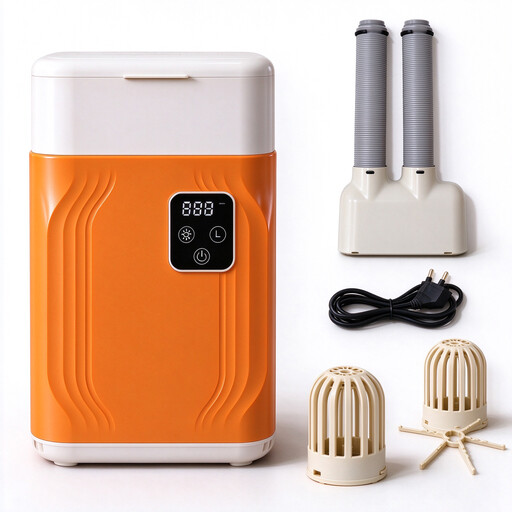
HB-222 portable 3-in-1 textile dryer with heater and timer
A portable heated textile dryer with a timer for anyone looking for an indoor drying solution.
Keep it at least 50 cm away from flammable materials. The air outlet gets very hot during use; do not block the ventilation openings.
View at Joybuy
Frequently asked questions
Does a heated airer also help with damp in the home?
No, a heated airer is no substitute for ventilation. Laundry dried indoors releases moisture into the air; Milieu Centraal recommends extra ventilation when laundry is drying inside.
Can any electric towel dryer be placed next to the shower?
No. Don’t assume where it can go based on the product name or IP code alone. The manual for the Eurom Sani-Towel 500 White restricts that specific model to bathroom zone 3. For any other appliance, check its own instructions and your installation location.
How do you clean an electric towel radiator?
Follow the manual for the exact model. The Eurom manual says to switch off the Sani-Towel, unplug it and let it cool completely before cleaning.
Is CE marking required for an electric airer in the Netherlands?
Yes. The Netherlands Food and Consumer Product Safety Authority states that CE marking is required for electrical products placed on the market in the Netherlands. Check this for the exact version; the marking does not automatically mean that a particular installation location is suitable.
Who can help if the appliance you bought is faulty?
In the Netherlands, the seller is responsible for resolving problems with a product, according to the Dutch government. There is no fixed statutory guarantee period of two years; a manufacturer’s guarantee is in addition to your statutory rights.


