
People with limited floor space
If you dry aprons indoors, compare the space an airer takes up when in use. Tomado gives the footprint of its Den Haag hanging airer when open as 55 × 82 cm.


First, choose based on the floor space available and the clearance needed for your longest apron: a tower makes use of vertical space, while a hanging airer keeps the floor clear if you have a suitable place to hang it. Heating is worth considering if you need that feature; also factor in electricity use and ventilation when drying indoors.
If you dry aprons indoors, compare the space an airer takes up when in use. Tomado gives the footprint of its Den Haag hanging airer when open as 55 × 82 cm.
You’ll want to know whether your longest apron can hang freely without resting on a lower level. Leifheit lists a total drying length of 27 m for the Classic Tower 270 Black; this total doesn’t tell you how much clearance there is in one spot.
If you plan to use the heating function indoors, consider the stated wattage, how long you’ll use it for and ventilation. Silvergear lists 300 W for the tower reviewed and 230 W for the winged airer reviewed; wattage isn’t a measured drying time.
Choose this if: you have room for a freestanding airer, want to keep floor space to a minimum and consider heating important. Check that your apron can hang freely.
Trade-off: Silvergear lists a wattage of 300 W for the tower reviewed; bear in mind electricity use and ventilation.
Choose this if: you want to spread your aprons across an accessible airer and have room for the wings when extended.
Trade-off: according to the manufacturer, the Silvergear model reviewed has a wattage of 230 W; measure the space the airer takes up when fully open.
Choose this if: floor space and plenty of hanging room are important, but you don’t need the extra heating function.
Trade-off: Leifheit lists three levels and a total drying length of 27 m for the Classic Tower 270 Black; check the clearance between levels if you have long aprons.
Choose this if: you want to keep the floor clear and have a suitable place to hang the airer.
Trade-off: according to the manufacturer, the Tomado Den Haag airer takes up 55 × 82 cm when open; also check that your apron can hang freely in the chosen spot.
| What to consider | What should you check? | Who is this important for? |
|---|---|---|
| Space for the airer | Measure the available floor and walkway space, then compare it with the airer’s dimensions when fully open. | If I have limited floor space, I want to avoid the airer blocking a walkway; around 33% of consumers say space for the airer is their top priority. |
| Hanging clearance | Measure your longest apron and check the clearance below the chosen rail, including when other levels are unfolded. | If I have a long apron, I want to know whether it can hang freely without touching a lower level; around 27% of consumers prioritise hanging clearance. |
| Heating | Compare the type of airer you want with its stated wattage and instructions for use; wattage alone doesn’t predict drying time. | If I need a heating function, I want to weigh it up against the other types of airer; around 20% of consumers put heating first. |
| Electricity use and ventilation | Calculate theoretical electricity use with wattage × hours of use ÷ 1000, and check whether you can ventilate the room. | Anyone mainly concerned about electricity use and removing moisture will want to consider both when drying indoors; around 20% of consumers put these factors first. |
An airer that folds away neatly can still take up floor or walkway space while you’re drying clothes.
Compare its dimensions when fully open with the space available. With a hanging airer, also allow room for the apron to hang down.
The combined length of all the rails doesn’t show whether a long apron can hang freely in one spot.
Check the layout and the clearance below the rail you plan to hang the apron from.
The Silvergear models reviewed have different stated wattages, but this doesn’t tell you how long it will take to dry your aprons.
Compare the wattage and expected hours of use separately. Don’t treat a claim of savings per drying session as proven by wattage alone.
Worth considering if you’re comparing a heated drying tower with a heated winged airer.
Worth considering if you’re looking at an unheated drying tower for a home with limited floor space.
Worth considering if you’re looking at a hanging airer instead of a freestanding heated airer.
Worth considering if you’re comparing a drying tower or over-door model with a heated airer.
This selection includes a heated winged airer and folding airers for wall-mounted or freestanding use. Check that the available space and hanging clearance suit your apron for each model.
 No image available
For anyone who wants to spread laundry across a central section and two fold-out side wings.
Stated wattage: 230 W. The airer measures 144 × 53 × 91 cm when set up; according to the product information, keep it at least 31 cm away from walls. Use indoors on a stable, level surface, and switch it off and unplug it after use.
 No image available
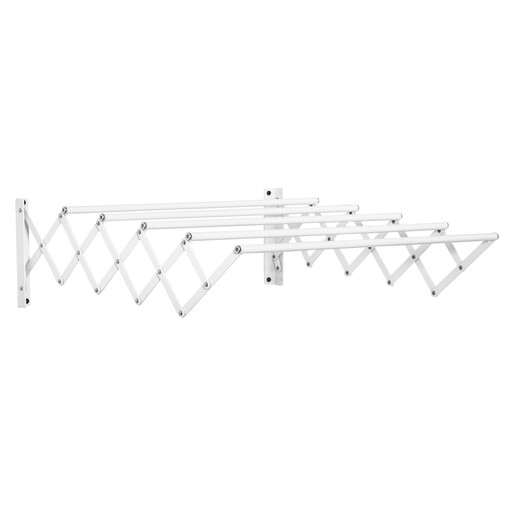
For anyone looking for a wall-mounted airer that folds flat against the wall when not in use.
The airer has five rails, each with a maximum load of 2 kg and a maximum total load of 10 kg. It’s designed for wall mounting; the product information says it’s suitable for indoor use and sheltered outdoor use, such as on a balcony.
 No image available
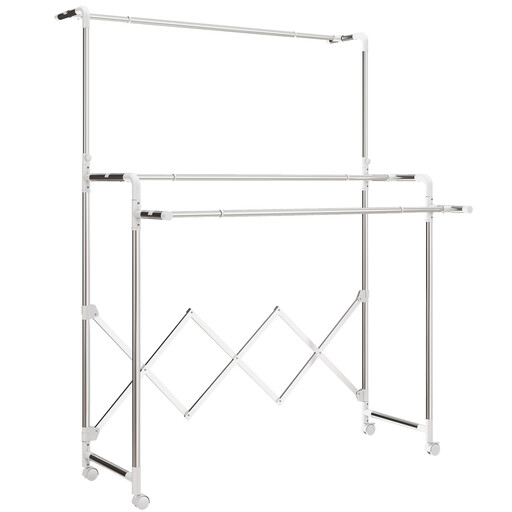
For anyone looking for an airer that folds away and has extendable rails; check first that your apron can hang freely in the chosen spot.
Three rails extend from 104 to 150 cm, and the airer has four wheels. When folded, it measures 50 × 6 × 150 cm. The product information doesn’t state its full dimensions when set up.
Measure the apron and check the clearance below the rail you want to hang it from. A tower with a long total drying length doesn’t guarantee that a single long garment can hang freely.
Yes, bear in mind that moisture needs to be removed when drying indoors. Milieu Centraal warns that excess moisture in the home can cause mould; a heated airer doesn’t remove that moisture from your home.
It depends on the wattage, how long you use it for and your electricity tariff. A device running continuously at 300 W for one hour uses a theoretical 0,3 kWh; this isn’t a measurement of a drying session or a price estimate.
According to ACM ConsuWijzer, the retailer is responsible for the statutory guarantee if a product doesn’t perform as you could reasonably expect during normal use. The solution depends on the circumstances; a manufacturer’s guarantee doesn’t replace this right.
The Netherlands Food and Consumer Product Safety Authority states that CE marking is compulsory for electrical products. This doesn’t prove that an individual airer has been independently tested; check the marking and usage information for the specific model.