Who is this useful for?

Drying apples with limited cupboard space

You want to dry apple slices regularly but also be able to put the appliance away after use. Compare both its external dimensions and its usable tray area. A description such as ‘space-saving’ doesn’t tell you on its own whether the dehydrator will fit in your cupboard.

Making larger batches of apple slices

You want to lay out several slices at once and will only choose a larger appliance if you have room for it at home. Rommelsbacher lists different drying areas and external dimensions for the DA 350 and DA 650.

Drying apples occasionally

You make apple slices now and then and want to see whether your oven or air fryer will do the job. The Netherlands Nutrition Centre provides a recipe for these appliances, with specific timings and storage advice.

What should you look for when choosing?

What to consider What should you check? Who is this particularly important for?
Storage and positioning Compare the appliance’s width, depth and height with your cupboard. Also check the positioning instructions for when it’s in use. If I want to put the dehydrator away in a small cupboard after use, it really does need to fit. Around 36% of consumers prioritise storage space.
Space per drying cycle Compare the tray dimensions or stated drying area with the batch of apple slices you usually make. If I want to lay out my usual batch in a single layer, usable area matters more than the number of trays alone. Around 29% of consumers prioritise the size of each batch.
Settings and attention Check the temperature range and timer, and inspect the slices once the cycle is complete. If I dry fruit regularly and want to set the cycles, temperature and timing are important. But a timer doesn’t prove that the fruit is dry enough. Around 21% of consumers prioritise adjustable cycles.
Avoiding another appliance If you only use it occasionally, try a suitable oven or air fryer recipe and follow the storage advice provided. If I only make a small batch now and then, I may not want another appliance to store. Around 14% of consumers prioritise avoiding an extra appliance.

Common mistakes

  • Assuming ‘compact’ means the dehydrator will fit in your cupboard

    Even models from the same brand can differ in depth. An appliance that doesn’t fit in the cupboard may end up staying on the worktop after use.

    Measure the cupboard opening and compare the external dimensions in the same order: width, depth and height. Also check the positioning instructions for use.

    An appliance that doesn’t fit may take up storage space or need a permanent place on the worktop.

  • Comparing only the number of trays

    The number of tiers doesn’t tell you how many apple slices will fit without overlapping. Tray size and total drying area vary by model, and the slices need space around them for air to circulate.

    Compare the usable area and tray dimensions with the batch you usually want to dry.

    A smaller usable area may mean you need to split the same batch across more drying cycles.

  • Taking a timer or a dry appearance as proof that the fruit will keep

    Drying time depends on factors including slice thickness, moisture content and the method you use. University of Minnesota Extension warns that excessive heat can dry the outside while leaving the inside moist.

    Follow suitable drying and storage instructions. If you use the Netherlands Nutrition Centre’s oven or air fryer recipe, also follow the storage advice for that method.

    Misjudging how dry the fruit is could cause your stored batch to spoil.

Brands worth considering

WMF

WMF describes the KITCHENminis 415250011 Snack to-go as a space-saving dehydrator for foods including fruit. That description alone won’t tell you whether the appliance will fit in your cupboard or suit the size of your batch.

  • WMF states that this model has five tiers, a temperature range of 30–70 °C and a timer of up to 24 hours.
  • Measure your storage space and check how many apple slices fit on the trays before making your choice.

Rommelsbacher

According to Rommelsbacher, the DA 350 and DA 650 offer different combinations of drying area and external dimensions. This makes it easier to weigh up batch size against cupboard space.

  • Rommelsbacher lists five adjustable tiers and a drying area of 0,42 m² for the DA 350; for the DA 650, the brand lists seven tiers and 0,5 m².
  • The stated external dimensions of the DA 650 are 29 × 43 × 27,5 cm (width × depth × height), compared with 31,5 × 33,7 × 25,3 cm for the DA 350. These dimensions show that the DA 650 is deeper, so it may be less suitable for a shallow cupboard.

Steba

The ED 5 is a five-tier stackable model worth comparing if you’re looking for adjustable drying cycles and can measure your available cupboard and worktop space in advance.

  • Steba lists trays measuring 32 × 25 cm, a temperature setting of 40–70 °C and a timer of 1–36 hours.
  • The stated external dimensions are 28,5 × 33,5 × 26,5 cm (height × width × depth). Check the order of the measurements when comparing it with other models.

Food dehydrators at Joybuy

These food dehydrators from Joybuy are designed for drying fruit and offer different numbers of trays and setting options.

YASHE GGJ-261B food dehydrator with five adjustable trays

YASHE GGJ-261B food dehydrator

An option to compare if you want to dry apple slices on several trays and set the temperature and drying time.

Five height-adjustable trays; 35–70 °C; timer up to 72 hours; 240 W.

View at Joybuy

YASHE GGJ-261A food dehydrator with five adjustable trays

YASHE GGJ-261A food dehydrator

An option if you want to dry fruit on several trays and set a timer.

Five adjustable trays; 35–70 °C; timer from 1–48 hours; 240 W.

View at Joybuy
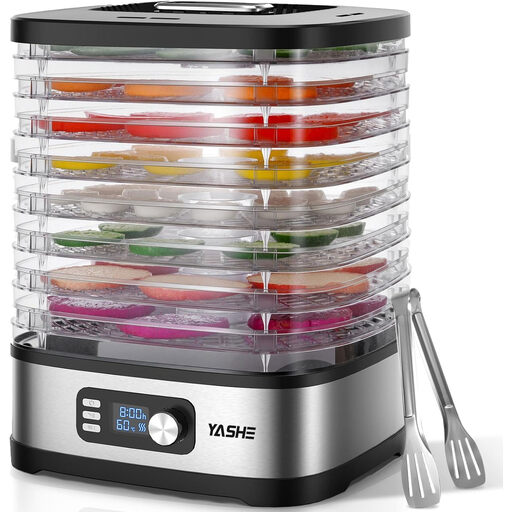
YASHE GGJ-261C food dehydrator with eight trays

YASHE GGJ-261C food dehydrator

The eight trays are useful if you want to dry fruit on several tiers in each cycle. Also check that the appliance will fit in your storage space.

Eight trays; 35–70 °C; timer up to 72 hours; includes mesh screens, a fruit leather sheet and stainless steel tongs.

View at Joybuy

YASHE FD-1019 food dehydrator with five stainless steel trays

YASHE FD-1019 food dehydrator

An option to compare if you want to dry fruit on several trays and set both the temperature and drying time.

Five stainless steel trays; 35–70 °C; timer from 1–36 hours; 400 W.

View at Joybuy
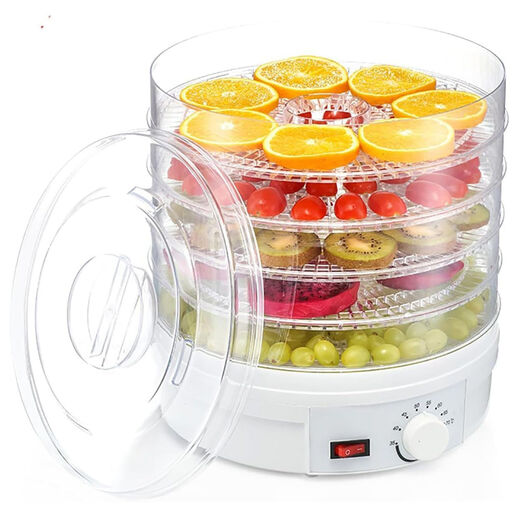
Food dehydrator with five tiers and temperature control from 35–70 °C

Five-tier food dehydrator, 350 W

An option to compare if you want to dry fruit on several tiers and adjust the temperature.

Five tiers; 35–70 °C; 350 W.

View at Joybuy

Frequently asked questions

Can I make apple slices without a food dehydrator?

Yes. The Netherlands Nutrition Centre provides a recipe for thin fruit slices made in an oven or air fryer. Follow the timings, turning instructions and storage advice for that method; don’t assume the result will keep for a long time.

Can I rely on the timer alone to determine drying time?

No. According to University of Minnesota Extension, drying time depends on factors including thickness, moisture content and the method used. Check the apple slices when the cycle is complete rather than treating the set time as proof that they’re fully dried.

How should I store dried apple slices?

For its specific oven or air fryer recipe, the Netherlands Nutrition Centre recommends storing the fruit in an airtight container for a few days or freezing it in portions. For fully dried food, University of Minnesota Extension recommends a cool, dark place and packaging that keeps moisture out. This general advice doesn’t establish a storage period for your particular batch.

Am I automatically entitled to exactly two years’ legal guarantee in the Netherlands?

No. The Dutch government states that there is no fixed statutory guarantee period in the Netherlands. You are entitled to a product that is fit for purpose, and the lifespan you could reasonably expect is one factor taken into account. If something goes wrong, contact the retailer; a manufacturer’s guarantee is in addition to your statutory rights.

What should I look out for to ensure product safety in the Netherlands?

The Netherlands Food and Consumer Product Safety Authority (NVWA) describes CE marking obligations for electrical products covered by the relevant rules, as well as requirements for materials that come into contact with food. Check the product information for the specific model and its trays. General rules alone don’t confirm that an individual product on sale complies with them.
