
If you have limited kitchen space
If you dry a few apples occasionally or regularly, worktop and storage space both matter. Compare the appliance’s external dimensions with the space you have for laying out slices on each tier without overlapping.


A food dehydrator is a good choice if you regularly make apple slices and want to lay them out on the trays without overlapping. Look at the usable space, temperature control and ease of cleaning. If you only dry fruit occasionally, your existing fan oven may be enough, provided it can maintain a low temperature and let moisture escape. The University of Minnesota Extension describes the oven method as taking longer and using more energy than a food dehydrator; the number of tiers alone does not tell you how many slices will fit in each batch.
If you dry a few apples occasionally or regularly, worktop and storage space both matter. Compare the appliance’s external dimensions with the space you have for laying out slices on each tier without overlapping.
Evenly sized slices and space between them matter more than the number of tiers alone. Penn State Extension advises placing pieces on drying trays without letting them touch or overlap.
If you want to work out whether a separate appliance is worth the space and cleaning, check whether your existing fan oven can be set to a low enough temperature and let moisture escape.
Best for: regularly drying small batches and laying the slices out separately on each tier.
Bear in mind: even a partly filled dehydrator still needs to be stored and cleaned, so compare its external dimensions and trays.
Best for: if you regularly dry larger quantities as well as small batches, or want to be able to set an end time.
Bear in mind: you may not use the extra drying space if you only dry a few apples at a time.
Best for: if you rarely dry fruit and your oven can maintain a low temperature while allowing moisture to escape.
Bear in mind: according to the University of Minnesota Extension, the oven method described takes longer and uses more energy than a food dehydrator; this is not a calculation of personal energy use.
For small batches, usable tray space, available kitchen space and how often you dry fruit matter more than the number of tiers alone.
| What to consider | What to look for | Who is it important for? |
|---|---|---|
| Usable drying space | Compare the external dimensions and tray sizes; check how many slices will fit on each tier without overlapping. | If I have limited worktop and cupboard space, I want to know whether the appliance will fit and allow enough slices on each tier. Around 36% of consumers prioritise usable drying space and size. |
| Even drying | Look at the temperature control and air circulation; cut the slices evenly and lay them out without overlapping. | I want my apple slices to dry evenly and not be piled on top of one another. Around 29% of consumers prioritise drying results. |
| Controls and cleaning | Check whether the exact model has a timer and whether its trays are dishwasher-safe. | If I have to set up and clean the dehydrator after every small batch, I want to know how much work is involved. Around 21% of consumers place most importance on ease of use and cleaning. Tristar states that the parts of the PD-4910 are not dishwasher-safe; Fritel says that the DH 2025 is. |
| Cost of occasional use | Check whether your oven can be set to a low enough temperature and let moisture escape; compare how often you use it and its measured energy use. | If I only dry apples occasionally, I want to find out whether my oven will do the job before buying another appliance. Around 14% of consumers prioritise this consideration. |
The number of tiers does not tell you how many apple slices will fit without overlapping; tray and appliance dimensions vary by model. Penn State Extension advises placing pieces on drying trays without overlapping.
Compare the usable tray area with the batch you usually make, not just the number of tiers.
If the slices do not fit without overlapping, you may need to dry a batch in several rounds.
The stated power in watts is not a measurement of energy use per drying cycle. The operating time and the actual power drawn also affect consumption.
Only compare energy use once you have figures for a complete drying cycle and your own electricity tariff.
The University of Minnesota Extension warns that food can still be moist inside even when the outside looks dry.
Check the apple slices, let them cool and follow guidance on conditioning and moisture-proof storage.
According to Tristar, the PD-4910 has five stackable tiers, an adjustable temperature range of 35–70 °C and dimensions of 30 × 24 × 27 cm.
According to Princess, the Princess 112380 (article number 01.112380.01.001) has six stackable tiers and external dimensions of 33 × 33 × 20 cm.
According to Fritel, the Fritel DH 2025 has five plastic trays measuring 24,5 × 31,5 cm, two stacking options and a temperature range of 35–70 °C.
According to Steba, the Steba ED 5 has five independently usable tiers measuring 32 × 25 cm.
According to the manufacturer, the Rommelsbacher DA 350 has five height-adjustable tiers with stainless steel trays.
This selection of food dehydrators for fruit at Joybuy focuses on temperature settings, trays and features that may come in handy for smaller drying batches.
 No image available
An option if you want to adjust the temperature, timer and tray height.
The product name lists temperature control from 35–70 °C, a timer of up to 72 hours, five height-adjustable trays and 240 W. The product description mentions 360° air circulation and dishwasher-safe trays.
 No image available
An option if you’re looking for five trays and temperature control, and want to take the external dimensions into account too.
The product name lists five adjustable trays, 35–70 °C and 240 W. The product description gives dimensions of 31 × 29 × 24,5 cm and mentions dishwasher-safe trays.
 No image available
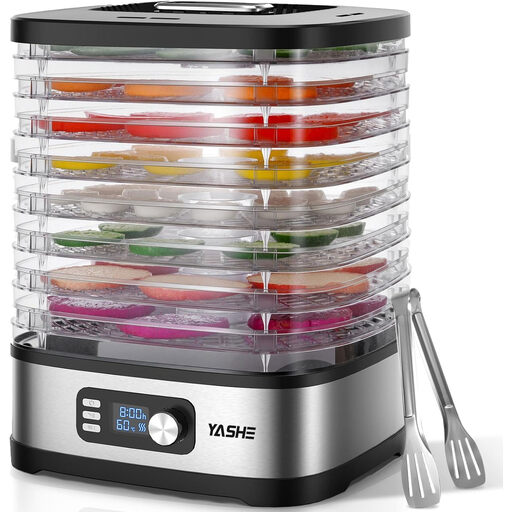
An option if you want to compare more trays and a timer with the space needed for small batches.
The product name lists eight trays, temperature control from 35–70 °C, and included mesh screens, a fruit roll tray and stainless steel tongs. The product description mentions a timer setting of up to 72 hours and 360° air circulation.
 No image available
An option if you want to compare stainless steel trays and adjustable controls.
The product name lists five stainless steel trays, an adjustable timer and temperature, 360° airflow and 400 W.
 No image available
An option if you want to weigh up five tiers against the space you need for a small batch.
The product name lists 35–70 °C, 350 W and BPA-free materials. The product description mentions vertical airflow and dishwasher-safe trays.
Wash the apples, cut them into evenly sized slices and lay them on the trays without overlapping. Penn State Extension describes drying fruit at 63 °C first to remove surface moisture, then at 57–60 °C; this does not specify a fixed drying time or guarantee that every batch will be dry at the same time. Also follow the instructions for your exact appliance.
Use clean hands and utensils, wash the apples and cut them into pieces of an even thickness. Let the slices cool and check that they are dry before storing them in a moisture-proof container in a cool, dark place. Penn State Extension recommends conditioning dried fruit so any remaining moisture can distribute more evenly; a long storage life is not guaranteed for every homemade batch.
According to the Dutch government, for a standard online purchase from a business you generally have 14 days to change your mind, although exceptions may apply depending on the purchase. There is no single fixed statutory guarantee period for all products in the Netherlands; if an appliance is faulty, contact the seller.
The Dutch government states that electrical appliances sold on the EU market must carry a CE mark. Also check the instructions, seller and safety warnings for the specific item on offer; the product description alone does not prove that a particular item meets the applicable requirements.
No. Separate food safety requirements apply if you regularly sell food from home. The Netherlands Food and Consumer Product Safety Authority states, among other things, that you must work with a food safety plan; these rules for businesses do not automatically apply to drying apples for your own use.