
Guest storing rice between stays
Wants to seal an opened pack of dry rice properly and first decide where and in what packaging to store it. The Netherlands Nutrition Centre recommends keeping opened rice in an airtight storage container.


For an opened pack of dry rice, an airtight storage container may be all you need: the Netherlands Nutrition Centre recommends storing rice in a cool, dry, dark place and sealing the packaging well. A vacuum sealer is worth considering if you want to seal rice in individual portions in advance. If so, check the storage space available, whether the bags are suitable for food contact and the cost of replacement rolls. Vacuum sealing does not make a warm or damp storage space suitable.
Wants to seal an opened pack of dry rice properly and first decide where and in what packaging to store it. The Netherlands Nutrition Centre recommends keeping opened rice in an airtight storage container.
Wants to seal rice in separate bags for several visits, so is looking at how easy the machine is to use, the bag size and the replacement rolls available.
Has limited storage space in the holiday cottage and wants to compare the size of the machine and the accessories it needs in advance.
Choose this if: you mainly want to seal an opened pack properly between stays and have a cool, dry, dark place to store it.
The trade-off: you won't need a sealer or sealing rolls, but you won't be able to seal individual portions.
Choose this if: you want to pack dry rice in individual portions in advance and have room for the machine and suitable bags.
The trade-off: check which bag width and replacement rolls are compatible, and what comes with the machine.
Choose this if: you want to use a suitable storage container as well as bags. Solis lists a container connection for the Vac Quick, while DOMO says the DO331L comes with a container.
The trade-off: check whether the container and hose are included with the specific version and are compatible with each other. The connection does not mean that storage remains safe in unsuitable conditions.
| What to consider | What should you check? | Who is this important for? |
|---|---|---|
| Sealing rice properly | Assess the storage location and check that the container or bag seals well and is suitable for food contact. | If I want to protect an opened pack of rice between stays, I start with suitable packaging and a suitable place to store it; around 36% of consumers prioritise this protection. |
| Storage space | Compare the stated dimensions of the machine and think about where the cord, rolls and any containers will fit. | With limited cupboard space, I want to be able to put the machine and accessories away between visits; around 29% of consumers give limited storage space top priority. |
| Sealing portions | Check the sealing width, which bags or rolls are suitable and what is included in the package. | If I want to seal rice in separate portions for several visits, I look for suitable sizes and controls that suit the way I plan to use it; around 21% of consumers make portioning their top priority. |
| Replacement rolls | Check which rolls or bags are compatible with the model and whether they are suitable for food contact. | If I plan to use the machine regularly, I want to know which rolls I can buy later; around 14% of consumers prioritise replacement materials and their associated costs. |
The Netherlands Nutrition Centre recommends storing dry rice in a cool, dry, dark place and sealing it well. A vacuum sealer does not replace these storage conditions.
First assess where you will store the rice, then decide whether sealing individual portions would be useful.
Packaging that comes into direct contact with rice must be suitable for food contact. The bag size and intended use must also suit the machine.
Check that the bags are suitable for food contact and compatible with the bag or roll sizes specified by the manufacturer.
Models may come with different rolls and containers. You may also need suitable replacement rolls for future portions.
Compare everything included in the package with the rolls and accessories you need for the way you plan to use it.
Solis describes the Vac Quick, type 576, as a compact model with automatic vacuum sealing, a separate sealing function and a container connection.
DOMO describes the DO331L as coming with a roll of film and a storage container, making it worth considering if you want to compare using bags with using a container.
Princess describes the 492960 as a machine that vacuums and seals automatically and comes with a roll.
CASO describes the VC 10 as featuring automatic vacuum sealing, a vacuum stop and a separate sealing function.
FoodSaver sells vacuum sealers and matching bags and rolls. The V2860 is one model whose controls and accessories you can compare for each version.
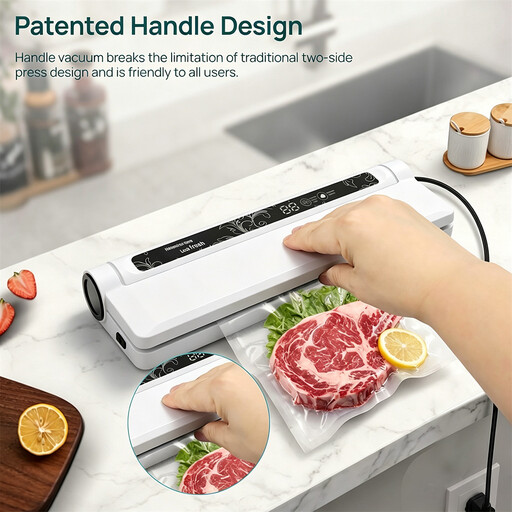
This product selection focuses on sealing individual portions of food using an external vacuum sealer and sealing bags.
 No image available
This version is designed for sealing food and comes with 20 sealing bags.
Bag size: 17 × 25 cm. Before use, check that the packaging material is suitable for food contact.
No, vacuum sealing is not necessary to follow the storage advice. The Netherlands Nutrition Centre recommends storing dry rice in a cool, dry, dark place and sealing opened rice well, for example in a storage container.
No, cooked rice needs to be handled differently. The Netherlands Nutrition Centre says cooked white and wild rice will keep for two days in the fridge, so don't apply the advice for dry rice to cooked rice.
Follow the manual for your exact model when positioning and sealing the bag, then check that the seam is closed. Continue to store the dry rice in a cool, dry, dark place. For powdery foods, FoodSaver recommends taking steps to keep particles out of the pump.
Bags that come into contact with rice must be suitable for food contact; the Netherlands Food and Consumer Product Safety Authority and the European Commission set out the requirements for these materials. Business.gov.nl lists CE marking and an EU declaration of conformity among the requirements for electrical equipment. Check the documentation for the specific version; this general information does not automatically confirm that an individual offer complies.
According to ACM ConsuWijzer, if a product does not meet what you could reasonably expect, you can contact the seller about your statutory guarantee. The seller must then offer an appropriate solution at no cost, such as a repair or replacement.