
Vandaag of morgen in huis

Kwaliteit gegarandeerd

Welkomstaanbiedingen ontgrendelen: GRATIS bezorging | Tot 80% korting | Gratis 30 dagen JoyPlus-proefperiode
Download de app
A drill-free door pull-up bar sounds simple: wedge the bar into the door frame and start training. In reality, the door width, the bar’s construction and the quality of the contact points determine whether you can keep using your purchase comfortably and safely.
Home fitness users with limited space often want a solution for pull-ups, chin-ups and resistance band work. Don’t just look for a high load rating on the product page. Installation, the door frame and your own setup are just as important.
A claim such as 200 kg load capacity sounds clear, but doesn’t always state the conditions under which it was measured. Real-world stability also depends on:
A static load isn’t the same as a sudden pulling force during a rep. Treat the stated value as a product specification, not an automatic guarantee for every doorway.
A multifunctional pull-up bar is used with multiple grips. Smooth plastic or thin foam can feel less comfortable during a session. Non-slip handles can give you better hold, but also check that the material is firmly fixed and up to regular use.
Not every frame is suitable for an over-door home fitness bar. A delicate, loose or very narrow door frame can get damaged or offer inadequate support. Check before you buy:
Start with the stated maximum load. The Worldgeil models mention a 200 kg load capacity. According to the product listing this is a design feature of the bar; actual suitability still depends on installation, door frame and how you use it.
For beginners, a model with multiple grip positions is handy for negative pull-ups, chin-ups and hanging work. Advanced users should also look at stability during repetitions and minimising swing.
A drill-free pull-up bar should fit without having to force it. Measure your door frame before you order. Watch for:
A bar that fits on paper can still be unsuitable if the trim is too narrow, rounded or uneven.
A model with multiple grips can support different exercises. Also check whether, per the product description, the handles are ergonomic and non-slip. Those are functional features, but they don’t replace safe installation.
A pull-up bar with resistance bands can add training options, for assisted pull-ups or light strength work, for example. Check whether bands are actually included and what length or resistance they are. Don’t assume features that aren’t stated in the product information.
The following models are selected based on their stated product specifications, colour variant and drill-free use as a pull-up bar. Always check the latest dimensions, installation instructions and what’s included before purchasing.
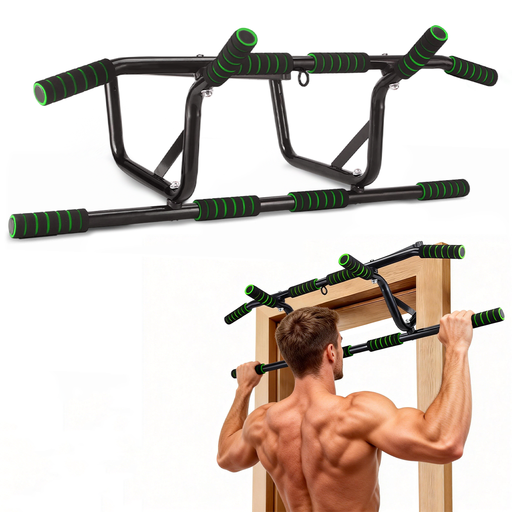
Why this fits the profile: The green variant combines multiple grips with a drill-free design and includes resistance bands according to the product listing. Ideal for beginners who want to try different exercises at home without installing fixed fitness equipment.
The stated load capacity, ergonomic handles and resistance bands make the key features checkable up front. Do still verify that your door frame is suitable.
Multifunctional design; stated 200 kg load capacity; non-slip handles as per the product name.
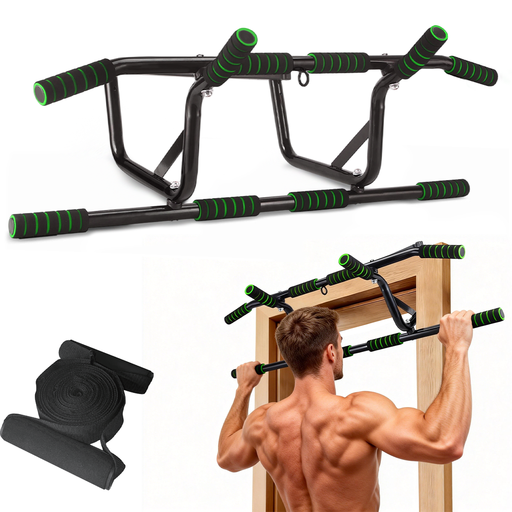
Why this fits the profile: This red version is aimed at shoppers who value clear product specifications and multiple training options in one over-door bar. It suits anyone wanting to make it a fixed part of their home fitness routine without drilling.
The product name explicitly states drill-free installation, a 200 kg load rating and non-slip handles. That lets you compare these points with other models rather than relying on photos alone.
Multiple grip positions; resistance training as per the product name; red colour variant.
Why this fits the profile: For users who want to alternate pull-ups with band training, this model offers multiple functions in one unit according to the product listing. That saves storage space, but it does mean paying extra attention to the setup before every intense session.
The combination of multiple grips and resistance bands reduces the need to buy different pieces of kit. You should always read the stated 200 kg in the context of the installation conditions.
Drill-free use; multiple exercises; resistance bands included as per the product name.
Set up the pull-up bar first without putting your full bodyweight on it. Check that all contact points sit flush and that the bar doesn’t twist or shift. Then test carefully with a partial load.
Don’t use sudden swinging movements if the manual doesn’t allow it. Regularly check for:
Keep the installation instructions and check that the seller provides information on materials, dimensions, maximum user weight and warnings. A product listing is no substitute for the safety instructions.
We’ve compiled a comprehensive, up-to-date list of products that fully meet these stringent selection criteria and current European safety regulations.
That depends on the model, the installation and the door frame. Check the maximum load, follow the manual and only use the bar on a sturdy, well-fitting frame. A stated load capacity of 200 kg doesn’t automatically mean every door frame can take the same load.
It’s possible if the contact points are positioned incorrectly, the bar is overloaded or the frame isn’t suitable. Before use, check that no pressure marks, cracks or shifts are appearing. Protective pads can help, but only if they’re part of or permitted by the design.
Lifespan depends on materials, frequency of use, bodyweight, training style and storage. With heavy use, regular inspection matters more than a fixed timeframe. Stop using it as soon as any joint, handle or support becomes damaged.
