
Lunchbox convenience, no weighing
You want to take a small, individually wrapped snack with you and know in advance how many lunches one multipack will cover.


Choose individual snack packs if you want to take a set portion with you or hand them out; a larger bag is a better choice if you want to decide the quantity yourself. Match the number of portions to your lunch days or group size, and check the ingredients and allergen information for each variety, as these can differ.
You want to take a small, individually wrapped snack with you and know in advance how many lunches one multipack will cover.
You’re mainly interested in the number of individual portions and want to be able to check the ingredients and allergen information for the exact product before sharing.
You want to decide the quantity yourself and are considering a larger bag instead of ready-portioned packs. Storage instructions and the cost of equivalent quantities are also relevant.
When choosing dried fruit for a packed university lunch, your decision mainly comes down to portion size, sharing, portioning it yourself and the ingredients in each variety.
| What to consider | What to look for | Who should consider this most? |
|---|---|---|
| Portion for your lunchbox | Check the weight per pack and the number of portions; an individual pack is not the same as a full lunch. | If you want to take a small snack with you without weighing it, a set portion matters. Around 25% of consumers prioritise lunchbox convenience. |
| Portions to share | Compare the number of packs with the number of people, and check the allergen information for the exact product. | If you want to take an individual pack for each fellow student, the number of units matters more than the total weight alone. Around 25% of consumers prioritise sharing. |
| Portioning it yourself | Compare equivalent quantities and factor in weighing, storage and, if needed, your own portion containers. | If you want to decide the portion size yourself, a larger bag is an option, but you’ll need to prepare the portions. Around 25% of consumers prioritise that flexibility. |
| Ingredients and allergens | Read the ingredients, allergen information and precautionary warnings on the packaging for your chosen variety. | If the ingredients determine your choice, check each variety individually. Around 25% of consumers give the greatest weight to ingredients and allergens. |
According to the ingredients information, the AH Hamsterchef variety with raisins and apple pieces that was reviewed contains sulphites. Ingredients can vary between varieties.
Check the ingredients and allergen information on the packaging of the exact product, even if the brand and pack size are the same.
For the AH variety with raisins and apple pieces that was reviewed, the product information lists 0 g of added sugars and 61 g of total sugars per 100 g.
Check both total and added sugars in the nutritional information; one statement does not replace the other.
A bag with a stated total weight does not contain individual portions; you’ll need to weigh them yourself and store the contents according to the product instructions.
Decide in advance whether you want to portion the fruit yourself or choose packs that are already individually wrapped.
Portioning it yourself may take preparation time and require your own portion containers.
The AH Hamsterchef range includes raisins and a variety with raisins and apple pieces, both sold in individual portions.
Jumbo Snoep Rozijntjes Doosjes is a multipack of individual portions.
The Alesto range includes dried fruit, such as mango strips that you can take with you or portion yourself.
ALDI lists Trader Joe’s raisins in a 500 g bag, a size that’s suitable for portioning yourself.
PLUS Sultana raisins come in a 375 g stand-up pouch of loose raisins.
Dirk lists a 750 g pack of raisins, which may suit you if you want to make up your own portions.
These Joybuy products are larger packs of dried fruit for you to portion yourself.
 Image unavailable
This pack is a good choice if you want to portion the fruit yourself and decide how much to take for different lunches.
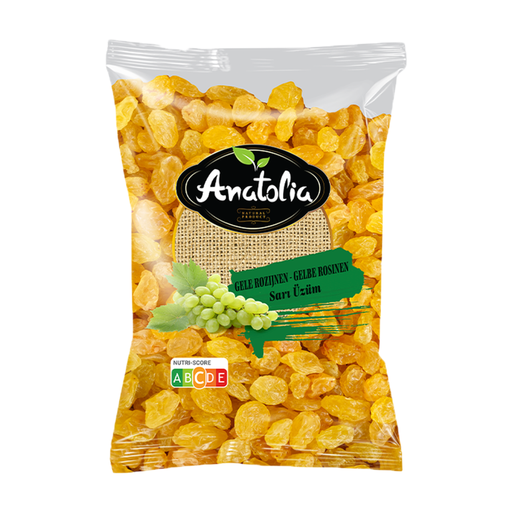 Image unavailable
This pack is a good choice if you want to decide how much to take for your lunch.
Follow the storage and best-before information on the packaging of the exact product. For PLUS Sultana raisins, PLUS recommends storing them in a cool, dry, dark place. Don’t assume that all products have the same shelf life once opened.
Albert Heijn says the product is often still fine after this date and recommends checking it by looking, smelling and tasting. Follow the stated storage conditions too; the date is no guarantee if the product has not been stored properly.
A canteen operator offering food to consumers must provide information about allergens present. The Netherlands Food and Consumer Product Safety Authority says that for non-prepacked products, this information may be given in writing or verbally; if given verbally, it must be readily available before purchase, among other requirements.
Yes, check the precautionary warnings on the packaging too. Since 1 January 2026, the Netherlands Food and Consumer Product Safety Authority has been checking the rules for warnings about allergen cross-contamination on prepacked product labels.
No, the multipack format does not prove that. The European Union sets out information requirements for prepacked foods, so check what mandatory information is shown on the individual pack and which exemptions actually apply before offering it separately.