What should you look for when choosing?
First decide whether you want to portion it yourself or would rather take individual boxes with you. Then compare the ingredients and choose an amount that suits your lunch plans.
| What to consider |
What should you check? |
Who should give this more weight? |
| Value of a bulk bag |
Compare the net weight and price per kilo, and choose an amount you’ll actually use. |
If I’m buying enough for several school days, I want to compare the price per kilo with the net weight. Around 29% of consumers make value for money in bulk their top buying priority. |
| Ingredients and portion size |
Read the ingredients and decide on a small portion; the Netherlands Nutrition Centre’s school lunch list recommends a maximum of one handful of dried fruit with no added sugar per day. |
I want to be able to check the ingredients and keep the amount I pack small. Around 29% of consumers prioritise ingredients and portion size. |
| Individual portions |
Check the number of boxes, the total net weight and the amount in each box. |
I want to pack portions without weighing them out of a large bag every morning. Around 18% of consumers name convenient packaging as their top buying priority. |
| Variety |
Check whether it’s one type of fruit or a mix, and read all the ingredients if it’s a mix. |
I want to be able to alternate between different types of dried fruit and know what each variety contains. Around 12% of consumers put variety first. |
| Individual ingredient requirements |
Check the ingredients and allergen information on the specific pack; don’t assume a product is suitable based on the type of fruit or the shop’s name. |
If an allergy or sensitivity to sulphites is relevant, I want to check the ingredients of that exact pack. Around 12% of consumers name an individual ingredient requirement as their top buying priority. |
Joybuy products for lunch portions and variety
These product options suit individual lunch portions or a selection of different dried fruits; check the ingredients and storage advice on each pack.
 No image available
De Kleine Keuken Organic Raisins 12M+ 140g
An option if you want to pack raisins in individual lunch portions rather than portioning them out of a large bag yourself.
The product name states 140 g and 12M+. The product information advises supervision while eating and says the product isn’t suitable for children with swallowing difficulties.
View on Joybuy
 No image available
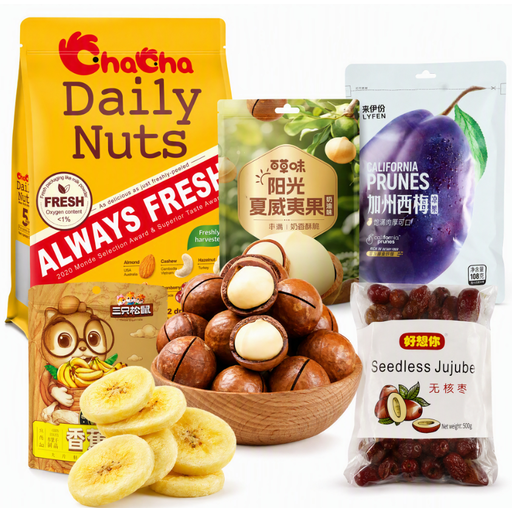
Full of Fruit Flavor Nuts and Dried Fruit Sharing Pack, 5-pack, 1.073 kg
A selection for trying different dried fruit products; this pack doesn’t contain fruit alone.
The product name states that it contains five products, totalling 1.073 kg. The product information mentions nuts and products with added sugar; the prunes listed also contain aspartame (E951), a source of phenylalanine. After opening, the product information advises keeping it chilled and consuming it within one day.
View on Joybuy
Frequently asked questions
How much dried fruit can I pack in a school lunch?
For school lunches, the Netherlands Nutrition Centre recommends a maximum of one handful of dried fruit with no added sugar per day. This is dietary advice, not a legal limit; keep the portion small and count any other dried fruit your child eats that day.
How do I compare a large bag with individual boxes?
For bulk bags, compare the current price per kilo and net weight with the amount you use. For individual boxes, also check the total net weight and the contents of each box: the number of boxes alone isn’t enough to compare the cost per portion.
How should I store an opened bag of raisins?
The Netherlands Nutrition Centre gives a general storage time of 6–9 months in a kitchen cupboard for opened raisins. Follow the label on the specific pack too; Jumbo advises keeping its organic sultanas in a cool, dry, dark place.
What should I look out for if my child has allergies or a sensitivity to sulphites?
Check the ingredients and allergen information on the specific pack. The NVWA says that pre-packed products must show allergen information on the label; a fruit mix may also contain nuts. Don’t assume a product is suitable for a child based on the type of fruit or the shop’s name.
Can every child eat raisins unsupervised?
No, don’t assume that’s the case. The Netherlands Nutrition Centre warns that children can choke on raisins or currants, and advises not giving them too many at once and staying with them while they eat. Consider your child’s eating skills and the level of supervision at school.


