
Regular bulk buyers
If you’re buying for several children or regular mealtimes, choose a pack size to suit how much you use and how you’ll store an opened pack. Product information from Jumbo, PLUS and Dirk lists packs in different sizes.


Choose a pack size to suit how much dried fruit you’ll actually use: a larger pack may suit regular mealtimes, while a smaller one means opening less stock at once. Compare the ingredients and storage instructions for the specific product, and offer young children small amounts under supervision, as advised by the Netherlands Nutrition Centre.
If you’re buying for several children or regular mealtimes, choose a pack size to suit how much you use and how you’ll store an opened pack. Product information from Jumbo, PLUS and Dirk lists packs in different sizes.
If you only use dried fruit occasionally in nursery lunches, a smaller pack may mean opening less stock at once. Albert Heijn lists a 250 g pack, while PLUS lists 375 g, for the raisin products described here.
Check the ingredients, nutritional information and allergen details before choosing a pack. The Netherlands Food and Consumer Product Safety Authority explains that pre-packed products must show allergen information on the label. If you’re aware of a sensitivity, always check the specific product.
First, consider how much you’ll actually use for nursery lunches. Then check the ingredients and make sure you can store the opened pack as directed.
| What to consider | What should you check? | Who is this important for? |
|---|---|---|
| Serving safely | Read the product warnings and offer small amounts under supervision. When portioning, also check for any stalks or stones if the packaging warns about them. | If you’re preparing dried fruit for young children, you’ll want to control the amount served at each mealtime and stay with them. Around 29% of consumers put safe serving first. |
| Ingredients and sugar | Read the ingredients alongside the nutrition table and compare sugar per 100 g. Don’t automatically treat the serving size on the label as a recommendation for children. | If you want to know what’s in the product and how much sugar it contains, the ingredients list and nutritional information will help you decide. Around 24% of consumers prioritise ingredients and sugar. |
| Pack size | Compare the net weight with how much you expect to use, and don’t buy more than you can use while following the storage instructions. | If you regularly buy for several mealtimes, a larger pack may suit your needs; for occasional use, a smaller pack may be more practical. Around 29% of consumers focus mainly on value for stock and pack size. |
| Storage and portioning | Follow the instructions on the specific pack and check whether it is explicitly described as resealable. If you’re using it in a childcare setting, follow your own food safety procedures. | If you want to portion small amounts from one larger pack, make sure the packaging suits your storage arrangements and routine. Around 18% of consumers prioritise storage and portioning. |
A larger multipack doesn’t change the Netherlands Nutrition Centre’s advice not to give young children too many raisins at once and to stay with them.
Choose a pack to suit your storage needs and portion out the amount for each mealtime separately.
Dried fruit can contain naturally occurring sugars. That’s why the Netherlands Nutrition Centre advises looking beyond the ingredients list.
Check the nutrition table too, and compare the sugar content on a like-for-like basis, such as per 100 g.
A serving size shown on a label isn’t automatically a recommendation for a young child. For example, Albert Heijn lists a serving size of 50 g for AH Raisins; this is label information, not specific advice for children.
Don’t confuse the label serving size with the amount you offer a child, and follow the Netherlands Nutrition Centre’s advice.
PLUS describes its packaging as a stand-up pouch, but that description alone doesn’t confirm that it can be resealed. Nor does the packaging type alone tell you how long the product will keep once opened.
Check the closure and follow the storage instructions on the pack you buy.
AH Raisins is described as a smaller 250 g pack.
Jumbo Sun-dried Sultana Raisins is described as a 500 g pack.
Lidl Netherlands lists Belbake Raisins as a product.
ALDI Netherlands lists Trader Joe's raisins in a 500 g pack.
PLUS Sultana Raisins is described as a 375 g stand-up pouch.
Dirk lists raisins in a 750 g pack, a quantity that may suit larger stock purchases.
This selection is suited to regular bulk purchases of raisins for nursery lunches.
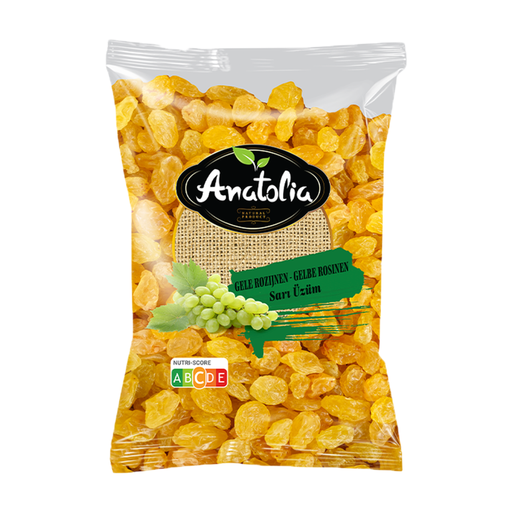 No image available
May suit regular bulk purchases if 500 g matches your needs and you store the pack according to the instructions.
The product name specifies raisins and a 500 g pack; the product description states that it contains 100% dried grapes.
The product information warns of a choking hazard for young children. Follow the Netherlands Nutrition Centre’s advice not to give too many raisins at once and to stay with them.
According to the Netherlands Nutrition Centre, you can offer raisins occasionally when a child is around one year old and joins the family for breakfast, lunch and dinner. Don’t give them too many at once, and stay with them. This is nutritional and safety advice, not a legal age limit.
No, dried fruit can contain naturally occurring sugars. So check both the ingredients and the sugar content per 100 g. A product’s suitability for inclusion in the Dutch Wheel of Five when it contains no added sugar doesn’t mean you need to offer it without limits.
Follow the storage instructions on the specific pack, as these can vary by product. Product information from AH, PLUS and Jumbo says to store in a cool, dry, dark place, but doesn’t give a standard time limit for use after opening.
Check the allergen information on the specific product. Sulphites are on the list of allergens named by the Netherlands Food and Consumer Product Safety Authority. A short online product description doesn’t confirm that a pack is suitable for a child with a known sensitivity.
Professional childcare settings that handle or provide food must follow appropriate food safety procedures. The Netherlands Food and Consumer Product Safety Authority describes working with a HACCP-based food safety plan; RIVM KIDDI refers childcare providers to an appropriate approved hygiene code. This doesn’t automatically apply to a household buying food for its own use.