Who is this relevant to?

Mindful portion snackers

You want to take a small sweet snack with you and keep track of how much energy you consume. Weighing and comparing equal portions are more important here than a product’s general appearance. The Netherlands Nutrition Centre provides portion advice, while product values can be found on the labels of retailers including Albert Heijn, Jumbo and PLUS.

Ingredient-conscious snackers

You pay attention to added sugars and to sulphites or other allergens that may be relevant to you. An ingredients list alone does not tell you how much energy a product contains. The NVWA emphasises that allergen information must be available before purchase.

Festival-goers stocking up on snacks

You want to shop in advance and prepare portions, while also taking into account how to store the snacks while you’re out and what to do with any leftovers at home. For example, Albert Heijn and PLUS product pages provide storage advice for specific varieties; always check the label of the product you buy.

What should you look for when choosing?

Start with the amount you want to take with you, then compare the nutritional information and check that you can follow the storage instructions and meet any ingredient-related requirements.

What to consider What should you check? Who is this important to?
Energy per portion Check the kcal per 100 g and weigh your own portion; calculate its energy content based on the portion weight. If I want to know how much energy my snack contains, I compare the exact products for the same quantity. Around 42% of consumers make portion control their top priority.
Sugars and allergens Read the ingredients and allergen information on the exact pack; compare total and added sugars if both are listed. If I want to avoid added sugar or need to take a relevant allergen into account, I check the packaging before buying. Around 25% of consumers put checking ingredients first.
Storing snacks while you’re out Pay particular attention to the instructions for after opening and consider whether you can follow them during the festival. If I’m out for several hours, I choose a snack whose storage instructions I can follow. Around 17% of consumers make storage while out their top priority.
Packaging and leftovers Check the net weight, consider how many portions you need and follow the storage advice for any leftovers. If I want to prepare portions in advance, I look for packaging that suits what I’ll actually use. Around 16% of consumers make buying the right amount and managing leftovers their top priority.

Common pitfalls

  • Assuming no added sugar means low in kcal

    A product’s claim that it contains no added sugar doesn’t tell you how much energy it contains per 100 g. For example, AH Raisins lists 0 g of added sugars and 344 kcal per 100 g on Albert Heijn’s product page.

    Compare the energy content for the same quantity, then calculate the kcal in the portion you weigh out.

  • Automatically taking the portion size on the label

    A stated portion of 50 g is not the same as the Netherlands Nutrition Centre’s recommendation to eat no more than 20 g of dried fruit a day.

    Weigh out your portion in advance and remember to include any dried fruit you eat at other times that day.

  • Storing all dried fruit in the same way

    AH Soaked Dried Apricots must be stored at a maximum of 7°C after opening. A lower energy content for the same quantity does not change this instruction.

    Only choose a variety if you can follow its storage requirements while you’re out.

    If a product needs to be kept cool, you’ll also need to arrange suitable refrigeration during the festival.

  • Overlooking sulphites and possible cross-contamination

    Jumbo Dried Apricots Without Stones contain sulphites and may contain nuts, peanuts and sesame.

    If these substances are relevant to you, check the exact packaging. If you’re buying an unpackaged snack, ask for the allergen information before you buy it.

Relevant brands to consider

Albert Heijn

The product pages for AH Raisins and AH Soaked Dried Apricots provide nutritional values and storage advice for the specific varieties.

  • AH Raisins lists 344 kcal per 100 g. AH Soaked Dried Apricots lists 182 kcal per 100 g; both values come from Albert Heijn’s official product pages.
  • The soaked apricots must be refrigerated at a maximum of 7°C after opening. This requirement applies to this variety.

Jumbo

Jumbo Dried Apricots Without Stones 250 g has a product page with nutritional values and allergen information.

  • The official product page lists 237 kcal per 100 g and nutritional values per 20 g.
  • This variety contains sulphites and, according to Jumbo, may contain nuts, peanuts and sesame. Check the packaging if this information is important to you.

Lidl

Alesto is Lidl’s range, which also includes dried fruit such as apricots.

  • Lidl’s brand range provides a way to shop for dried fruit.
  • Assess the exact variety using its label; the range description is not a nutritional assessment of every product.

ALDI

ALDI Netherlands has a product page for TRADER JOE’S Sun-Dried Apricots 250 g.

  • ALDI’s product description says these apricots are soft and dried.
  • The description doesn’t say how much energy the exact variety contains. Check the nutritional information on the packaging for this.

PLUS

PLUS Dried Apricots in a 375 g stand-up pouch are an option for preparing portions at home from one pack.

  • The official PLUS page lists 254 kcal per 100 g, 0 g of added sugars, and advises storing the product in a cool, dry, dark place.
  • The product contains sulphites. The larger pack size alone tells you nothing about the nutritional value per portion.

Dirk

Dirk presents 1 de Beste Apricots 375 g as its own-brand product for snacking and recipes.

  • The product page gives the product name and pack size.
  • Dirk’s description of the apricots’ softness and flavour is a retailer description; use the nutritional information on the packaging to compare energy content.

Dried apricots at Joybuy

These Joybuy products are dried apricots. Compare the energy content of a weighed portion and check the ingredients, including sugar and sulphites.
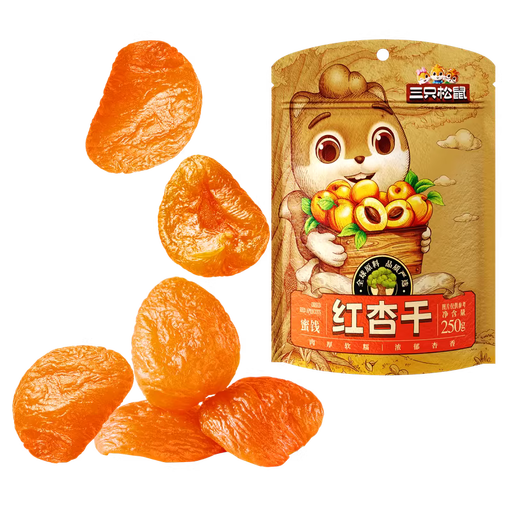
Three Squirrels Red Apricot Dried, 250 g

Three Squirrels Red Apricot Dried, 250 g

Suitable if you weigh out a small portion in advance and want to calculate its energy content.

Listed energy: 311 kcal per 100 g, or 62.2 kcal per 20 g.

The ingredients list includes white sugar, maltose syrup and sulphites.

View at Joybuy
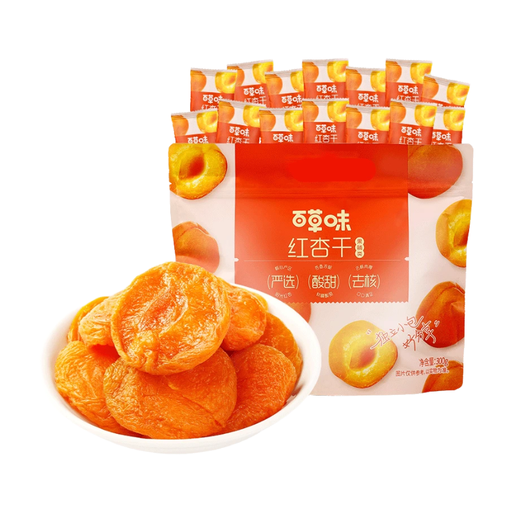
Be&Cheery Dried Red Apricots, 300 g

Be&Cheery Dried Red Apricots, 300 g

Suitable if you want to weigh out your portion in advance and calculate its energy content.

Listed energy: 327 kcal per 100 g, or 65.4 kcal per 20 g.

The ingredients list includes sugar, maltose syrup and sulphites.

View at Joybuy

Frequently asked questions

Is 20 g a legal limit or dietary advice?

It’s dietary advice from the Netherlands Nutrition Centre: eat no more than 20 g of dried fruit a day. It is not a legal limit on packaging or purchases; remember to count any dried fruit you eat at other times that day too.

Does no added sugar mean a snack is low in calories?

No. AH Raisins lists 0 g of added sugars and 344 kcal per 100 g on Albert Heijn’s product page. So check the energy content and the weight of your portion separately.

Can I take soaked apricots in my bag after opening?

Only if you can follow the storage instructions. AH Soaked Dried Apricots must be refrigerated at a maximum of 7°C after opening and have a limited shelf life; transferring them to another container doesn’t change this requirement.

When can dried fruit be described as low in energy?

According to the European Commission, a ‘low energy’ claim for solid foods is permitted when they contain no more than 40 kcal (170 kJ) per 100 g. A small portion does not change the energy content per 100 g.

What allergen information must a festival stall provide?

The NVWA requires allergen information to be available before purchase. For prepacked products, this information is on the label; for unpackaged products, the seller can provide it in writing or verbally. If the information is given verbally, it must be clearly stated that you can ask for it. Sulphites are among the listed allergens.
