When choosing dried fruit for a children’s party, consider the ingredients, nutritional values per 100 grams and the portion you’ll hand out. A small portion doesn’t make the product itself low in calories. For young children, also check the shape and firmness, and if anyone has a known allergy or sensitivity, check the latest information on the packaging before choosing.
Who is this guide for?
Parents planning to hand out small portions
You want to decide in advance how much each child will get at the party, so you’re considering portion size, not just the type of fruit. The Netherlands Nutrition Centre recommends small portions for party treats.
Shoppers looking to avoid added sugar
You check the ingredients to see whether sugar has been added. The Netherlands Nutrition Centre notes that dried fruit can naturally contain a lot of sugar, even without added sugar.
Organisers considering whether the food is suitable
You’re organising a party for young children or children with known allergies or sensitivities. The shape of the treat and the allergen information on the specific pack are important considerations.
What should you look for in dried fruit for a children’s party?
First compare the nutritional values per 100 grams, then decide on the portion size. The Netherlands Nutrition Centre gives average reference values of 65 kcal for a 20-gram handful of raisins and 26 kcal for a 9-gram dried apricot. These are not universal portion recommendations or values for specific products sold in shops.
| What to consider |
What should you check? |
Who should pay extra attention? |
| Calories per portion |
Check the kcal per 100 grams on the label and weigh the amount you’ll hand out. Calculate the calories in a portion using: kcal per 100 grams × portion weight in grams ÷ 100. |
If you want to weigh out a small treat for each child, check the energy content of that portion. Around 28% of consumers prioritise the calories in the portion they hand out. |
| Added sugar |
Check the ingredients list for added sugar, and also look at the nutrition table. |
If you want to avoid added sugar, look beyond the name of the fruit and read the ingredients. Around 22% of consumers pay the most attention to this. |
| Suitability for children |
Ask about any relevant allergies or sensitivities. For young children, also consider the shape and firmness of the treat. |
If young children or children with known sensitivities will be attending, check in advance what’s suitable for them. Around 22% of consumers prioritise suitability. |
| Portioning and handing out |
Check the net weight and decide how many grams you want to give each child. |
If you want to prepare the treats in advance, easy-to-manage portions and convenient serving are important. Around 17% of consumers pay most attention to this. |
| How much you’ll need |
Work out the total amount based on the number of children and the portion size you’ve chosen. Also plan what to do with any leftovers. |
If you don’t want to buy more fruit than you need, calculate the amount based on the number of children and portion size. Around 11% of consumers make the amount needed their main priority. |
Common mistakes
-
Assuming a small portion means the product is low in calories
A small portion may contain fewer calories than a large one, but it doesn’t change the nutritional values per 100 grams.
Compare products on the same basis, such as kcal per 100 grams, then calculate the value for the amount you’ll actually hand out.
-
Buying a large pack without planning portions
The total contents of a bag aren’t the same as a portion for a child. Without a plan, you may have fruit left over after the party.
Decide in advance how many portions you need and how you’ll store any leftover fruit.
A larger pack may also take extra preparation if you need to divide the contents into smaller portions yourself.
-
Assuming fruit is suitable for every child
For young children, the shape and firmness may need consideration. If a child has a known allergy or sensitivity, check the information on the exact product packaging.
Ask parents about any relevant dietary needs and check the latest allergen information before choosing the same treat for the whole group.
Brands and product ranges to consider
Albert Heijn
Albert Heijn’s range includes AH Soaked Dried Apricots.
- The product page identifies this variety as soaked dried apricots.
- ‘Soaked’ alone tells you nothing about the energy content or whether the product is suitable for every child.
Jumbo
Jumbo’s range includes dried and soaked apricots, raisins, prunes and dates.
- The range information distinguishes between pitted apricots and soaked apricots.
- ‘Pitted’ describes a product feature; it doesn’t guarantee that the product is suitable for every child.
Lidl
Lidl’s Alesto range includes nuts and dried fruit, such as mango strips.
- Lidl describes its mango strips as sweet and convenient.
- That product description doesn’t tell you the energy content; check the nutrition table for the specific variety.
Aldi
Aldi describes Trader Joe's sun-dried apricots in a 250-gram pack.
- The product description says the apricots are soft.
- The description doesn’t tell you the kcal per 100 grams or what portion size is suitable for a child.
PLUS
PLUS describes dried apricots in a 375-gram stand-up pouch.
- The product information clearly identifies the variety and total pack size.
- The pack size isn’t the same as a child’s portion; check the latest information on the packaging.
Dirk
Dirk describes 1 de Beste apricots in a 375-gram pack.
- The product page states the variety and total pack weight.
- A description such as ‘soft’ or ‘flavoursome’ doesn’t support a low-calorie claim; compare the product’s nutritional values.
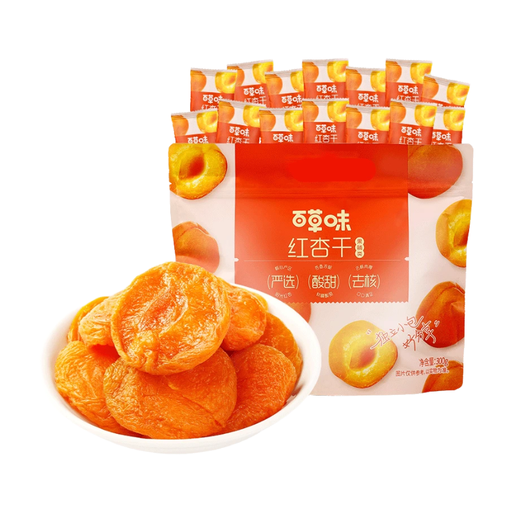
Dried apricots at Joybuy
The Joybuy products below are dried red apricots. Their stated nutritional values are 311 and 327 kcal per 100 grams. For solid foods, the European Commission sets a maximum of 40 kcal per 100 grams for the ‘low energy’ claim. These options therefore aren’t suitable if you’re looking for a product carrying that claim.
 No image available
Three Squirrels dried red apricots, 250 g
An option if you’re considering dried apricots for a party treat. The stated nutritional value doesn’t make this a low-calorie product.
Nutritional value: 311 kcal per 100 g. The ingredients include added granulated sugar and maltose syrup; the product information also lists sulphites (sodium metabisulphite).
View at Joybuy
 No image available
Be&Cheery dried red apricots, 300 g
An option if you’re choosing dried apricots and want to decide on the portion size yourself. The stated nutritional value means this isn’t a low-energy product.
Nutritional value: 327 kcal per 100 g. The ingredients include sugar and maltose syrup; the product information also lists sulphites (E223).
View at Joybuy
Frequently asked questions
When can dried fruit be described as ‘low energy’?
A small serving on its own isn’t a reason to describe a product this way. According to the European Commission, the ‘low energy’ claim for solid foods is limited to a maximum of 40 kcal (170 kJ) per 100 grams.
Is 20 grams of raisins the recommended portion for every child?
No. The Netherlands Nutrition Centre gives an average reference value of 65 kcal for a 20-gram handful; this isn’t a universal portion recommendation for a specific age group. When preparing a treat for a children’s party, consider the children and how much you want to hand out.
How do I compare raisins and dried apricots?
Compare the nutritional values per 100 grams on the labels of the specific products, then decide on the portion size. The Netherlands Nutrition Centre’s average calorie checker values are based on different portion sizes and aren’t the nutritional values of individual products sold in shops.
What should I consider for young children?
Consider whether the shape and firmness of the food are suitable for the child. The Netherlands Nutrition Centre highlights eating and hard pieces of fruit as choking risk considerations; this general guidance isn’t a specific safety assessment of every variety of dried fruit.
What should I check if someone has a known sensitivity to sulphites?
Ask the parents which products are suitable and check the latest allergen information on the packaging. The NVWA states that allergen information for prepacked products must appear on the label. The name of the fruit alone doesn’t tell you what’s in a specific variety.


