
Parents avoiding a specific allergen
You’re looking for a product that meets a specific dietary need. Read the ingredients and free-from statements alongside any cross-contamination warnings; these are separate parts of the product information.


Don’t choose dried fruit based solely on a claim such as ‘unsulphured’ or ‘no added sugar’. Check that the ingredients and allergen information meet your specific dietary needs, and assess how you serve it separately. The Netherlands Nutrition Centre says children should be able to sit upright, swallow and chew before having larger pieces; the CDC lists unprepared dried fruit, including raisins, as a choking risk for young children. So a free-from claim does not automatically make dried fruit suitable to eat as finger food.
You’re looking for a product that meets a specific dietary need. Read the ingredients and free-from statements alongside any cross-contamination warnings; these are separate parts of the product information.
Your baby is starting to pick up food independently. So, as well as the ingredients, consider the form in which you serve the fruit and whether it suits your baby’s ability to sit, chew and swallow. The Netherlands Nutrition Centre lists these skills as prerequisites for larger pieces.
You want to compare labels carefully. Bear in mind that ‘unsulphured’ does not mean ‘no preservatives’, and ‘no added sugar’ does not mean there are no naturally occurring sugars.
When choosing dried fruit for baby-led weaning, consider four separate questions: how you’ll serve it, what dietary needs apply, whether you’re avoiding sulphites, and how you assess sugars and portion size.
When to consider it: first assess your baby’s eating skills and the form of the fruit, not just the packaging or a free-from claim.
Consideration: the CDC lists unprepared dried fruit, including raisins, as a choking risk for young children.
When to consider it: if the ingredients meet your dietary needs and you prepare the fruit to a texture that suits your baby.
Consideration: this requires preparation and is different from eating individual pieces of dried fruit as finger food; cooking does not change the ingredients.
When to consider it: if you want to offer fruit and have no particular reason to choose dried fruit.
Consideration: fresh fruit also needs to be served in a form and texture that suit your baby’s eating skills. The Netherlands Nutrition Centre recommends fresh fruit over raisins as a general fruit choice for children.
| What to consider | What should you check? | Who is this important for? |
|---|---|---|
| Texture and eating skills | The CDC lists unprepared dried fruit, including raisins, as a choking risk for young children. The Netherlands Nutrition Centre says children should be able to sit upright, and swallow and chew well, before having larger pieces. | If your baby picks up food independently, you’ll want to know whether the way you serve it suits their eating skills. Around 34% of consumers in this purchasing context prioritise texture and eating skills. |
| Specific allergen | Read the ingredients and allergen information, and check for warnings about possible cross-contamination too. The Netherlands Food and Consumer Product Safety Authority (NVWA) explains allergen labelling. | If you need to avoid a particular allergen, you’ll want to assess whether both the ingredients and warnings meet that need. Around 33% of consumers put a specific allergen first. |
| Sulphites | Check the ingredients list and the exact claim on the packaging. ‘Pitted’ says nothing about sulphites; ‘unsulphured’ is not the same as ‘no preservatives’. | If you want to avoid sulphites, a general claim such as ‘vegan’ is not enough to confirm that the product is sulphite-free. Around 20% of consumers name sulphites as their main consideration. |
| Sugars and portion size | Compare nutritional values on the same basis and distinguish between added and naturally occurring sugars. Don’t automatically use the pack’s suggested serving as a portion for your baby. | If you’re keeping an eye on sugar and how much you offer, you’ll want to assess both separately. Around 13% of consumers prioritise sugar and portion size. |
An ingredients claim doesn’t tell you whether your baby can chew and swallow the product safely. The CDC lists unprepared dried fruit, such as raisins, as a choking risk for young children.
Assess how you serve it separately from the ingredients and claims, and take your baby’s eating skills into account.
The PLUS dried apricots and Jumbo pitted apricots reviewed here list E220 (sulphites). These product features therefore do not prove that a variety is sulphite-free.
Check the preservative and allergen information on the packaging of the exact variety you’re considering.
Historical product information for Puur Natuur Organic Unsulphured Apricots listed 100% apricots, as well as possible traces of nuts, peanuts and sesame.
Read the ingredients list and warnings about possible cross-contamination separately.
For Alesto mango strips, Lidl says no sugar has been added, but the product contains naturally occurring sugars. For the sultanas reviewed here, Jumbo lists 75,5 g of sugars per 100 g. This is product information, not portion-size advice for babies.
Compare nutritional values on the same basis, and don’t use an adult serving on the pack as portion advice for your baby.
AH product information shows why individual claims and preservatives should be considered together.
Jumbo’s product information gives details of the ingredients and preservatives in specific varieties.
Alesto is a Lidl range that includes dried mango strips.
Aldi sells a variety of sun-dried apricots under the name Trader Joe’s.
PLUS provides product-specific ingredient and storage information for the dried apricots reviewed here.
The option reviewed is 1 de Beste Blanke raisins.
This selection includes dried fruit intended as a prepared ingredient, as well as fruit described as a snack. Product descriptions do not automatically mean a product is suitable to give to a baby as finger food; assess its texture and your baby’s eating skills too.
 No image available
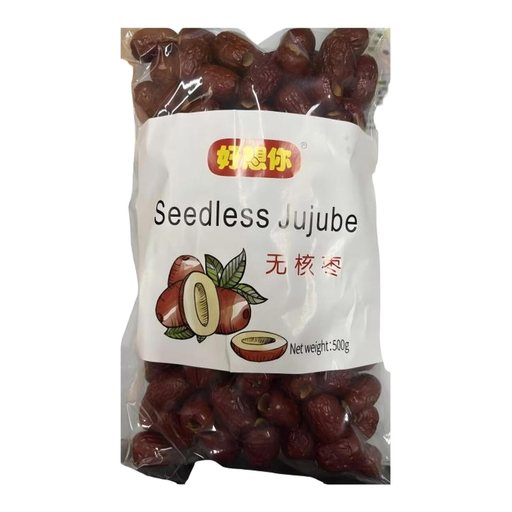
The product description says these pitted red dates can be used as an ingredient in cooking and baking, among other things.
The description lists 100% red dates and confirms that they are pitted.
 No image available
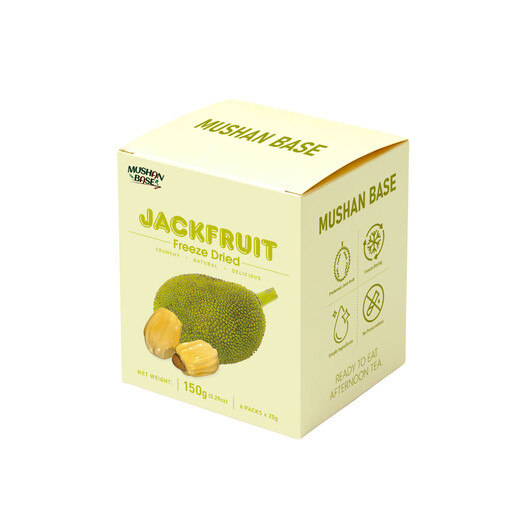
The product description presents this as a crunchy snack to eat straight from the pack, but that does not automatically make it suitable as a baby-led weaning snack.
The description lists jackfruit as the only ingredient and gives six portions of 25g. The CDC lists unprepared dried fruit as a choking risk for young children.
 No image available
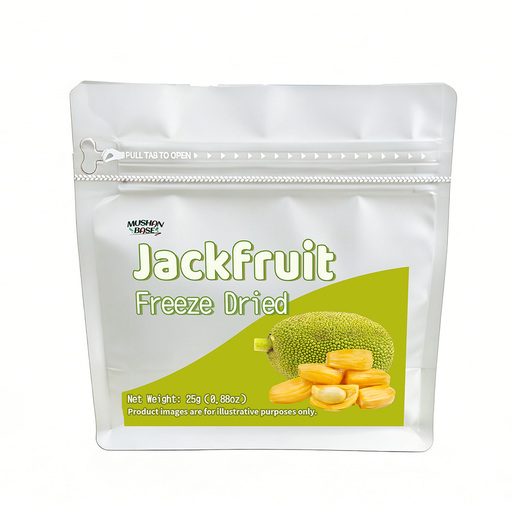
The product description presents this as a crunchy snack to eat straight from the pack; assess the texture separately before offering it to a baby.
The description lists jackfruit as the only ingredient and says no sugar has been added. The CDC lists unprepared dried fruit as a choking risk for young children.
 No image available
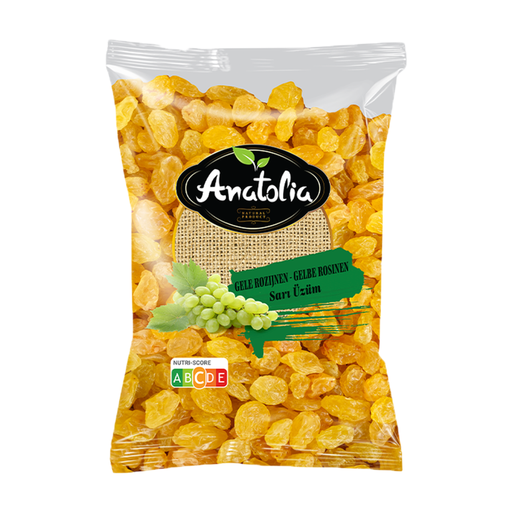
The product description suggests these raisins as a snack and as an ingredient in foods such as breakfast cereals and baked goods.
The description lists 100% dried grapes. It also warns of a choking hazard for young children; the CDC lists unprepared raisins as a choking risk.
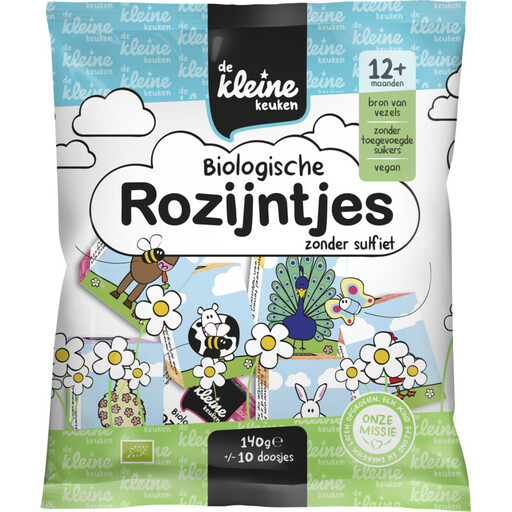 No image available
The product information says these raisins are intended for children aged 12 months and over; this age label is not a recommendation to offer them earlier as a snack.
The description says no added sugar and no sulphites, and lists ten boxes of 14g. The CDC lists unprepared raisins as a choking risk for young children.
No. Historical product information for AH Unsulphured Apricots listed potassium sorbate (E202). So ‘unsulphured’ does not describe all additives; check the ingredients list for the exact variety too.
No. The PLUS dried apricots reviewed here are listed as vegan, but the product information says they contain E220 (sulphites). Check the ingredients list if you want to avoid sulphites.
Unprepared raisins are not automatically suitable to offer as finger food. The CDC lists unprepared raisins as a choking risk for young children; you should also take your baby’s eating skills into account. The Netherlands Nutrition Centre says children should be able to sit upright, and swallow and chew well, before having larger pieces.
No. For the Alesto mango strips described, Lidl says they contain no added sugar but do contain naturally occurring sugars. So check the nutritional information, and don’t automatically treat a pack serving as a portion for your baby.
Read both the ingredients and any warnings about accidental presence; a short ingredients list does not answer the second question. The NVWA outlines the rules, effective from 1 January 2026, on how and when businesses must warn about allergens that may be present unintentionally. The NVWA says the production date is the reference point for existing packaged stock, so you shouldn’t disregard an older warning just because you bought the product later.