What should you look for when choosing?
Start by considering your baby’s eating skills and the preparation that suits them; only then look at protein, sugar and practical storage instructions.
| What to consider |
What should you check? |
Who does this matter most to? |
| Texture, shape and stone fragments |
Choose a shape and texture to suit your baby’s ability to chew and swallow; check for hard stones and read the variant’s allergen information. |
When choosing fruit for a baby who is just starting to self-feed, I mainly want to know how to prepare it appropriately and what to check before serving. Around 36% of consumers put eating safely first. |
| Protein and the claim |
Compare protein and energy per 100 g on the same basis; assess the claim requirements separately from the number of grams of protein. |
If you search for ‘high protein’, you want to know what the label actually says and whether the claim applies to the exact product. Around 29% of consumers prioritise checking the protein claim. |
| Sugar and portion size |
Check both total sugars and the ingredients; a standard pack serving is not automatically a suitable portion for a baby. |
If you’re considering dried fruit for your child, you want to take the sugar information into account and decide for yourself how much to use. Around 21% of consumers make sugar and portion size their main priority. |
| Processing and storage |
Check whether water is listed as an ingredient, how large the pack is and what the instructions say about storage after opening. |
When using it in family meals, I want to know how the variant has been processed and whether the pack suits the way I use it. Around 14% of consumers focus mainly on preparation and storage after opening. |
For the variants reviewed, AH lists 4 g of protein per 100 g, Jumbo 3.2 g and PLUS 3.4 g. These figures come from the labels of those specific products; they are not independent measurements or proof that a product is suitable for babies. The European Commission and the Netherlands Food and Consumer Product Safety Authority explain that nutrition claims must meet the relevant requirements. Simply reading the grams of protein is therefore not the same as assessing a claim.
The AH and PLUS labels reviewed list 37 g and 53.4 g of total sugars per 100 g respectively, alongside 0 g of added sugars. This shows why ‘no added sugars’ does not mean low in total sugar. The Netherlands Nutrition Centre recommends small portions of dried fruit and favours fresh fruit as a snack for children.
Soaked apricots are not automatically ready to give directly to your baby. Adapt the preparation to your baby’s eating skills, supervise them and check for hard stone fragments. UK safety guidance advises against giving whole raisins or dried fruit to babies under 1 year old and recommends cutting them into small pieces. This is UK safety guidance, not a Dutch legal age limit.
Products at Joybuy
These Joybuy products are dried apricots discussed as ingredients for dishes. The product information lists added sugar and sulphites for both; assess preparation for your baby separately.
 No image available
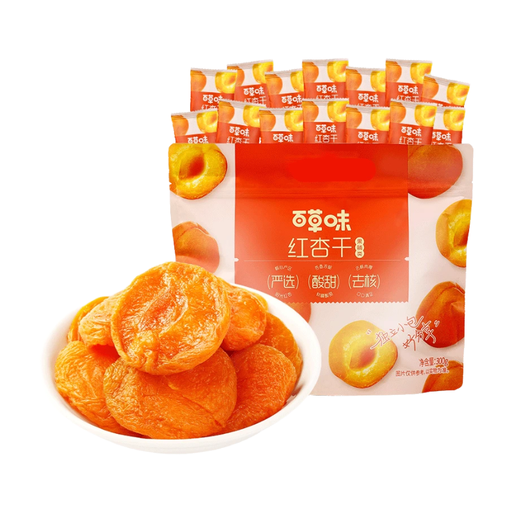
Be&Cheery dried red apricots 300 g
The product information suggests using them in recipes; assess the shape and preparation for your baby separately.
Protein: 0.9 g per 100 g.
Sugars: 64.5 g per 100 g; contains added sugar.
Contains sulphites.
View at Joybuy
 No image available
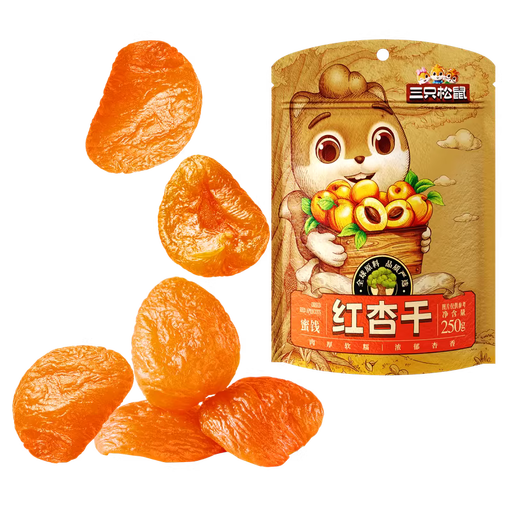
Three Squirrels dried red apricots 250 g
The product information suggests using them in dishes; prepare the fruit appropriately and assess the texture for your baby separately.
Protein: 1.1 g per 100 g.
Sugars: 62.0 g per 100 g; contains added sugar.
Contains sulphites. The product information describes whole apricots; UK safety guidance advises against giving whole dried fruit to babies under 1 year old.
View at Joybuy
Frequently asked questions
Can my baby eat whole raisins or whole dried apricots?
Don’t assume whole dried fruit is a suitable baby-led weaning snack. Official UK safety guidance advises against giving whole raisins or dried fruit to babies under 1 year old and recommends cutting them into small pieces. For larger pieces, the Netherlands Nutrition Centre says babies should be able to sit upright and chew and swallow well; the UK age guidance is not a Dutch legal limit.
Does ‘pitted’ mean I no longer need to check the fruit?
No. The AH and Jumbo product pages reviewed warn that a stone or stone fragment may still be present despite checks. Check the fruit before preparing it and remove any hard stones.
Is ‘high protein’ just a marketing term?
No. Nutrition claims are covered by European rules and must meet the requirements for the specific claim. The European Commission and the Netherlands Food and Consumer Product Safety Authority provide information on this; a protein figure on a label does not by itself prove that a product meets the requirements.
Does ‘no added sugars’ mean dried apricots are low in sugar?
No. The AH and PLUS labels reviewed list 0 g of added sugars, but also 37 g and 53.4 g of total sugars per 100 g respectively. Check both figures and consider how much you use.
How should I store soaked apricots after opening?
Follow the instructions for the exact variant. AH Soaked Dried Apricots should be refrigerated at a maximum of 7°C after opening and have a limited shelf life. Don’t automatically apply these storage instructions to other dried fruit.


