
Vandaag of morgen in huis

Kwaliteit gegarandeerd

Welkomstaanbiedingen ontgrendelen: GRATIS bezorging | Tot 80% korting | Gratis 30 dagen JoyPlus-proefperiode
Download de app
Buying a box of drawing and writing supplies seems straightforward – until you find the marker dries out too quickly, the pen bleeds through the paper, or a child struggles to grip the colouring pens. Product packaging often emphasises lots of colours, ergonomic shapes or “quick-drying” ink. Those features are only useful if they suit how you’ll actually use them.
This guide helps parents, school pupils, students, teachers, office professionals and creative hobbyists make informed choices. We focus on verifiable product specifications such as tip size, ink type, number of pieces, surface suitability and age recommendation.
A set with dozens of colours isn’t automatically practical. For hand lettering, brush pens with a flexible tip are more useful than broad colouring pencils. For small notes, a 0.5 mm gel pen often gives greater precision than a marker with a wide tip. So check the intended use first, and only then consider the number of colours.
According to product information from various brands, certain inks can be washed from skin and most fabrics. That’s no guarantee for every surface, colour or drying time. Always test new wax crayons, dot markers or dual-tip markers on an inconspicuous area first, and close pens and markers tightly after use.
Acrylic markers and permanent markers are designed for different surfaces than ordinary felt-tip pens. Check whether the product description mentions paper, wood, glass, ceramic, metal or fabric. Also pay attention to preparation: some markers need to be shaken and activated with a pump mechanism.
The tip determines how much control you have:
Pay attention to the difference between:
Claims about drying, washability or opacity should be read as product information from the brand, not as a guarantee for every situation.
For children, a sturdy casing, well-fitting caps and a clear age recommendation are important. With products for young children, also check whether the manufacturer provides information about ventilation in the cap and materials used. The EN 71 marking on some Faber-Castell brush pens refers to a European toy safety standard; always check which information applies to the specific product you choose.
Store pens and markers in a dry place, close caps immediately and retract any retractable tips. This helps prevent drying out and damage. With ballpoint pens and gel pens, it’s also wise to avoid pressing the tip against a hard surface.
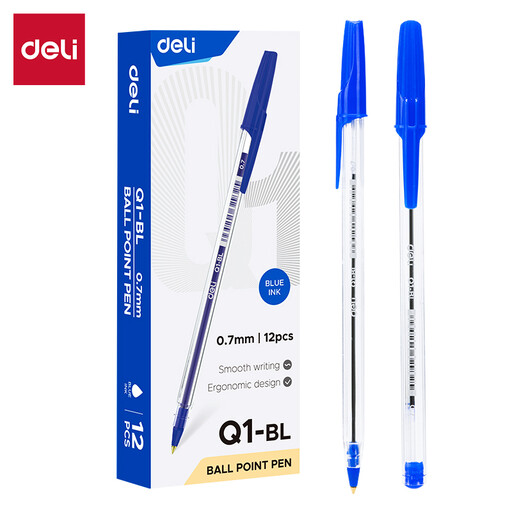
Why this fits the profile: A 12-pack of blue ballpoint pens is practical for school bags, homework stations and office supplies.
The 0.7 mm bullet tip and blue oil-based ink are clearly described, so you’re not relying solely on colour images.
12 pens, medium tip and suitable for notes, forms and everyday writing tasks.
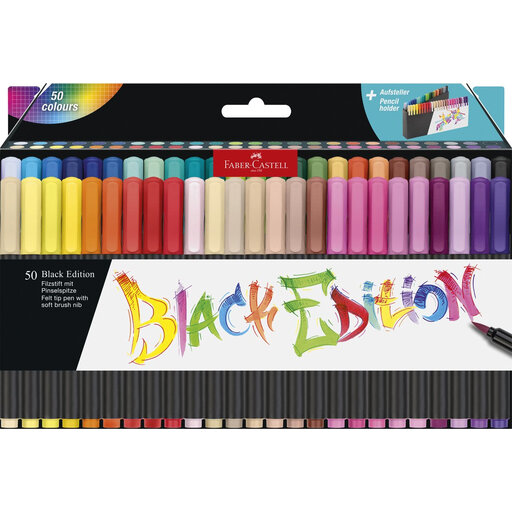
Why this fits the profile: For journaling, small drawings and hand lettering, this set offers a wide colour choice in a cardboard storage box.
The product information explicitly states that the brush pens are intended for light-coloured paper and not for black paper.
50 colours, flexible brush tip and, according to the product information, washable ink based on food colourings.

Why this fits the profile: This set is aimed at creative projects where metallic colours and writing on multiple materials are desired.
The set specifies the surfaces, two tip sizes of 1 and 3 mm, and an ink level indicator. Activation is done by shaking 20 to 30 times and pressing the tip down.
6 metallic acrylic markers, opaque water-based ink according to the product information, and usable on various smooth and porous surfaces.
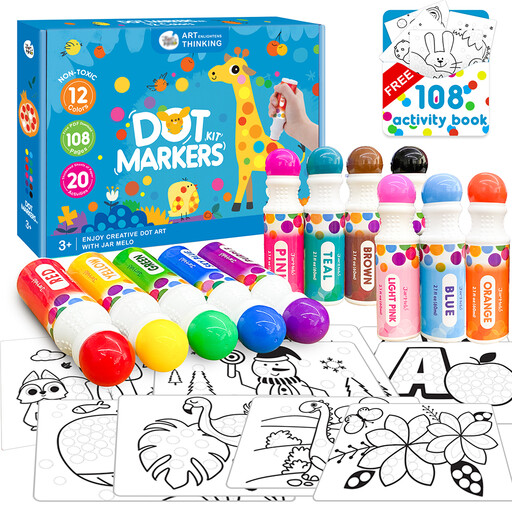
Why this fits the profile: The jumbo shape and sponge-like tip are designed for easy stamping, dotting and large colour areas.
According to the product information, the water-based ink is 90% washable from skin and most fabrics. Even so, prompt cleaning is still advisable.
12 colours, large sponge stamp and an activity book with physical and digital pages according to the product description.
We’ve put together a full, up-to-date list of products that fully meet these strict selection criteria and current European safety regulations.
For school, ballpoint pens, gel pens, mechanical pencils, colouring pencils and highlighters are often practical. Choose a tip size that suits the handwriting style and check that the ink dries quickly enough. For young children, wax crayons and washable markers can be handy, provided the age recommendation is appropriate.
The lifespan depends on use, storage and the type of ink. Close caps immediately after use, store markers horizontally if the product information advises it, and don’t leave acrylic markers open unnecessarily. With mechanical pencils and propelling pencils, you can extend their life by using the correct refills and not applying too much pressure.
Don’t just look at the purchase price. Compare the number of pens, the amount of ink, available refills and the likelihood of drying out. A larger set can be practical for a classroom or shared workspace, while a smaller set makes more sense if you only do journaling, sketching or colouring occasionally.
