For making local corrections to an old portrait, a compact screenless pen tablet is a practical choice if you’re working on the monitor already set up at your shared desk. Choose a wireless model if a cable would get in your way, or consider a pen display if drawing directly on the image matters more to you than the extra space and connections it requires. Adobe describes local corrections using tools including the Spot Healing Brush and Clone Stamp. Also check the dimensions, computer ports and software support for the model you’re considering.
Which type is right for you?
Retoucher with limited desk space
You share your desk and want to be able to put your input device away easily after a session. Compare the overall dimensions and the connection type: these determine how much space the device takes up and how you connect it. Wacom, XPPen and Huion publish dimensions for their named tablet models.
Portrait restorer working on fine details
You want to be able to make small corrections to things such as scratches, marks or damaged details. For remaining damage, Adobe describes local edits using the Spot Healing Brush and Clone Stamp.
Editor who wants to work directly on the image
You want to position the pen over the visible portrait rather than use a separate input surface. The Huion Kamvas 13 (Gen 3) is a pen display with a 13.3-inch screen; check beforehand that its required connections are compatible with your computer.
What should you consider when choosing?
Compact wired pen tablet
A good fit if: you want to clear the shared desk after use and can retouch using the monitor already there.
Bear in mind: you draw on the tablet while looking at another screen; also check which USB connection you need.
Wireless pen tablet
A good fit if: you’d rather not have a connection cable running across the shared desk while you work.
Bear in mind: check the exact model and its connection and power requirements; wireless doesn’t mean you can ignore power management.
Pen display
A good fit if: you want to draw directly on the portrait and can make space for a screen.
Bear in mind: check the video, data and power connections, and which cables are included with the model.
| What to consider |
What should you check? |
Who is this for? |
| Desk space and storage |
Compare the overall dimensions with the space available, then check the active area separately. Huion lists the Inspiroy H640P as measuring 260 × 147,7 × 8 mm overall, with a 160 × 100 mm working area; XPPen lists the Deco mini7 V2 as measuring 260,2 × 162,2 × 9,3 mm, with an active area of 177,8 × 111,1 mm. |
I want to be able to clear the shared desk quickly after retouching, so space and storage are the main consideration for around 36% of consumers. |
| Making small retouches |
Check that your editing software supports pen input and lets you use the brush settings you want. Adobe recommends the Spot Healing Brush and Clone Stamp for remaining damage to old photos; XPPen lists Photoshop support for the Deco mini7 V2. |
I want to use the pen precisely for local corrections to small areas of damage; accurate retouching is the top priority for around 29% of consumers. |
| Connecting to your computer |
Make a note of the ports available and check support for your operating system and software for the exact model. The wired Deco mini7 V2 and wireless Deco mini7W V2 are different models; XPPen lists Bluetooth for the mini7W V2. |
I regularly switch computers or workspaces and want a connection that suits both; connecting and switching is the top priority for around 21% of consumers. |
| Drawing on a screen |
Decide whether you want to see the image directly beneath the pen. For a pen display, check the video output, data and power connections, and the cables included; Huion describes several connection options for the Kamvas 13 (Gen 3). |
I want to position the pen directly over the portrait, even if that means making room for it; working directly on the image is the top priority for around 14% of consumers. |
Common mistakes
-
Comparing only the active drawing area
The whole device takes up more desk space than the active area. That difference matters when you share your workspace with others.
Compare the stated overall dimensions with the space available, then consider whether the active area gives you enough room to work.
-
Assuming every USB-C cable carries a video signal
For a pen display, the connection options depend on the capabilities of your computer’s port and the cable.
For the Huion Kamvas 13 (Gen 3), check that your chosen connection meets the stated requirements, including DisplayPort support for the USB-C connection.
The USB-C-to-USB-C cable for the connection option described by Huion is not included and must be bought separately.
-
Treating wired and wireless versions as the same product
The XPPen Deco mini7 V2 and Deco mini7W V2 have different connection options; similar model names don’t mean they’re the same version.
Check the full model name and stated connection before buying.
Brands to compare
Wacom
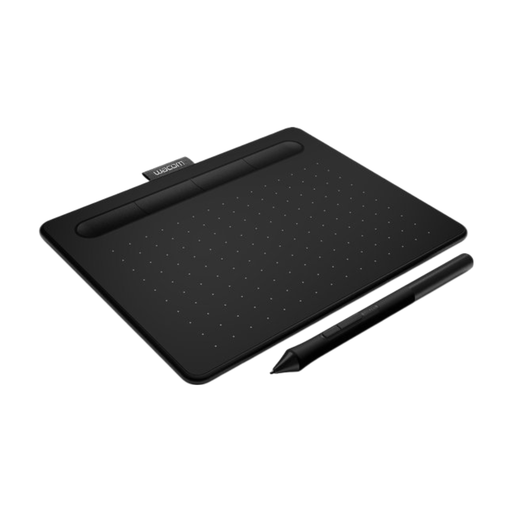
The Intuos Small CTL-4100K-S is a compact screenless pen tablet for use with an existing monitor. Wacom lists this model in its Dutch catalogue.
- Wacom describes the Intuos range as space-saving for desk use.
- Check the version: the CTL-4100K-S is not the Bluetooth model.
XPPen
The Deco mini7 V2 is a wired screenless pen tablet; the separate Deco mini7W V2 is designed for those looking for a wireless connection.
- XPPen lists a 177,8 × 111,1 mm working area, eight shortcut keys and support for software including Photoshop for the mini7 V2.
- Don’t confuse the wired mini7 V2 with the wireless mini7W V2; check the full model name.
Huion
The screenless Inspiroy H640P is a compact option; the Kamvas 13 (Gen 3) is a pen display for those who want to work directly on a screen.
- Huion lists a 160 × 100 mm working area and a Micro-USB connection for the H640P. The Kamvas has a 13.3-inch screen.
- The models have different connections. For the Kamvas, check your chosen connection option and whether the required cable is included.
Xencelabs
The Pen Tablet Small is a screenless model for a compact workspace; the manufacturer says two pens are included.
- Xencelabs lists an active area of 6,93 × 3,89 inches and a carrying case for the Small.
- According to Xencelabs, Quick Keys are sold separately for this Small version.
Drawing tablets at Joybuy
These Joybuy products are suited to retouching at a shared desk, with both screenless pen tablets and models you can work on directly.
 No image available
Wacom MovinkPad 11 Standalone Drawing Tablet, 11.45-inch, 8 GB RAM, 128 GB, Android 14, Pro Pen 3
Suited to anyone who wants to draw directly on the screen and use creative apps on the device.
The product title lists an 11.45-inch IPS display, Android 14, 8 GB RAM and 128 GB storage.
View at Joybuy
 No image available
Wacom Intuos Medium Wired Pen Tablet
Suited to anyone who wants to work on a separate screenless tablet and is looking for a wired connection.
View at Joybuy
 No image available
Wacom Intuos Pro Pen Tablet Medium
Suited to anyone who wants to edit photos using a pen on a screenless tablet while viewing the image on a separate monitor.
View at Joybuy
 No image available
Wacom Intuos Pro Pen Tablet Small
Suited to anyone looking for a screenless pen tablet for a shared workspace and wanting to use it with a pen.
View at Joybuy
 No image available
Wacom One Pen Tablet Small - S
Suited to anyone looking for a small screenless pen tablet and the flexibility to switch between wired and wireless connections.
View at Joybuy
Frequently asked questions
Do I need a tablet with a screen to remove scratches from an old portrait?
Not necessarily: a screenless pen tablet works with the monitor you already use. Adobe describes local corrections using the Spot Healing Brush and Clone Stamp; choose a pen display if drawing directly on the image matters more to you.
What should I check before connecting a pen display?
Check the video, data and power connections, and what’s included in the box for the exact model. For the Kamvas 13 (Gen 3), Huion describes a connection using the included 3-in-1 cable or a suitable USB-C port with DisplayPort support; the USB-C-to-USB-C cable mentioned is not included.
How can I touch up small areas of damage without changing the whole portrait at once?
Adobe describes locally retouching remaining damage with the Spot Healing Brush and, where needed, the Clone Stamp. The technique described uses layer settings for non-destructive editing; practise on a copy of your digital photo first.
What are my rights when buying online in the Netherlands?
Online consumer purchases generally come with a 14-day cooling-off period, although exceptions and the seller’s status may affect this. You’re also covered by the statutory guarantee if a product doesn’t perform as you could reasonably expect under normal use. ACM ConsuWijzer says you should contact the seller to resolve the issue; there isn’t one fixed statutory two-year guarantee period for every product.


