
当日/次日达

品质保障

开启新人专享福利: 全场免邮 | 低至 2 折 | 免费试用 30 天 JoyPlus 会员
下载 Joybuy
A cordless handheld vacuum cleaner is handy for picking up crumbs from the sofa, sand from the car or hairs from a chair. However, compact models can vary considerably in how they perform. A small vacuum cleaner may be ideal for quick clean-ups, but less practical for cleaning an entire home. A cordless stick vacuum offers greater reach, but takes up more space and often needs longer to charge.
So don’t focus solely on claims such as “powerful handheld vacuum” or a high pascal rating. Read on to find out which specifications really matter, which marketing claims to treat with caution and what type of cordless vacuum cleaner best suits your needs.
Manufacturers may state suction power in Pa, kPa or AW. These figures are not always directly comparable. Performance also depends on the nozzle, airflow, filter and selected setting.
So a high figure on the packaging doesn’t automatically mean a vacuum cleaner will work well on thick carpet. Check which floor brush is included, whether there’s a turbo brush and how long the battery lasts on the highest setting.
“Up to 40 or 60 minutes” usually refers to the lowest setting and use without a motorised brush. Battery life can be considerably shorter in turbo mode. For a handheld vacuum cleaner for your car or sofa, 15 to 30 minutes may be enough. For a whole home, a stick vacuum with a longer battery life is more practical.
Also check the charging time, whether the battery is removable and whether an additional battery is available. A fixed battery may be more difficult to replace over time.
A handheld vacuum cleaner with a HEPA filter still needs maintenance. A full dust container or clogged filter reduces airflow and can put strain on the motor. Check whether the filter is washable and how long it needs to dry before you put it back.
Pay attention to the dust container capacity, too. A compact vacuum cleaner with a 300 to 500 ml container is easy to hold, but needs emptying more often. For larger areas, a capacity of 0.6 to 0.9 litres is more convenient.
A moderate setting is often enough for crumbs, dust and sand on hard floors. Pet hair on a sofa, mat or carpet puts more demands on the brush and airflow. A vacuum cleaner for carpets and hard floors works best with multiple settings and a floor brush designed for both surfaces.
Only compare Pa or kPa figures within the same product category. The manufacturer’s product information is a useful starting point, but performance can vary from one surface to another. Claims such as “powerful” or “professional” are not independent performance standards.
Consider battery capacity, charging time and settings together:
An LED light on the nozzle can make dust under furniture or in dark gaps between car seats easier to see. This helps you direct the vacuum, but doesn’t by itself indicate how effectively it picks up dirt.
A HEPA filter can, according to the product description, filter fine particles from the air drawn into the vacuum. Always check which type of filter is actually included. For example, the Philips XC8055/01 is listed as having a five-stage filtration system, but the specifications don’t mention a HEPA filter. The Aspiron AS-CA038 does list a HEPA filter, and its metal filter is washable.
Useful accessories include:
Don’t use a regular dry handheld vacuum cleaner to pick up liquids. Only models with an explicit wet-and-dry function are designed for this, and the limits in the instruction manual still apply.
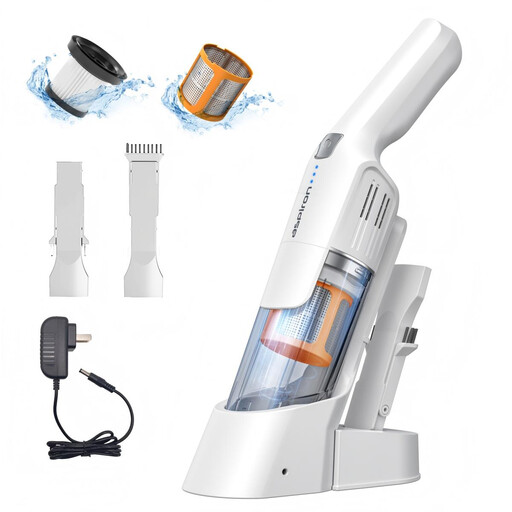
Why it suits this type of user: This compact model is designed for quick clean-ups of crumbs and for cleaning furniture, desks and car interiors.
The product information lists two settings, a battery life of up to around 25 minutes on the standard setting and a 500 ml dust container. This makes the main usage limits clear.
According to the product description: up to 24 kPa on the highest setting, a HEPA filter, crevice tool, brush and charging station.
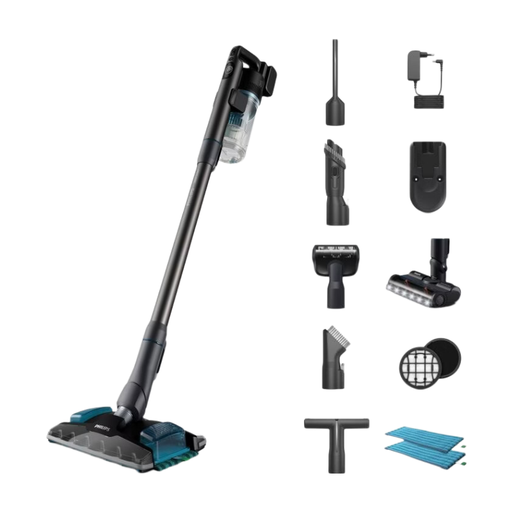
Why it suits this type of user: This 2-in-1 stick vacuum is ideal for households looking to combine floor cleaning, handheld vacuuming and mopping in one appliance.
The stated battery life is broken down by setting: up to 80 minutes on low and 30 minutes in turbo mode with the motorised nozzle.
According to the product information: a 0.6-litre dust container, LED lighting, removable battery, handheld mode and integrated mopping function.
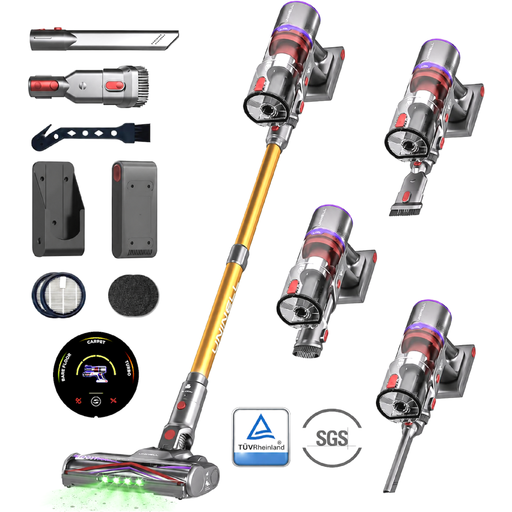
Why it suits this type of user: Designed for larger households and pet owners who want one system for cleaning carpets, hard floors, furniture and car interiors.
The manufacturer lists a removable battery, an anti-tangle brush and a battery life of up to 65 minutes. These details help you judge whether it’s suited to quick daily touch-ups or longer cleaning sessions.
According to the manufacturer: peak suction power of 60 kPa, seven-stage filtration, LED lighting and conversion to handheld mode.
We’ve put together a complete, up-to-date list of products that meet these strict selection criteria and the applicable European safety regulations.
That depends on the brush. A brush attachment is useful for removing hair from furniture or car seats. For carpets, a motorised or anti-tangle brush is generally more practical. Also check whether the brush is easy to remove and clean.
Battery life varies depending on the setting and attachment. Manufacturers often state the maximum running time on the lowest setting. Expect a shorter battery life during intensive use. A removable battery can be useful if you want to clean several rooms in one go.
As well as the purchase price, the main costs to consider are electricity, filters and possible battery replacement. Washable filters help reduce ongoing costs, but must be completely dry before you put them back. Empty the dust container regularly and keep the air inlet clear to avoid putting unnecessary strain on the motor.
