
Vandaag of morgen in huis

Kwaliteit gegarandeerd

Welkomstaanbiedingen ontgrendelen: GRATIS bezorging | Tot 80% korting | Gratis 30 dagen JoyPlus-proefperiode
Download de app
Coffee that cools too quickly, hot fingers on a glass or condensation rings on the table: these are familiar problems with ordinary glasses. Double-walled glasses can help reduce these inconveniences, but not every model suits every drink or household. Marketing terms such as “thermal”, “heat-resistant” and “suitable for all temperatures” also don’t always tell you enough about everyday use.
So focus on capacity, material and which appliances the glasses can be used with. Read on to find out what to look for and which models suit different needs.
An 80 ml glass is practical for espresso, a small dessert or a strong coffee. It’s usually too small for cappuccino, latte or cold drinks. Conversely, a 450 ml glass can be awkwardly large for an espresso.
So look beyond the shape and check the actual capacity. Allow room for milk froth, ice cubes or layers of dessert.
Borosilicate glass is known for how well it handles changes in temperature. Even so, it’s still breakable. For example, don’t pour boiling water into a glass straight from the fridge. Also check whether the product is explicitly suitable for the microwave, oven, freezer and dishwasher. These features can vary between collections and sizes.
According to Bodum’s product information, various PAVINA, BISTRO, SKÅL and CANTEEN models are suitable for these appliances within a specified temperature range. That doesn’t mean every double-walled glass can be used in the same way.
The double wall is designed to make the outside feel less hot or cold and to limit condensation. With a very cold drink, high humidity or prolonged use, moisture can still form. So think of “condensation-free” as a benefit of the design, not an unlimited guarantee in every situation.
Many thermal glasses are made from borosilicate glass. Product descriptions often associate this material with a lighter weight and resistance to temperature changes. According to the manufacturer, the Bodum models in this guide are mouth-blown from heat-resistant borosilicate glass.
Other models, such as the DeLonghi DLSC311, use tempered glass. According to the product information, it’s designed to offer extra resistance to thermal shock. Be sure to check appliance compatibility for this model: the listed specifications say it’s dishwasher-safe, but don’t mention whether it’s suitable for the microwave or freezer.
Use these guidelines as a practical starting point:
A straight tumbler is handy for cocktails, soft drinks and tea. A handled cup is more comfortable to hold when drinking cappuccino or latte. Also check the diameter if you want to place the glasses under a coffee machine.
Always check the product specifications rather than relying on the words “dishwasher-safe” alone. According to the manufacturer, some models are also suitable for the oven and microwave, but only up to a limit such as 176 °C or 180 °C. Don’t put a glass straight from the freezer into a hot oven, and avoid sudden changes in temperature.
A small silicone valve or an opening on the base may be part of the design. According to the product description, this helps equalise the pressure between the two layers of glass. Don’t try to remove or damage it.
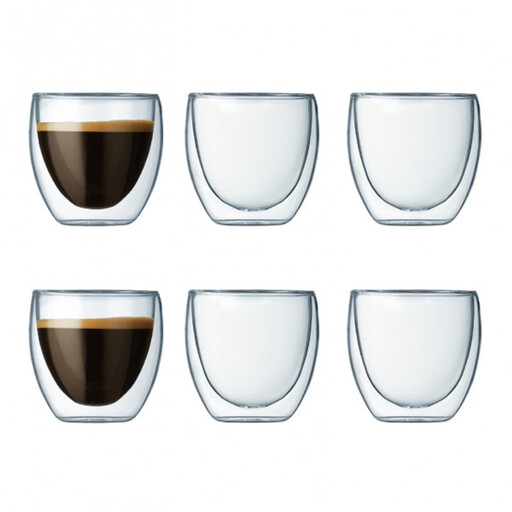
Why it suits this need: This set of six small glasses is ideal for households looking to try them out with espresso or small desserts, without buying several different sizes straight away.
The 80 ml capacity makes it clear what this glass is designed for. Don’t expect a latte-sized glass; the capacity is easy to gauge and works well for espresso and small servings.
Set of 6, made from borosilicate glass and, according to the product description, suitable for the dishwasher, microwave, oven and freezer up to 176 °C.
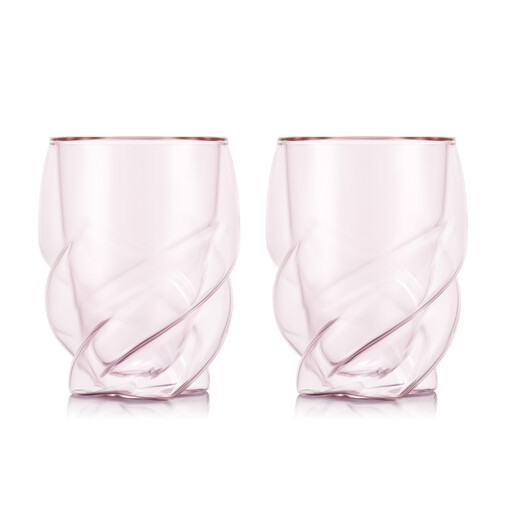
Why it suits this need: The 270 ml capacity is versatile enough for coffee, tea, soft drinks, cocktails and cold brew. The twisted outer wall gives you extra grip and a distinctive look.
The product information lists the material, capacity, set size and maximum oven temperature. This makes it easy to compare the model based on practical details, rather than choosing on looks alone.
Mouth-blown borosilicate glass, 270 ml per glass and, according to the product description, dishwasher-safe, microwave-safe and oven-safe up to 180 °C.
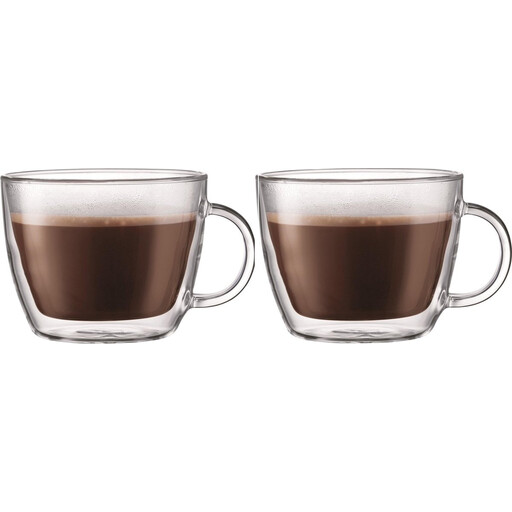
Why it suits this need: The generous capacity is ideal for café latte, large cold drinks and desserts, as well as soup according to the product description.
The generous capacity leaves room for milk froth or ice without bringing the drink right up to the rim. For espresso, though, this model is unnecessarily large.
Set of 2, mouth-blown borosilicate glass and, according to the product description, suitable for the dishwasher, freezer, microwave and oven up to 176 °C.
We’ve put together a complete, up-to-date list of products that meet these strict selection criteria and the applicable European safety regulations.
It depends on the model. Many Bodum PAVINA and BISTRO glasses are described as dishwasher-safe. Always check the specifications for your exact version, and don’t put damaged glasses in the dishwasher.
Some double-walled glasses are described by the manufacturer as microwave-safe, but that doesn’t apply to every thermal glass. Check the maximum temperature too, and avoid sudden changes in temperature.
How long they last depends on how you use and clean them, and how you handle changes in temperature. Borosilicate or tempered glass can be practical for hot and cold drinks, but both materials can break if dropped, knocked or exposed to thermal shock. Don’t use a glass with a crack, chip or damaged base.
