
Vandaag of morgen in huis

Kwaliteit gegarandeerd

Welkomstaanbiedingen ontgrendelen: GRATIS bezorging | Tot 80% korting | Gratis 30 dagen JoyPlus-proefperiode
Download de app
At first glance, a donut dog bed seems simple: a round shape, soft plush fabric and a raised edge. However, there are clear differences in size, filling, ease of cleaning and stability. Particularly with medium-sized and large dogs, making the wrong choice can result in a bed that quickly goes flat, shifts around or is difficult to clean.
So don’t just look for terms such as “soft” or “calming dog bed”. Above all, check the product specifications and consider how your dog sleeps, how much space they need and where the bed will be placed.
The external dimensions don’t tell the whole story. The raised edge takes up part of the lying area. A dog that likes to stretch out therefore needs more space than a dog that usually curls up.
Measure your dog from nose to the base of their tail and add extra room for movement. Also look at the height of the edge. A donut dog bed measuring 90 cm in diameter and 20 cm high may suit many medium-sized dogs, but it is not automatically suitable for every dog of that size.
With some models, only the cover can be machine washed. The inner filling then needs to be aired separately or cleaned locally. That isn’t a problem, as long as you know this in advance.
So check:
A dog bed with a washable cover or a washable dog basket is practical for muddy paws, wet fur and accidents, but the care instructions remain important.
A dog bed with a non-slip base can help reduce sliding, but it only works well on a flat, dry surface. Rubber dots are no substitute for stable positioning. On smooth tiles or a wet floor, the bed may still move.
Also check the seams, zip and underside regularly. With dogs that like to chew, supervision during the first few uses is advisable. Stop using the bed if filling becomes visible or parts come loose.
The models in this selection are mainly aimed at medium-sized and large dogs:
Measure not only your dog, but also the crate. A donut-shaped bed will not automatically fit every crate. Check the internal dimensions of the crate and allow for the raised edge. For a dog bed for a crate, the width and unobstructed door opening are particularly important.
Plush fabric feels soft and suits dogs that like to lie in a warm, cosy spot. However, a plush dog bed can trap dirt more quickly than a smooth cover. Regularly shaking it out and washing it according to the care label will help keep the sleeping area fresh.
The models mentioned use PP cotton filling or PP filling. According to the product descriptions, this filling provides a resilient, supportive layer. This is a product specification, not a medical benefit. Firmness can change over time through use, weight and maintenance.
The beds are vacuum-packed. Gently shake and knead the bed after delivery so that it can regain its shape. Leave it to expand on a flat surface before allowing your dog to sleep on it.
Wash the removable cover according to the care label. With several models, the central filling can be removed through a zip on the underside. According to the product information, the inner core is not suitable for machine washing and should be spot-cleaned or aired regularly.
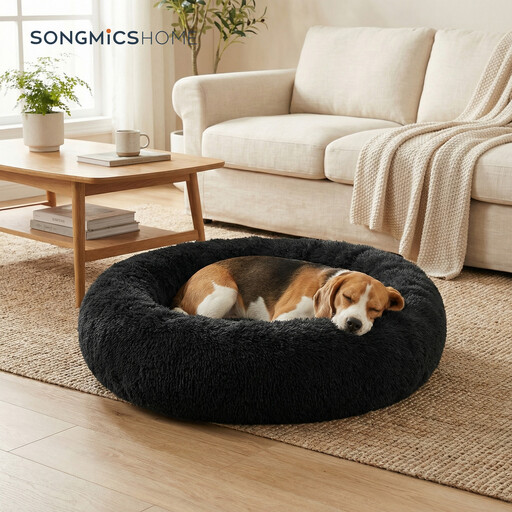
Why it suits this profile: This compact model is aimed at medium-sized dogs and can be placed in a quiet corner or a suitable crate.
The size and materials are clearly stated. The cover can be removed via a zip; the inner core needs to be maintained separately.
Plush surface, PP cotton filling, removable cover and rubber non-slip dots.
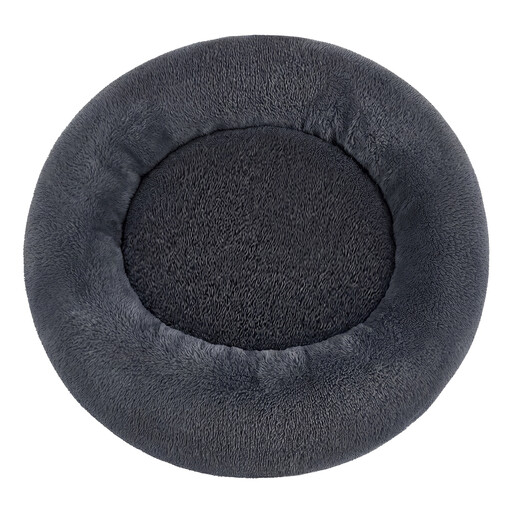
Why it suits this profile: The generous diameter gives large dogs and households with several pets more room to move.
The product information lists the diameter, height, plush fabric, PP cotton filling and care of the inner core separately.
120 cm diameter, removable cover, rubber non-slip base and PP filling.

Why it suits this profile: A practical choice for a medium-sized dog that uses a dedicated spot at home or in a suitable crate.
The instructions state that the cover can be washed on a gentle cycle according to the care label, while the inner pad should only be spot-cleaned.
90 cm diameter, plush covering, PP cotton filling and non-slip dots on the underside.
Place the bed on a dry, flat surface and make sure the non-slip side is in full contact with the floor. In a crate, the door must be able to close freely and your dog must still be able to turn around comfortably.
For the first use, you could place a familiar blanket or toy on the bed. This may make the transition easier, but a dog bed is not a substitute for training or guidance. According to the product information for the models mentioned, regularly shaking the bed out helps keep the filling light and airy.
Wash the cover when it is dirty and allow everything to dry completely before using the bed again. Inspect the material regularly for loose seams, damaged zips and exposed filling.
We’ve put together a complete, up-to-date list of products that fully meet these strict selection criteria and the applicable European safety regulations.
That depends on the internal space and your dog’s sleeping habits. According to the product information, models measuring 120 cm in diameter are intended for large dogs, but always measure your dog and the available space first. A dog that sleeps stretched out needs more free space than one that curls up.
Yes, provided the bed’s dimensions are suitable for the crate’s internal measurements. Check the crate’s width, length and height, and make sure the door does not press against the raised edge. A large donut bed may take up too much space in a standard crate.
The lifespan depends on your dog’s weight, daily use, washing and chewing habits. Regular airing, gentle washing and repairing minor damage promptly can help keep the bed usable. Replace it as soon as seams start to come apart or the filling becomes visible.
