
Vandaag of morgen in huis

Kwaliteit gegarandeerd

Welkomstaanbiedingen ontgrendelen: GRATIS bezorging | Tot 80% korting | Gratis 30 dagen JoyPlus-proefperiode
Download de app
A donut dog bed looks soft and inviting, but not every round bed is suitable for your pet. A bed that is too small restricts sleeping positions, a poorly filled edge quickly loses its shape and a cover that cannot be removed makes cleaning unnecessarily difficult.
If you focus only on the colour or amount of plush material, you could end up spending money on a bed that is no longer comfortable or practical after a few months. Pay particular attention to the size, raised edge, filling and cleaning method.
With a round dog bed, the outside diameter matters. The raised edge takes up some of the interior space. A 70 cm bed is therefore not automatically suitable for a dog that is 70 cm long.
Measure your dog while it is lying down in a relaxed position, preferably in the posture in which it usually sleeps. Add extra room for turning around and stretching its legs. Dogs that like to curl up may be comfortable in a smaller size, while larger dogs generally need more open space to lie down.
A plush dog bed or fluffy dog bed feels soft when you unpack it. That says little about how firm it will remain after daily use. So check the type of filling and whether the edge retains its shape.
PP cotton is used as a soft, resilient filling in the models mentioned. If your dog moves around a lot or regularly leans heavily against the edge, it is a good idea to fluff up the filling regularly. If you are looking for a firmer sleeping surface, you could also consider a bed with egg-crate foam, as found in some orthopaedic models.
A product may be described as “washable” even though only an inner cushion or cover can go in the washing machine. Check whether it is a dog bed with a removable cover, which parts can be washed and whether the care instructions specify a gentle cycle.
An anti-slip dog bed also does not automatically prevent a bed from sliding on every type of floor. Place it on a flat, dry surface and check that the anti-slip pads are fully in contact with the floor.
Use the guide below as a starting point, not as a fixed rule:
Always check the stated maximum load and dimensions on the product page. For example, the larger models in this selection are described as suitable for dogs weighing up to around 30 kg, but sleeping habits and body length remain decisive.
A dog bed with a raised edge can be comfortable for dogs that like to lean against something or rest their head. The donut shape surrounds the sleeping area. According to the brands’ product descriptions, this shape is designed to create a feeling of security; this is a manufacturer’s design claim and does not guarantee any effect on anxiety or behaviour.
Pay attention to the height of the edge. An edge of around 20 cm provides support, but may be less accessible for a very small, older or less mobile dog.
Check these points before ordering:

Why it suits this profile: A manageable size for small and medium-sized dogs, with a round design and a removable central cushion.
The 70 cm diameter and 20 cm height are clearly stated. The central cushion can be removed via the zip for cleaning.
Plush fabric, PP filling, anti-slip pads and a washable central cushion.
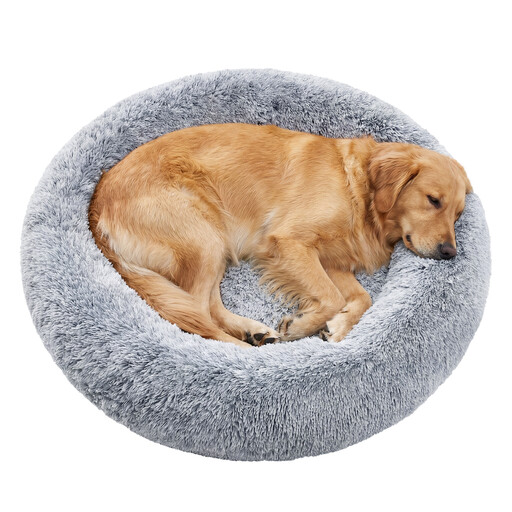
Why it suits this profile: For owners looking for a spacious, soft sleeping area for a medium to large dog or several small pets.
The generous diameter prevents you from focusing only on a small interior space. The outer cover can be removed using a concealed zip and, according to the product information, is machine washable.
100 cm diameter, raised edge, plush polyester and PP cotton filling with an anti-slip base.

Why it suits this profile: An alternative for those who want not only plush comfort, but also a more structured sleeping surface and raised head support.
The product description mentions egg-crate foam, a removable machine-washable cover and anti-slip material. However, check the exact size of variant M before purchasing.
Egg-crate foam, raised head support, plush and sherpa fabric, removable cover and anti-slip underside.
We have compiled a complete, up-to-date list of products that fully meet these strict selection criteria and the applicable European safety regulations.
Allow a vacuum-packed bed to expand fully first, then loosen and fluff the filling. Place it in a quiet spot away from direct moisture or strong heat. A familiar blanket or toy can help your pet get used to it.
Only wash the bed according to the care label. Use a mild detergent and avoid bleach or harsh chemicals. Allow all parts to dry completely before putting them back together. Fluff up the filling regularly and remove hair with a hoover or lint roller.
A dog bed is not a substitute for a crate, restraint or medical equipment. If your pet shows ongoing anxiety, signs of pain or movement difficulties, it is wiser to seek advice from a vet than simply to buy a different bed.
Measure your dog while lying down and add room for turning around. Consider the interior space, not just the overall diameter. A 70 cm bed is often suitable for small to medium-sized dogs; larger dogs can use models measuring 100, 120 or 140 cm.
This varies by model. On several of the beds mentioned, the cover or central cushion can be removed and machine-washed according to the care label. The inner filling or core is not machine washable on some models. Check this before purchasing.
Yes, according to their product descriptions, several round models are also suitable for cats. Cats that like to curl up may particularly appreciate the raised edge. Check the diameter and place the bed in a quiet, dry spot.
