
Vandaag of morgen in huis

Kwaliteit gegarandeerd

Welkomstaanbiedingen ontgrendelen: GRATIS bezorging | Tot 80% korting | Gratis 30 dagen JoyPlus-proefperiode
Download de app
At first glance, a donut dog bed seems simple: a round bed with a soft raised edge and a padded centre. In reality, models vary considerably in size, care requirements and stability. Choose the wrong one and your dog may have too little room, the filling may flatten quickly or the bed may slide across the floor.
In this buying guide, I focus on verifiable features as a Joybuy Product Recommendation Officer. That way, you can look beyond claims such as “calming”, “orthopaedic” or “extra durable”.
A 70 cm dog bed sounds spacious, but the raised edge takes up some of the sleeping area. So, measure your dog while they’re lying comfortably, from nose to the base of the tail. Add around 15 to 25 cm if your dog likes to stretch out.
A round dog bed with a diameter of 60 or 70 cm will usually suit a cat, puppy or small dog. For medium-sized dogs, 80 or 90 cm may be more practical. Large dogs often need a bed that’s at least 100 cm in diameter, depending on how they sleep.
Check whether you can wash just the centre cushion, the cover or the entire bed. With some models, the inner filling isn’t suitable for machine washing. A dog bed with a washable cover is often more convenient for everyday use, as it lets you tackle hair, mud and accidents more easily.
Check the care label, too: you may need to use a delicate wash cycle, mild detergent and air-drying. Don’t use bleach unless the manufacturer explicitly says it’s safe to do so.
A plush dog bed may feel comfortable, but without an anti-slip layer it can move when your dog gets in. This can be particularly inconvenient on laminate, vinyl or tiled floors. An anti-slip dog bed with rubber grips can help reduce movement, but you should still place it on a flat, dry surface.
Check regularly for loose seams, torn fabric and exposed filling. Dogs that like to chew need extra supervision, especially while they’re getting used to the bed.
Don’t choose based only on your dog’s breed or weight. A dog that sleeps curled up needs something different from one that stretches out fully. Consider:
If you have both a dog and a cat, a bed for dogs and cats could be a good option, as long as there’s enough room for both animals and neither crowds the other while resting.
PP cotton filling is light and resilient. The product descriptions for the donut beds say that this filling provides support and helps the bed keep its shape. That doesn’t automatically mean the bed has a medical or orthopaedic effect.
When considering a so-called orthopaedic dog bed, it’s useful to look at how it’s made. For example, FUNNYFUZZY models use egg-crate foam and a raised headrest. These are verifiable design features. Claims about alignment or joint comfort come from the brand’s product description and shouldn’t be taken as medical advice.
A concealed or low-set zip lets you remove the inner cushion from the cover. Check whether:
Many models are vacuum-packed. Shake and fluff the bed after unpacking it. Some products recommend waiting 24 to 48 hours for the bed to regain its full shape.
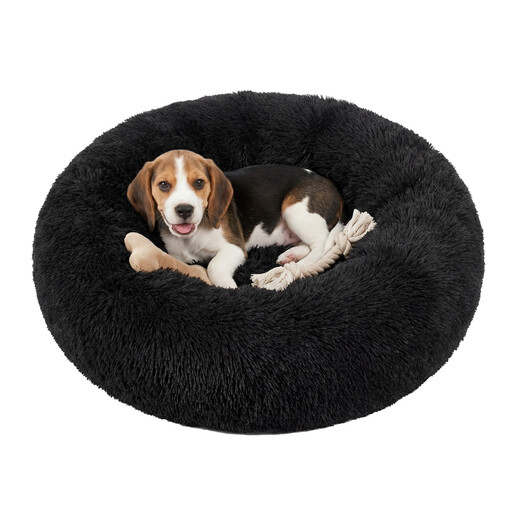
Why it suits this profile: This round model is designed for small and medium-sized dogs and has a diameter of 70 cm. The central cushion can be removed using a zip.
The product details list a removable centre cushion and rubber anti-slip grips. Check beforehand that 70 cm is large enough for the way your dog sleeps.
70 cm diameter, 20 cm high, plush fabric, PP cotton filling and an anti-slip base.

Why it suits this profile: The sofa-style design combines plush and sherpa fabric with egg-crate foam, a raised headrest and a removable cover.
According to the product information, the cover is machine washable. The foam core needs to be cared for separately, following the care instructions.
Egg-crate foam, raised headrest, removable machine-washable cover and anti-slip fabric.
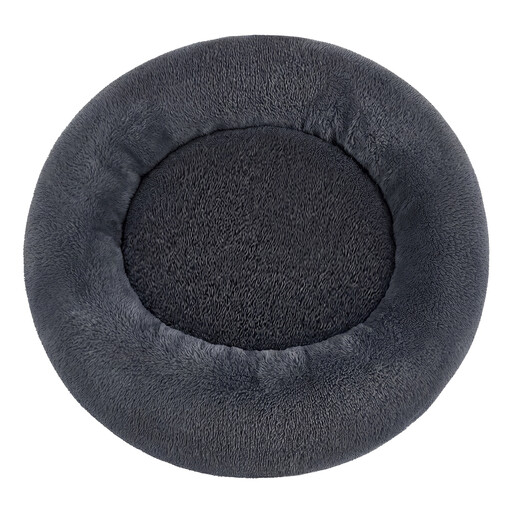
Why it suits this profile: This model is designed for small to medium-sized dogs and cats. Its 80 cm diameter offers more room than compact versions.
The inner pad can be removed using the zip. The product information also mentions an anti-slip base and separate care for the core.
80 cm diameter, 20 cm high, plush material, PP filling and suitable for dogs and cats.
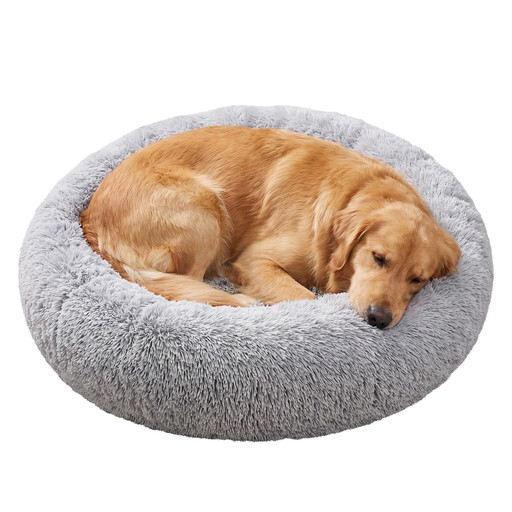
Why it suits this profile: According to the product information, this extra-large version is designed for large dogs. Its wide donut shape may also suit several small pets, provided they have enough room.
The dimensions give you a clear basis for choosing, rather than relying on breed descriptions alone. The cover is removable; check the washing instructions before use.
140 cm size, 20 cm high, plush fabric, PP filling and rubber anti-slip grips.
We’ve put together a complete, up-to-date list of products that meet these strict selection criteria and the applicable European safety requirements.
Place the bed in a dry, level spot where your dog likes to rest. A quiet corner of the living room or a suitable place in a crate can help your dog get used to it. You could also put a familiar blanket or toy in the bed.
If the bed is vacuum-packed, loosen the filling first by shaking and gently fluffing it. Let the bed dry completely after washing, and keep it away from radiators, open flames and other heat sources.
It depends on the diameter and how your dog sleeps. A 120 cm or larger model offers more room than a 70 cm bed. Measure your dog while they’re lying down, and always check the dimensions of the specific product.
That depends on how often it’s used, how much your dog sheds and whether there have been any accidents. Wash the cover when it looks dirty or starts to smell less than fresh. In between washes, you can remove hair with a vacuum cleaner or lint roller. Check first whether the cover alone or the inner cushion is washable too.
Its lifespan depends on use, your dog’s weight and their chewing habits. Regularly fluffing the bed can help keep the filling springy. Check the seams, zips and anti-slip layer regularly, and replace the bed as soon as the filling becomes visible or the structure is damaged.
