
Vandaag of morgen in huis

Kwaliteit gegarandeerd

Welkomstaanbiedingen ontgrendelen: GRATIS bezorging | Tot 80% korting | Gratis 30 dagen JoyPlus-proefperiode
Download de app
A crate bed needs to do more than just feel soft. It should fit without blocking airflow or room to move, stay put, and be easy to clean regularly. With medium to large dogs, older pets or enthusiastic diggers, the wrong material can quickly lead to wear, smells or a bed that no longer lies flat.
The Joybuy Product Recommendation Officer therefore filters key product information down to practical essentials. Pay particular attention to these three common pitfalls.
A 90 cm dog bed won’t automatically fit a crate that’s 90 cm wide. Raised rims, seams and any protruding parts all take up space. So measure the inside of the crate and compare that to the actual lying area, not just the total diameter or length of the bed.
Your dog should be able to lie down, turn around and get up comfortably. For a bed for medium dogs, 80 or 90 cm can sometimes be right, while a large dog often needs more space. A 120 cm round donut bed is, for example, better suited to a roomy crate or as a bed in your living space than to a standard crate.
A very soft dog bed can be appealing, but the filling may compress over time. Look at the type of filling and construction. PP cotton and polyester fibre are used in the models described as supportive padding. That tells you something about the material, but not automatically how long the bed will hold its shape.
For an older or joint-sensitive dog, an orthopaedic dog bed with a firm lying surface and an all-round rim can be practical. Treat “orthopaedic” here as a product label: according to the product description, the FUNNYFUZZY bed is designed to support the entire body. This does not replace advice from a vet.
Check which parts can be washed. With various donut models the cover is removable and washable, while the inner filling should only be aired or spot cleaned. For FUNNYFUZZY models, the inner cushion must be removed before washing the cover.
A washable dog bed is especially practical when zips are sturdy, the cover comes off easily and everything can dry fully. Putting the filling back while it’s still damp can encourage odours and mould. Always allow all parts to air-dry completely first.
Measure your dog from nose to base of tail and add extra room to turn and stretch. Also consider sleeping position:
For round models, check whether the stated diameter is the total size. A model listed as 80 × 20 cm has, according to the product information, a diameter of 80 cm and a height of 20 cm.
Oxford fabric is generally practical for dogs that dig or come in with wet paws. According to the product description, FUNNYFUZZY models are made from water-resistant Oxford fabric. “Water-resistant” doesn’t mean the bed will withstand prolonged rain, heavy spills or submersion. The benefit is mainly quicker wipe-downs and simpler daily maintenance.
Plush feels softer and suits dogs that love to cuddle. Do note that longer fibres can trap dirt, hair and moisture. Place a plush dog bed in a dry spot and check seams and zips regularly.
A dog bed with an anti-slip base is less likely to slide on laminate, tiles or a smooth crate floor. The donut models mentioned have rubber dots on the underside. According to the product description, these help reduce slipping, but they don’t replace a stable surface.
In a crate, it’s wise to check that the anti-slip layer makes full contact with the floor. Outside the crate, an extra anti-slip mat can help when your dog enthusiastically jumps into the bed.
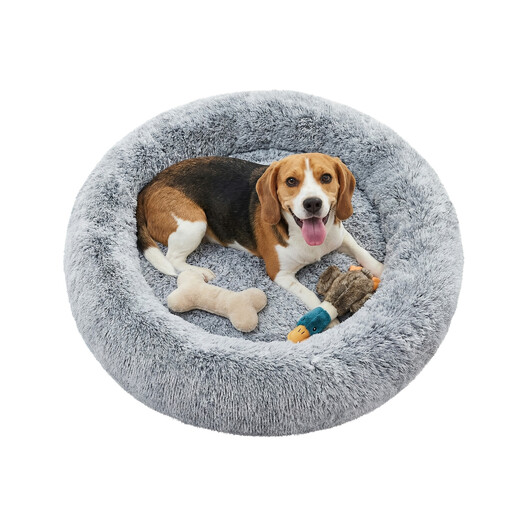
Why this suits the profile: This size is intended for medium-sized dogs and has a soft plush finish for dogs that like to sleep curled up.
The cover is removable and washable. The product information clearly states that the inner core must not go in the washing machine.
80 × 20 cm, PP cotton filling, plush cover and rubber anti-slip dots.
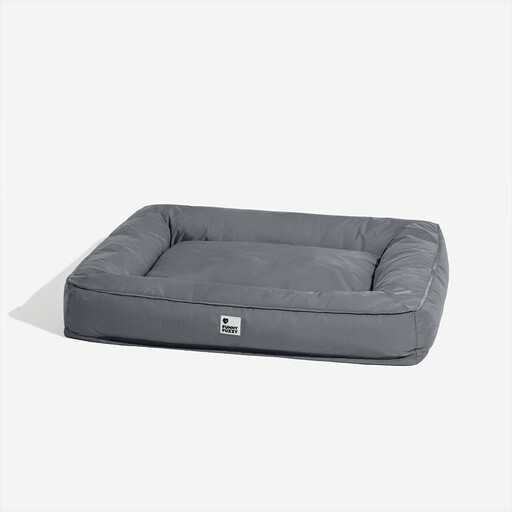
Why this suits the profile: A logical choice for large dogs and owners who want support, a surrounding bolster and easy maintenance in one.
The product description mentions water-resistant Oxford fabric and a removable inner cushion. That makes daily wipe-downs easier than with a fixed, fully fabric filling.
Oxford fabric, polyester fibre filling, raised rim and, according to the product information, fully detachable for cleaning.
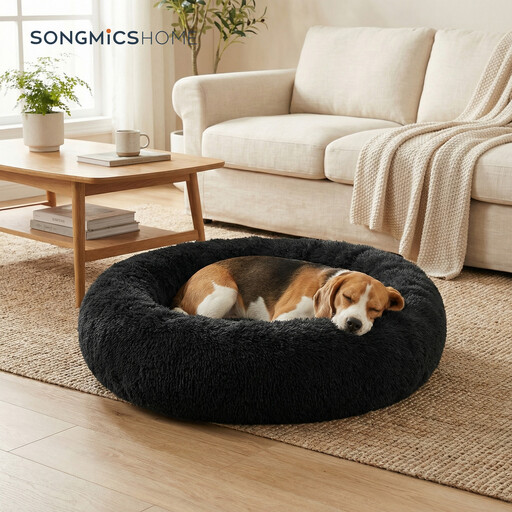
Why this suits the profile: Designed for medium-sized dogs that like to nestle. The round shape and long plush cover suit use in a crate or a quiet corner.
The product information lists a removable cover, a zip on the underside and anti-slip dots. The inner core should be aired separately and spot cleaned.
Plush fabric, PP filling, washable cover and a base with rubber dots.
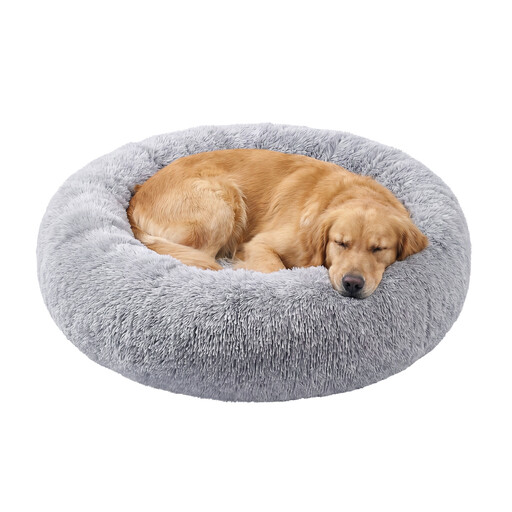
Why this suits the profile: The 120 cm diameter is aimed at large adult dogs and homes where a generous resting spot is more important than a compact crate size.
The large size makes it easier to meet a big dog’s need to stretch out. Do measure the available floor space first; this size won’t fit every crate.
120 × 20 cm, long plush fabric, PP filling, removable cover and anti-slip rubber on the underside.
Give a vacuum-packed bed a good shake before your dog lies on it. Place the bed on a flat, dry surface and give your dog time to get used to it. A familiar blanket or toy can help.
Check seams, zips and fabric weekly. Supervise dogs that like to chew. Stop using the bed when the filling becomes visible or if tears appear. Wash according to the care label and only put the bed back in place once all parts are completely dry.
We’ve compiled a complete, up-to-date list of products that fully meet these strict selection criteria and comply with current European safety regulations.
Measure the inside of the crate and compare it to the actual lying area of the bed. Leave room for your dog to turn, and make sure the crate door can move freely. For round beds, look at both the diameter and the height of the raised rim.
That depends on your dog’s weight, digging and chewing behaviour, frequency of use and maintenance. Regular airing, washing according to the label and repairing small damages in time can help extend its life. There’s no fixed lifespan that applies to every bed.
Not necessarily. A firm lying surface, enough space and a low step-in can be practical. A product labelled as an orthopaedic dog bed may offer extra support according to the product description, but if there are joint problems, consulting a vet is wiser than relying on a marketing term.
