
Vandaag of morgen in huis

Kwaliteit gegarandeerd

Welkomstaanbiedingen ontgrendelen: GRATIS bezorging | Tot 80% korting | Gratis 30 dagen JoyPlus-proefperiode
Download de app
A cat scratching post can give your cat a dedicated place at home to scratch, play and rest. But the wrong model can quickly end up unused in a corner. Often, it’s not that your cat isn’t interested; it’s that the furniture doesn’t suit your space or your cat’s behaviour.
So don’t focus only on colour or a low price. Check the dimensions, stability, materials and maximum load capacity first. Read on to find out which features really matter and which type of scratching furniture suits different households.
When scratching, a cat pushes forwards and upwards. A tall cat tree with a small base can therefore move or tip over. This makes it less appealing and could pose a safety risk. Check the dimensions of the base, the thickness of the supporting panels and the stated maximum load.
A tall scratching post isn’t automatically the right choice. Some cats prefer to scratch horizontally, while others like to stretch out against a vertical post. A combination of a vertical sisal scratching post, a horizontal scratching surface and a resting place gives your cat more choice.
Also consider the space around the furniture. A model that’s 83 cm tall needs plenty of room, especially if it’s in a busy walkway.
Plush feels comfortable, but it isn’t designed to be scratched. For everyday scratching, sisal, jute or seagrass are more practical. Check that the scratching material is wrapped securely around the post or barrel, and that loose threads won’t be an issue. A cat scratching barrel can be compact, but it should still have a clear, usable scratching area.
First, measure the space where you plan to put the furniture. Note the width and depth of the base as well as the height. Compact models measuring around 40 × 30 cm are practical for smaller homes. A larger cat climbing tree offers more features, but takes up more floor space too.
Also check the maximum weight capacity. A model designed for cats weighing up to 4 or 5 kg won’t necessarily suit a heavier cat. If you have more than one cat, consider their combined weight if the manufacturer explicitly states a combined limit.
A cat scratching post with a toy can encourage extra activity, but the toy is no substitute for a sturdy scratching surface.
A wide base, sturdy panels and well-fitted joints all help to make furniture stable. If you’re assembling it yourself, secure all the parts according to the instructions and check the screws again after a few days.
Think about maintenance, too. A removable or washable cushion is useful in homes with lots of pet hair. Check toys, cords and upholstery regularly for signs of wear.
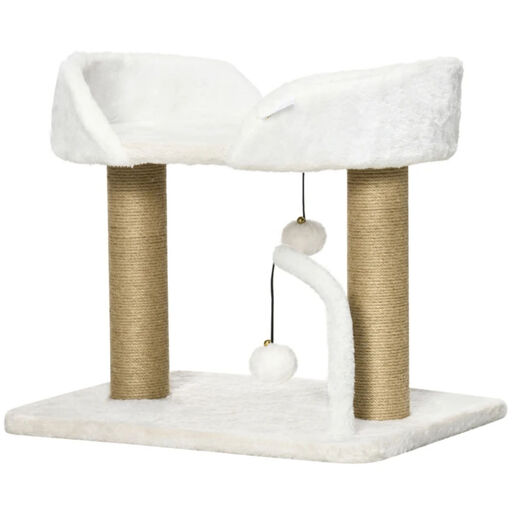
Why it suits this type of buyer: The 48 x 38 cm base and 42 cm height make it a good fit for smaller spaces. Your cat gets scratching posts, a raised plush platform and two play balls in one compact piece of furniture.
Its low design and wide base mean it’s less like a tall, narrow tower. Just check that the stated maximum weight of 5 kg is suitable for your cat.
Compact design, two rope-wrapped scratching posts, a plush resting platform and two hanging balls.
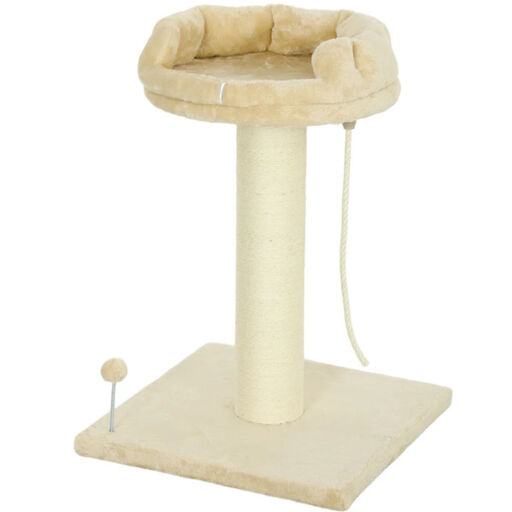
Why it suits this type of buyer: This model combines a vertical natural sisal post with a raised 46 x 46 cm bed. At 83 cm tall, it gives your cat a vantage point without taking up as much space as a large cat tree.
The base measures 55 x 55 cm and is made from 12 mm E1 particleboard. These are specific details you can use to assess stability, rather than judging by product photos alone.
Natural sisal, a plush bed, a hanging rope and a ball on a spring; according to the product information, it’s suitable for cats weighing under 6 kg.
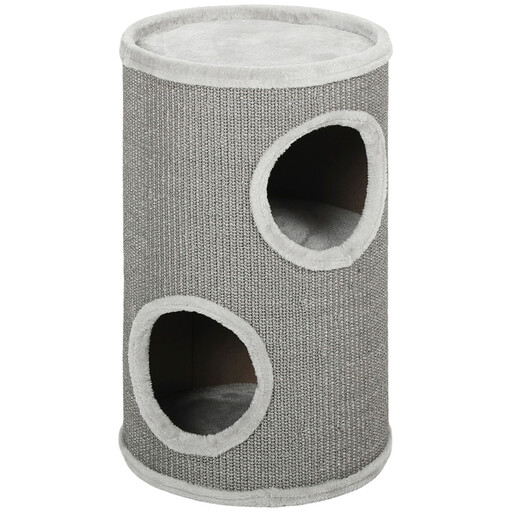
Why it suits this type of buyer: A cat scratching barrel takes up little floor space and offers two levels. The outside is covered in sisal, while the inside has two plush hideaways.
The sisal covering wraps around the barrel, so scratching isn’t limited to one small area. According to the product information, the barrel arrives fully assembled.
35 cm diameter, 60 cm height, two resting levels and, according to the product description, a design for one or two cats weighing up to 5 kg.
We’ve put together a complete, up-to-date list of products that meet these strict selection criteria and current European safety regulations.
A scratching post doesn’t suit every cat in the same way. A cat tunnel can add a low, sheltered place to play. A foldable tunnel with a resting cushion is useful if you want to arrange your space flexibly. For active cats, interactive cat toys, such as a remote-controlled mouse, can offer variety.
A small toy containing silvervine or catnip can catch your cat’s attention. Always supervise your cat the first time they use this type of toy. Check the material regularly and replace the toy if the fabric, stuffing or any parts start to come loose.
Put the scratching post somewhere your cat already spends time, such as near a bed or window. You can hang a toy nearby, but don’t force your cat to use the furniture. Reward calm behaviour and only move the post once you know which spot your cat prefers.
Its lifespan depends on the number of cats, their weight and scratching habits, as well as the quality of the covering. Check the sisal or jute fibres, joints and base regularly. A damaged cord, loose plush sections or a wobbly structure will need repairing or replacing.
Place it close to the spot where your cat already scratches. This could be next to a sofa, door frame or carpet. Choose a stable surface if possible, and leave enough room for your cat to stretch out fully. Combining a vertical post with a horizontal scratching surface makes it more likely that different scratching preferences will be catered for.
