
Vandaag of morgen in huis

Kwaliteit gegarandeerd

Welkomstaanbiedingen ontgrendelen: GRATIS bezorging | Tot 80% korting | Gratis 30 dagen JoyPlus-proefperiode
Download de app
A dog bed for a crate needs to do more than simply feel soft. It must fit inside the crate, stay in place and be easy to clean. Particularly with medium-sized and large dogs, incorrect dimensions, thin padding or a difficult-to-remove cover can quickly lead to a disappointing purchase.
Be mindful of marketing terms, too. A brand may describe a product as ‘calming’, ‘orthopaedic’ or ‘extra durable’, for example. A brand’s own research may associate such claims with certain results, but they do not automatically apply to every dog. First, look at verifiable features such as the material, dimensions, filling, fastenings and washing instructions.
In practice, a 90 cm diameter donut bed takes up a lot of space because of its raised edge. So don’t just measure the crate – also measure the space between the bed’s edges. Your dog should be able to lie fully stretched out and turn around comfortably.
For a dog bed for medium-sized dogs, models measuring 80 to 90 cm are often a good starting point, but breed, build and sleeping position will determine the final choice. For a dog bed for large dogs, 120 cm versions offer more room, although the crate must of course be large enough to accommodate one.
Check which part can be washed. With various plush models, the cover or central cushion can be removed with a zip, while the inner filling may only be suitable for spot cleaning. A dog bed with a removable cover is therefore more practical than one that has to go into the washing machine as a whole.
Pay attention to the care instructions: a delicate wash programme, mild detergent and thorough drying may be required. Putting damp filling back into the crate can encourage unpleasant smells and mould.
A soft dog bed or plush dog bed feels comfortable, but softness says little about stability. PP cotton filling provides resilient padding, while a raised edge all the way around adds extra structure. For dogs that like to rest their head on an edge, a bed with raised sides can be practical.
An orthopaedic dog bed is a product category description. The term is not a guarantee of any medical effect. If your dog already has joint problems, advice from a vet is more sensible than relying solely on a product title.
A round bed is suitable for dogs that like to curl up. A rectangular bed often makes more efficient use of the space inside a crate, especially if your dog sleeps stretched out.
A washable dog bed is practical for muddy paws, loose hair and accidents. Check:
With a dog bed with a removable cover, cleaning is usually easier, but always follow the washing label for the specific product.
A non-slip dog bed with rubber dots can reduce movement on a smooth floor. In a crate, this helps keep the bed in place, but the base does not replace positioning the crate securely. Oxford fabric is generally more practical for dogs that dig or get dirty outdoors. Plush is appealing for dogs that like to snuggle up, but it can hold on to more hair and dirt.
A water-resistant dog bed is useful for damp paws or a spot near the back door. Water-resistant does not necessarily mean fully waterproof. So check whether this applies to the cover, the underside or the entire bed.
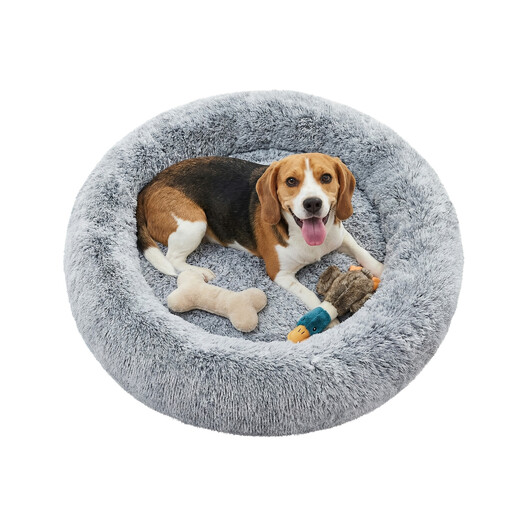
Why it suits this profile: A compact donut shape for medium-sized dogs that like to curl up. The plush cover and PP cotton filling are designed for comfortable everyday use in a crate or quiet corner.
The dimensions of 80 x 20 cm are clearly stated. The cover can be removed with a zip; according to the product information, the inner core is not machine washable.
Plush fabric, PP filling, removable washable cover and rubber non-slip dots on the underside.
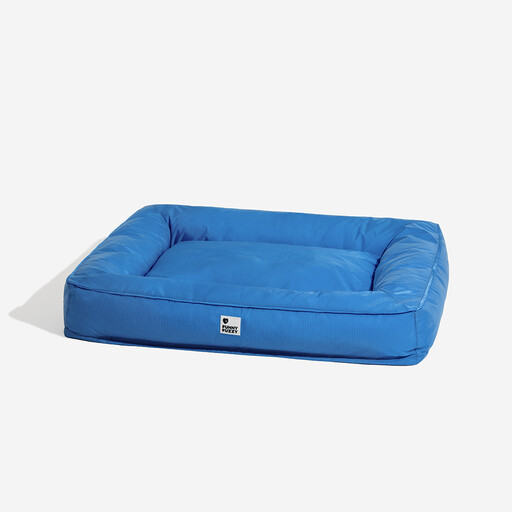
Why it suits this profile: A spacious choice for large dogs and households where the bed will be used intensively. The raised edge and Oxford fabric provide more structure than a fully soft plush bed.
According to the product description, the cover and inner components can be removed for cleaning. The water-resistant Oxford fabric is practical for dirt and moisture, but check the measurements against your crate before buying.
Water-resistant Oxford fabric, scratch-resistant construction, raised edge and an all-round design marketed as orthopaedic support.
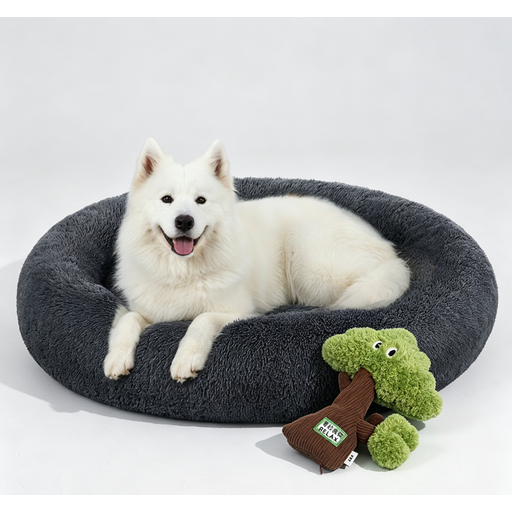
Why it suits this profile: The generous diameter is designed for large dogs or households with several pets. The bed can be used in a large crate, but also as a standalone resting place.
The cover can be removed using the zip and, according to the product information, washed on a delicate programme. The PP filling itself is not machine washable and must be spot-cleaned.
120 cm diameter, plush cover, PP cotton filling, non-slip rubber on the underside and a removable cover.
Place the dog bed on a flat, dry surface and make sure the non-slip base is in full contact with the floor. If the bed arrives vacuum-packed, shake and fluff it thoroughly before use. The filling needs time to regain its shape.
Let your dog get used to it gradually. A familiar blanket or toy can help make the new sleeping place feel recognisable. Check the seams, zips and fabric regularly. If you notice loose threads, tears or exposed filling, stop using the bed. Dogs that like to chew require extra supervision.
We have compiled a complete, up-to-date list of products that fully meet these strict selection criteria and the applicable European safety regulations.
Measure the inside length and width of the crate and compare them with the bed’s actual sleeping area. With a donut dog bed, you need to take the thick edge into account. Do not choose a model that blocks the door or prevents your dog from turning around.
That depends on use, coat, moisture, washing and chewing behaviour. Regular airing, cleaning the cover according to the washing label and checking the seams can help extend its usable life. There is no fixed lifespan that applies to every dog bed.
It can be, provided your dog does not chew the fabric and you can maintain the bed properly. Plush is soft, but generally holds on to more hair and dirt than Oxford fabric. For muddy paws or intensive use, a water-resistant cover may be more practical.
