
Vandaag of morgen in huis

Kwaliteit gegarandeerd

Welkomstaanbiedingen ontgrendelen: GRATIS bezorging | Tot 80% korting | Gratis 30 dagen JoyPlus-proefperiode
Download de app
A dog bed might seem like a simple purchase, but the wrong size, a slippery base or a cover that’s difficult to wash can quickly become frustrating. A bed that looks spacious in the product photo may turn out to be too small at home. Terms such as “orthopaedic” and “calming” don’t automatically tell you anything about the construction or whether it’s right for your dog.
Use these practical checks to compare a dog bed by features you can assess: dimensions, materials, stability, washability and intended use.
With a donut dog bed, the raised sides take up some of the surface area. So a bed with a diameter of 70 cm offers less lying space than its outer dimensions might suggest. Measure your dog when they’re lying stretched out, then allow some extra room all around. Dogs that like to sleep on their side need more lying length than dogs that curl up.
Pay attention to the height too. A high edge can suit dogs that like to lean against something, but may be less suitable for dogs with limited mobility or those that could easily trip over it.
Check exactly which parts can be removed. Some models have a washable cover, but the inner cushion and its filling can’t go in the washing machine. A dog bed with a removable cover is generally more practical for muddy paws, shedding or accidents.
Check the care instructions too: a delicate wash cycle, mild detergent and a low drying temperature can help reduce wear on the fabric, zips and filling. Bleach and harsh cleaning products can damage materials.
A product may be marketed as an orthopaedic dog bed, but that doesn’t automatically mean it has a particular medical effect or meets a specific standard. Look for information you can check, such as the type of filling, thickness, shape retention and dimensions. The products mentioned are not medical devices.
“Calming” often describes a design with high sides or an enclosed shape. According to the manufacturer’s product description, this kind of design may help some dogs feel secure. This effect isn’t guaranteed and doesn’t replace support for dogs experiencing severe anxiety or stress.
Use this simple guide as a starting point:
Measure from your dog’s nose to the base of their tail, then allow extra room for their favourite sleeping position. Compare this measurement with the product specifications, not just the photo.
Plush polyester feels soft, but softness alone doesn’t tell you much about how well a bed will hold up over time. PP filling can feel light and springy; fluffing the bed regularly helps distribute the filling more evenly. If the bed gets heavy use, check the seams, zips and underside.
An anti-slip base with rubber studs can help stop the bed sliding on smooth floors. Place it on a flat, dry surface too. An anti-slip layer doesn’t automatically make a bed suitable for every floor or dog.
Where possible, choose a cover that can be removed with a zip. Check whether the manufacturer recommends a delicate wash cycle and air-drying or drying at a low temperature. Inspect the bed regularly for loose seams, exposed filling and damaged zips. Dogs that like to chew shouldn’t be left unsupervised with a new bed; swallowed fabric or filling can be dangerous.
A dog bed is also not a substitute for a dog crate as a safe place to travel or rest. A crate must provide enough room for your dog to stand, turn around and lie down, and should never be used as a punishment.
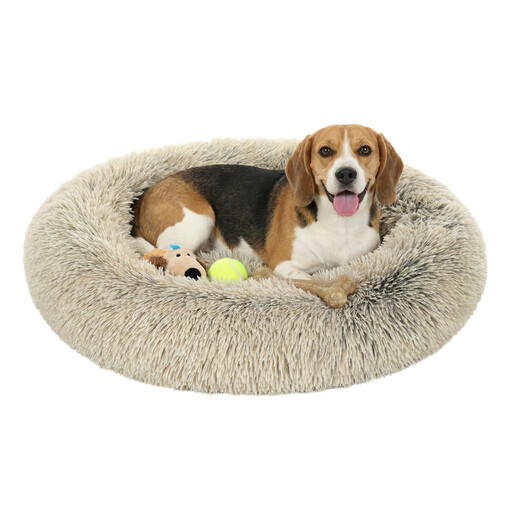
Why it suits this profile: According to the product information, this round bed is designed for small to medium-sized dogs weighing up to around 15 kg. It’s a good option for owners looking for a soft bed with straightforward care instructions.
The dimensions and recommended weight range are clearly stated. The central cushion cover is removable and, according to the description, can be washed on a delicate cycle.
Plush fabric, PP filling, raised sides and a removable central cushion cover.
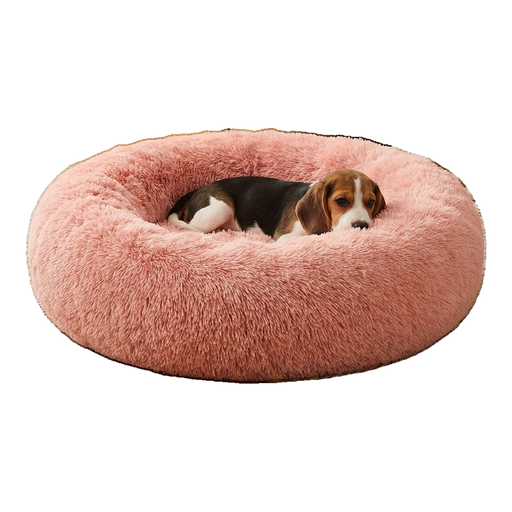
Why it suits this profile: According to the product information, this round bed is designed for medium to large adult dogs. The combination of a plush surface, PP filling and a removable central cushion makes it a good choice for anyone who values both comfort and easy care.
It measures 80 cm in diameter and 20 cm high. The underside has rubber anti-slip studs, but check that the size leaves enough clear lying space for your dog.
Washable outer cover, anti-slip base and a size designed for medium to large dogs.
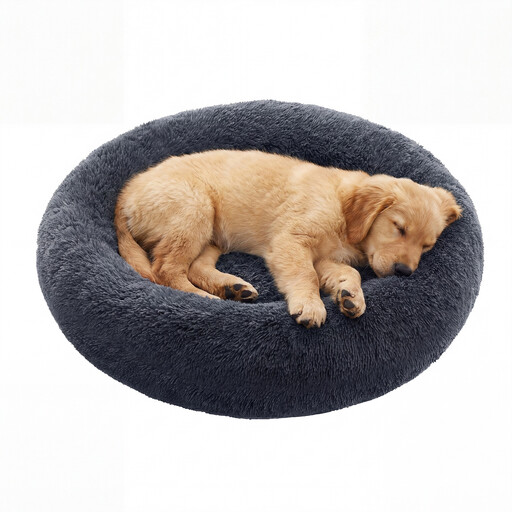
Why it suits this profile: The 100 cm diameter is designed for medium to large dogs weighing up to around 30 kg. Its high, round sides may suit dogs that like to curl up in a sheltered spot.
The cover can be removed using a concealed zip. The manufacturer recommends washing it on a delicate cycle. The effect of the high sides on anxiety varies from dog to dog and isn’t guaranteed.
100 cm diameter, generous PP filling, soft plush fabric and a removable, washable cover.
A dog that particularly values privacy may benefit from a different design. The TRIXIE Silas is an igloo-style indoor dog house measuring 40 × 33 × 45 cm, with a soft interior and an anti-slip base. According to the product information, it’s suitable for cats and small dogs. Check your dog’s body size and the entrance height before ordering.
We’ve put together a full, up-to-date list of products that meet these strict selection criteria and the applicable European safety requirements.
Measure your dog from nose to the base of their tail, then allow extra room for their usual sleeping position. Compare this measurement with the usable inner space, especially with a donut dog bed with thick sides. If you’re choosing between two sizes, the larger one is often more practical for a dog that likes to stretch out, provided the bed remains stable.
It depends on how often it’s used, how much your dog sheds and how dirty it gets. Wash the removable cover as soon as it smells or looks dirty, or has a stain. An extra blanket can make everyday care easier. Always follow the care label and check after each wash that the seams, zips and filling are still intact.
Not without supervision. Soft fabric and PP filling can be damaged if a dog chews them. Check the cushion regularly and remove it as soon as the seams start to come apart or the filling becomes visible. Choose a crate or another resting place based on the right size and safe use, not as a solution for chewing behaviour.
