
Vandaag of morgen in huis

Kwaliteit gegarandeerd

Welkomstaanbiedingen ontgrendelen: GRATIS bezorging | Tot 80% korting | Gratis 30 dagen JoyPlus-proefperiode
Download de app
A dog bed should feel soft, but that is not all that matters. It needs to suit your pet’s sleeping position, body size and habits. Even so, there are several common pitfalls that can make an attractive bed less practical in everyday use.
The first pitfall is choosing the wrong size. A bed that looks spacious may be too small once your dog lies stretched out. The second is thick, soft filling without enough structure. This can flatten over time, especially under a heavier dog. The third is a cover described as “washable” that cannot be fully removed or may only be cleaned by hand.
Below, you’ll discover what to look for in a dog bed and which models suit different homes and uses.
Measure your dog from nose to the base of the tail, then consider how much space they need when lying on their side. Add extra room for turning and stretching out. A round donut dog bed is often used differently from a rectangular sofa bed or crate bed: the raised edge reduces the available space inside.
Pay particular attention to the internal dimensions, not just the external measurements. For small dogs and cats, a model of around 60 cm may be suitable. Medium-sized dogs often need 70 to 90 cm. For large dogs, 100 to 120 cm models may be worth considering, provided your dog actually fits comfortably inside the bed.
A soft dog bed with polyester or PP cotton filling is suitable for pets that like to sleep curled up. For older dogs or pets that need more support, a design with foam or a firmer inner cushion may be more practical.
Some models are marketed as orthopaedic dog beds. If so, check exactly what the product description says. For example, the FUNNYFUZZY models below use egg-crate foam, a profiled foam structure. According to the product description, it is designed to provide a supportive base. This is not medical treatment and does not replace advice from a vet if your pet has joint problems.
A dog bed with a headrest can be comfortable for dogs that like to rest their head on an edge. With a raised edge, it is important that your dog can still get in and out of the bed easily.
A dog bed with a washable cover is easier to keep clean than a bed made from one solid piece. However, check:
A dog bed with a non-slip base will generally stay in place more effectively on a smooth floor. However, non-slip material does not eliminate every risk: always place the bed on a level, stable surface.
A water-resistant dog bed made with Oxford fabric is particularly useful for muddy paws or minor accidents. Water-resistant does not automatically mean completely waterproof. The FUNNYFUZZY All-Around Support models are listed as having water-resistant Oxford fabric; always follow the label for cleaning and drying.

Why it suits this profile: According to the product information, this compact model is intended for cats and small dogs. The round shape suits pets that like to curl up.
The 60 × 20 cm dimensions make it easier to compare the size with your pet before buying. The cover or central cushion can be removed using a zip.
Plush surface, PP filling, non-slip rubber on the underside and a removable, washable component.

Why it suits this profile: The combination of Sherpa, soft plush, egg-crate foam and a raised headrest suits pets looking for comfort and a defined sleeping position.
The product description specifies both the foam structure and the removable, machine-washable cover. This makes the support and care requirements clearer.
Egg-crate foam, raised headrest, non-slip fabric and a cover that, according to the product information, can be machine washed.
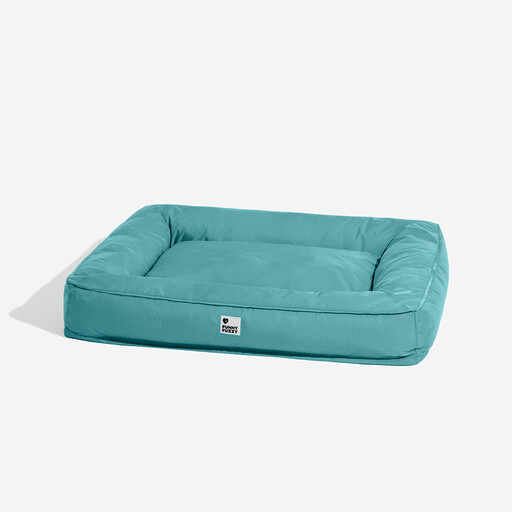
Why it suits this profile: This model is designed for large dogs and households where the bed is used more intensively, for example by pets that dig, scratch or have muddy paws.
The product information mentions water-resistant Oxford fabric and a fully detachable construction. This gives you more specific care information than simply describing it as “easy to clean”.
Surrounding edges, water-resistant Oxford fabric, a separate inner cushion and cover cleaning in line with the product instructions.
We’ve put together a complete, up-to-date list of products that fully meet these strict selection criteria and the applicable European safety regulations.
Place the bed in a quiet, dry spot where your dog already likes to lie. Put a familiar blanket or toy in the bed. A vacuum-packed fluffy dog bed should first be shaken out and allowed to regain its shape according to the product instructions. Do not force your dog to lie in it; give them time to accept the new resting place.
This depends on how often it is used, your dog’s coat and any accidents. Remove hair regularly with a vacuum cleaner or lint roller. Wash the removable cover as soon as it becomes visibly dirty or starts to smell. Only wash it according to the care label. Some inner cushions are not machine washable and must be spot cleaned.
Check the seams, zips, non-slip material and filling regularly. Replace the bed when the filling has permanently flattened, the base keeps shifting or tears appear that could allow your pet to swallow the material. For an older dog or a pet with sensitive joints, it is sensible to check again whether the size and support still meet their current needs.
